Hormuz Confusion – Make it make sense!
Kit Knightly
Last month, I wrote an article tracking – or, at least, attempting to track – the very confused back-and-forth narrative around the Strait of Hormuz.
Is it closed or open? Who closed it and how? Were there mines or not?
These were just some of the questions to which it was impossible to find a single straight answer.
With peace talks underway in Islamabad today, we’re being hit with a fresh wave of contradictory messaging about the Strait’s status, and I just wanted to collate it all together in one place and ask, “Does this make sense?”
Do you remember the mines that both sides said weren’t there?
Well, now the New York Times is reporting they are definitely there, but Iran doesn’t remember exactly where…
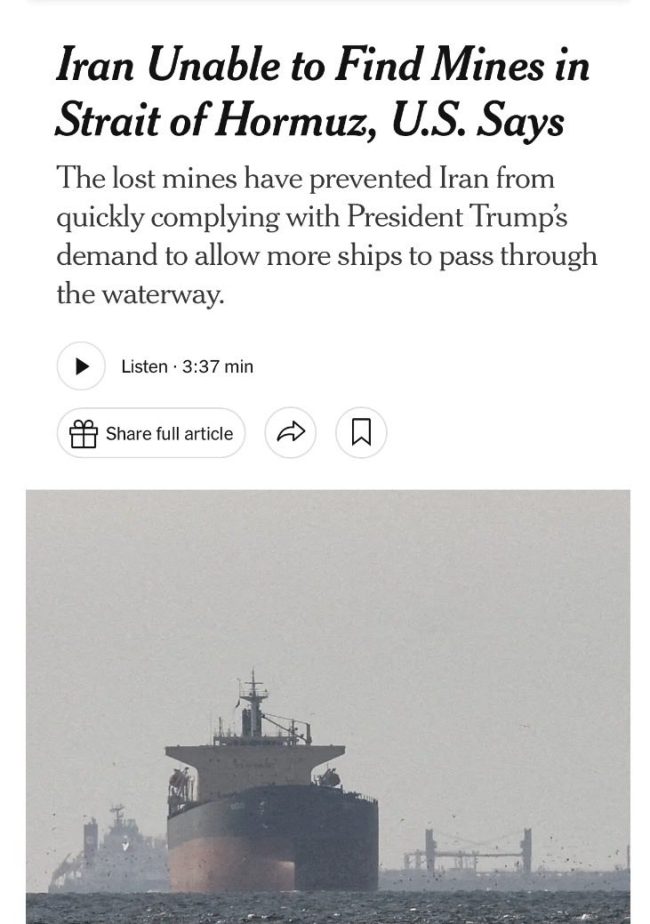
Does that make sense?
Haven’t Iran-approved ships from friendly countries been paying at the “toll booth” for at least a couple of weeks? How is that possible if there were mines? Let alone mines that Iran can’t locate?
This potential contradiction doesn’t matter in the end, though, because Donald Trump has said the US Navy is already “clearing out” the mines (adding that all 28 of Iran’s mine-laying ships are “at the bottom of the sea”).
Does that make sense?
Because the US supposedly decommissioned their minesweeping ships back in September, and sailed them out of the Gulf theatre in January (and we know no new US naval assets have entered the Gulf since, see below).
Speaking of decommissioning the minesweepers…did that decision make sense, given the tension with Iran?
This January was actually the first time the US Navy had no minesweeping capacity in the Gulf in over forty years. Minesweepers were always docked at US bases in Bahrain, specifically to counter potential Iranian attempts to mine the Strait.
Oh well.
Speaking of the US Navy, earlier today, it was reported that a pair of US missile destroyers transited the Strait of Hormuz and entered the Persian Gulf, according to the Times of Israel…
A pair of US Navy guided-missile destroyers transited the Strait of Hormuz while US-Iran negotiations commenced in Pakistan, The Wall Street Journal reports, marking the first American warships to do so since the US-Israel war against Iran began.
This was apparently done without pre-arrangement with Tehran. We can confirm this because Iranian news sources have claimed the naval ships were given a thirty-minute warning to retreat or be fired upon, and that upon this warning, the ships retreated.
However, an American source claims no such warning was ever received, and the ships have passed into the Gulf unmolested.
Bloomberg is reporting “differing accounts”, and the ships may have left the theatre again already.
In other news, three Chinese supertankers are passing through the Strait as we speak. This is the biggest single oil shipment to traverse these waters since the war began…
Does that make sense? Isn’t it awfully risky, since it’s apparently full of mines the Iranian government has misplaced, toll booth or no toll booth?
Speaking of their toll booth, did you know Iran’s “ability to control the strait” has only grown, despite being “weakened militarily”?
That’s what Landon Derentz says in his piece for the Atlantic Council:
Iran’s military capabilities have been weakened, but its ability to disrupt global trade via the Strait of Hormuz has grown and remains a major source of leverage.
He doesn’t explain how that’s possible. But the BBC agrees, with Faisal Islam highlighting that [emphasis added]:
Iran has now created a new reality in the Gulf […] It has established that it can control the key maritime chokepoint, even without a navy and an airforce. It had even begun to collect tolls.
How can it control it without a Navy or Air Force? We’re not told all the specifics, but The Guardian informs us…
As part of a clearance process described by analysts as “fairly unsophisticated”, Iranian officials standing on Larak Island in the north of the strait have used binoculars to check the names of passing ships and give approval to proceed.
To allow for visual verification, Tehran has tried to reroute ships to a more northerly corridor close to its coastline and away from traditional shipping lanes.
They are identifying ships through binoculars and asking them nicely to sail closer to the shore to make such identification easier.
Does THAT make sense?
Does any of it?
Thanks for reading...
You can help us keep doing what we do. Every little helps and is hugely appreciated.




For other ways to donate, including direct-transfer bank details click HERE.



Iran has around 20 Ghadir subs – (not nuclear) – patrolling in and around the straits – apparently the US took over 300 delegates to Islamabad for the negotiations.
Iran sent out three different planes – as decoy planes to try and prevent the assassination of their delegates by the US and Israel, it worked this time.
Bullshit, they want the straight closed just as much as their allies, Israel and America
How can no one see the innuendo????????????
Elementary, my dear Watson. People who have followed Erik Nielsen’s high valued commenting on these pages here will easily know the answer to the article:

It’s all just theatre, just like the Ukraine “war” that is just endless missile and drone strikes at buildings with the occasional skirmish, this fake war will be exactly the same as the objective is clear, to disrupt global energy infrastructure and usher in the NWO
So no deaths so far in this “fake war?”