Gulf of Oman: International Context
Despite much egg on Pompeo’s and Bolton’s faces, US expansion of its Cold War II continues regardless
Tony Kevin
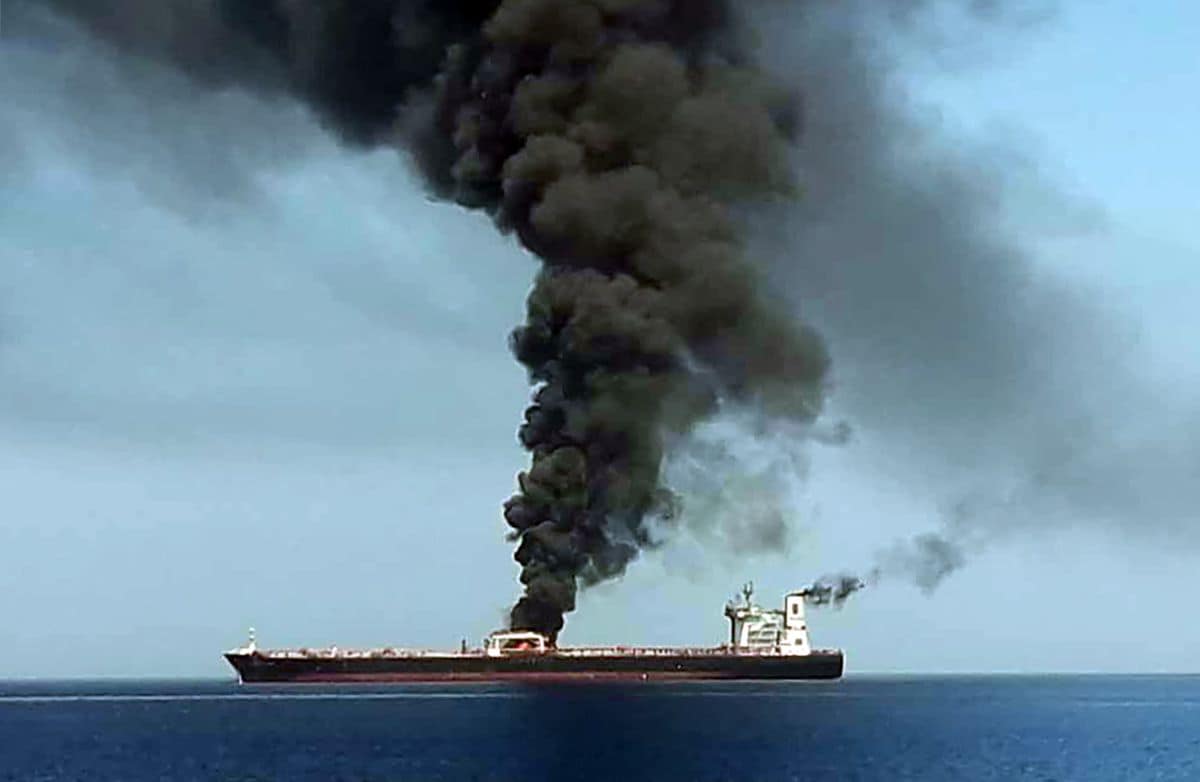
It is now clear that the US has manufactured a false case against Iran for the two-tanker sabotage incident in the Gulf of Oman on 13 June. Evidence of Iranian guilt so far offered by the US is flimsy and contestable: but Mike Pompeo does not seem to care, continuing to press for alliance solidarity no matter what.
Of this solidarity there has been remarkably little, even five days later.
The general refrain of ‘we would like to see more of the evidence’ is polite dipspeak for ‘we think you are lying’.
Trump has reluctantly backed the false US story, but with evident lack of enthusiasm. He would no doubt like to sack his irresponsible lieutenants Pompeo and Bolton, but they currently seem invulnerable, with the power of the military-industrial –national security Deep State at their backs.
Trump, a helpless passenger President, will have little room to move towards detente with Xi or Putin at Kyoto G20 (28-29 June).
Both leaders have pretty much written the US off as a serious negotiating partner for now.
Already, US Cold Warriors are flexing their muscles, with reports of US testing cyberwarfare attacks on the Russian power grid; more sanctions imposed on US allies who dare to trade with Iran; and military preparations to attack Iran reportedly moving forward
Australia is trying to lie low but pressure is mounting from official Washington to declare where we stand on the Oman Gulf incident.
First US claims were that these were torpedo or mine attacks. This was soon disproven, as damage holes were well above the waterline: torpedoes or mines do not bounce into the air before exploding.
Also, the captain and crew of the Japanese-owned tanker Kokuda Courageous reported seeing approaching ‘flying objects’, (i.e. missiles or attack drones), and the CEO of their company Kokuda Sangyo backed their story.
Holes to both tanker hulls were reported on the southwest open-sea side, away from the nearby Iran coast.
First rescuers were small Iran coastguard vessels who took both ships’ crews to the closest Iranian port of Bandar, as maritime rescue law requires
Pompeo shifted his story, claiming that a US-released blurry intelligence video showed Iranian saboteurs attempting to place (or remove) a limpet mine on the side of a tanker’s hull:
This false narrative was soon contradicted by a far more probable explanation: that this was a video of one of the crew rescue operations: many people are seen in the small boat wearing orange life jackets – with an electromagnetic mooring device having been attached by cable to the tanker hull. This is a normal crew rescue technology.
The list of countries and organisations calling for further independent investigation, more evidence, or more dialogue, quickly grew: EU, France, Germany, Russia, China and Japan, the UN Secretary-General and even Democratic senior Congress leader Nancy Pelosi.
Even Britain’s Foreign Secretary, after initial full support for US, hedged to Iran being ‘almost certainly’ responsible, while Opposition Leader Corbyn questioned whether the UK has ‘credible evidence’ of Iranian responsibility for the attacks.
But Pompeo seemed not to care, ploughing on demanding allied solidarity. He has been making phone calls, no doubt including to Australia. Australia has so far offered no public reaction.
Australian mainstream media quickly downgraded the story, sensing its implausibility, and reflecting the increasingly common practice in Australia of censorship by omission of embarrassing news or news topics.
The US has mounted new diversions: first, a remarkable story planted in the New York Times that US is already waging experimental cyberwarfare against Russia, to prove to the Russians that it could take out the Russian power network, crippling the country’s economy; and that knowledge of this activity may be being kept from Trump.
The message is that Pompeo and Bolton are in charge of US national security policy, and Trump is too weak to sack them now.
Russiagate continues its malevolent hold over the US liberal media. On this fraught subject, objective truth no longer matters: two and two make five. Both Xi and Putin know that Trump is now flotsam, floating helplessly on the sea of American Sinophobia and Russophobia. Neither leader currently sees him as a serious negotiating partner.
I agree with UK former ambassador Craig Murray that over the past two weeks the international security system has taken a sharp turn towards more dangerous instability.
About the best outcome one can hope for now is a peaceful gradual decoupling of the US-centric economy from China, Russia and much of the world. There seems now no alternative to an increasingly bifurcated world economy. The US system does not have a reverse button: it continues to compound its bullying with more bullying, of adversaries and allies alike.
Australia cannot go on delaying difficult but necessary choices. We need to start to downscale our dependence on this increasingly unstable and aggressive partner nation before it is too late. We need to turn off the electromagnetic device mooring Australia to this dangerous ally.
We need an independent foreign and national security policy: a conclusion towards which the continental EU is also reluctantly moving.
Tony Kevin is a former Australian senior diplomat, independent writer and author of Return to Moscow, University of Western Australia Publishing, March 2017.
Thanks for reading...
You can help us keep doing what we do. Every little helps and is hugely appreciated.




For other ways to donate, including direct-transfer bank details click HERE.
 wpDiscuz