“But surely you don’t want Jones back?”
Frank Lee
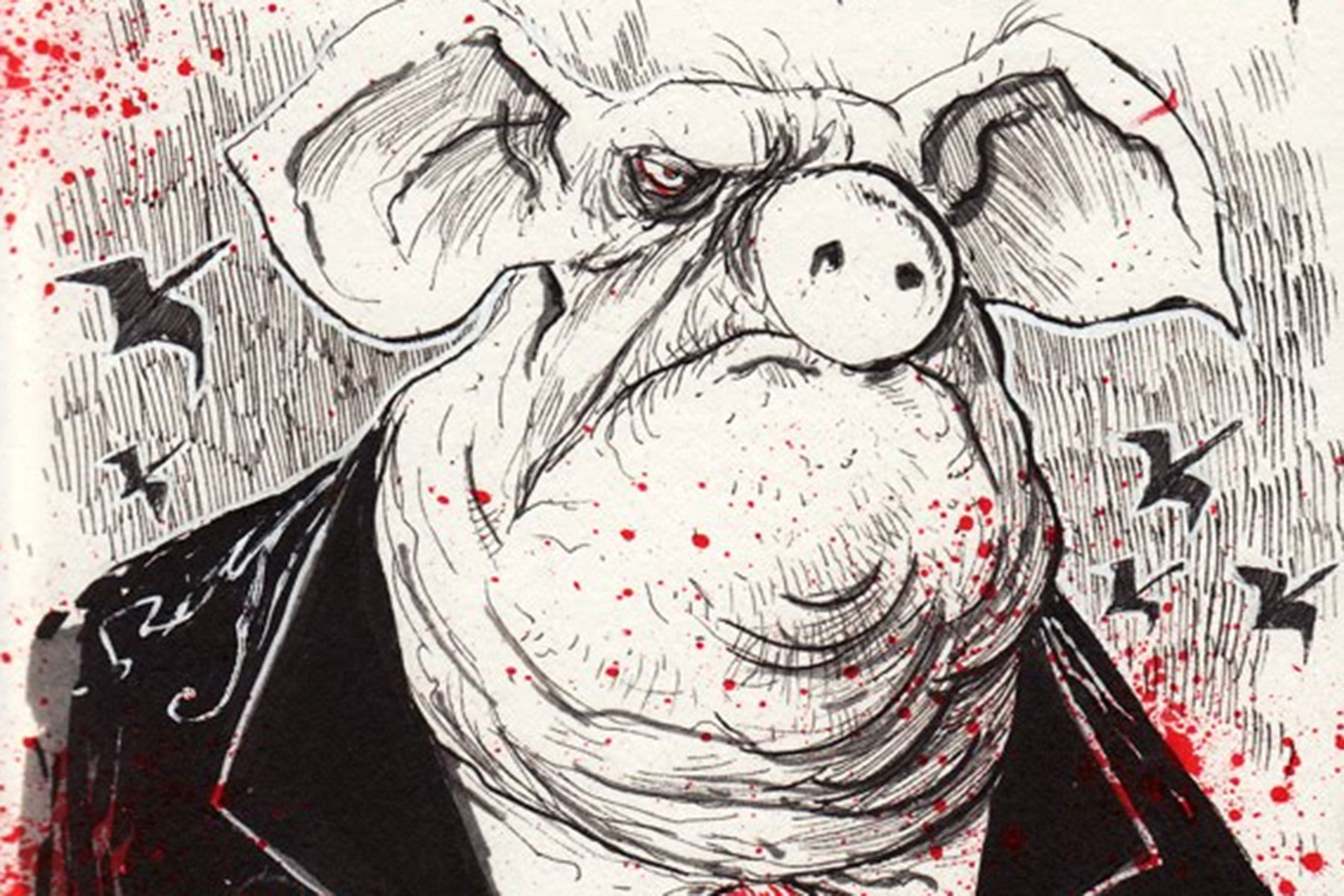
Such was the response to any of those who questioned what was happening to the animal revolution which had expropriated the farmer (Jones) and set up the animal republic with its own green flag complete with the design symbols of hoof and horn.
As with most revolutions, however, this one could not deliver on its promises; after the initial euphoria of Jones’ overthrow, the charismatic stage of the animal insurrection became transformed into an inevitable period of consolidation and legal-rational authority, with the pigs, who were the new rulers, now firmly in control. This is to be expected since,
…most importantly of all, emotionalist revolution is followed by traditionalist routine …The followers of the warrior of faith, once they have achieved tend to generate with particular ease into a thoroughly commonplace class of office holders.” [1]
This short novella of Orwell’s was taken as a skit on the Russian Revolution but was applicable to all revolutions. Apparently, revolutions promise everything but often fail to deliver anything – Cf Ukraine after the 2014 Maidan.
Such radical upheavals are generally followed by a partial or even total restoration. Such was the case with the transformation of Cromwell to Charles II, Trotsky to Stalin, Danton to Talleyrand, Mao Zedong to Chou en Lai.
Strange to say that in the contemporary UK the ancien regime is not being challenged by a radical force from below, although many like to imagine this – but is a struggle between two contending establishment forces. HM’s Government and HM’s loyal opposition. It has always been thus, and this petrified political structure has never been seriously challenged apart perhaps from the general strike in 1926 and, more remotely, the miners’ strike in 1984.
I would contend that the Conservative and Labour parties and their media backers are essentially class-based with the working classes pretty much excluded – particularly from the Labour party. In this respect there are comparisons to be made with the US Democrats and Republicans.
These Ex-reformist parties in the anglosphere are now, having been cleansed of any residual idealism (although necessarily engaged in rhetorical playing to the gallery) have been tamed and now provide the natural political environment of the urban petit-bourgeois who espouse the prescriptions of post-modernist identity politics, neo-liberalism and neo-conservatism.
In the UK the Conservative party has always been associated with the rentier, financial classes both rural and urban, as well as in addition to business interests and the military/security complex.
The contemporary Labour party is an inner-city cosmopolitan class alliance composed in the main of professionals in the media, high-tech industry, education, health and the legal and state bureaucracy at various levels, mainly based in the big urban conurbations, particularly London and the South East.
This stratum is fanatically pro-EU and not particularly fussy about the methods whereby their love-object is protected and realised. The class-hatred of the ‘other’ leave voters is barely concealed and often overt.
It should be understood that the middle-class is the key grouping in the political structures of contemporary society. Often referred to as the intelligentsia (or what passes for one) this particular formation has occupied a pivotal position in the social class hierarchies.
The haute bourgeois and working-class both have a fixed relationship to the economy, and this is exactly what the middle-class lacks. Thus.
There are two courses of action which the unattached intellectuals have actually taken as ways out of the middle-of-the-road position: first, what amounts to a largely voluntary affiliation with one or the other of the various antagonistic classes; secondly, scrutiny of their own social moorings and the quest for the fulfilment of their mission as the predestined advocate of the intellectual interests as a whole…
…The ability to attach themselves to classes to which they originally did not belong was possible for the intellectuals because they could adapt themselves to any viewpoint and because they and they alone were in a position to choose their class affiliation, whilst those who were immediately bound by class affiliations were only in rare exceptions able to transcend their class outlooks. [2]
Suffice it to say that the middle-class has moved en masse in what amounts to a reactionary accommodation with the monied rentier interests. In what the American social theorist, Christopher Lasch, had once called the ‘Revolt of the Elites’. This being a repudiation of the post-war settlement in effect from the mid-40s to the mid-70s.
Socialism appears to have vanished entirely from their intellectual/ideological landscape being regarded as hopelessly fuddy-duddy and passé in the contemporary political and social dispensation.
This movement has been manifest since the end of the cold war – circa 1990 – and what amounts to an abject surrender of the centre-left of Clinton and Blair to the most reactionary political forces now in control of the deep-state, military and security complex and Transnational Corporations.
As for the losers in this brave new world, those who live in the unfashionable venues of the midlands and north of England and the Rust-belt in the US, well they can simply stew in their own juice. Hey, – in the words of Freddie Mercury ‘no time for losers’ – in this era.
Party manifestos are yet to make an appearance, but since they are never broadly read and bear no relation to what the main parties propose in detail and are able to carry out in terms of their implementation, they can be safely ignored.
As far as the Tories are concerned the details of the UK ‘withdrawal’ from the EU are still to be worked out. But short term we can expect nothing other than more of the same, i.e, fudge, and a great deal of Corbyn bashing.
The Labour party leadership has mooted some of its policy proposals regarding anti-austerity policies, abolition of student tuition fees, modest nationalisation of some of the privatised industries. Laudable enough, but … firstly student tuition fees.
If my memory serves me well wasn’t this what Nicholas Clegg of the Liberal Democrats promised in the run-up to the 2010 election only to revoke this promise in 2012. Making promises you have no ability or intention to keep is not a long-term or manageable policy.
As far as Labour’s other untested policies the question arises will they pass muster in a neoliberal environment such as the EU? This seems somewhat problematic. For a start, social-democracy is in a situation wherein Europe it has virtually disappeared, or is disappearing, seems lost on Labour who seem to think they are going to buck this trend?
There have been enough failures to demonstrate the collapse of the social democratic ascendency in Germany and France, Spain and Greece, which shows no sign of recovery. As one critic has pointed out.
As Tsipras and Syriza had made it abundantly clear the party’s intent was not to exit the Eurozone or the euro regime. They … and the majority of Greek people consistently indicated in polls that they did not want to leave the Eurozone either. They like Syriza wanted to end the austerity but stay in Europe and keep the Euro. Neither understood that the root of the austerity lay in the neoliberal euro regime which they wanted to keep.” [3]
This is more or less the situation which Labour will face if it joins the EU. However, Labour has been outflanked by history in the sense that
…Tsipras and the Greek electorate wanted to return to a social-democratic Europe that was already history, buried by a neo-liberal transformation throughout Europe in preceding decades, and especially since 1999. A Europe fundamentally incompatible with social-democratic programmes and policies.
As neoliberal forces, led by financial elites throughout the region, were rolling back social-democracy and social democratic parties everywhere, Syriza was proposing a resurrection and unification of social democratic institutions – economic and political – and a return to social-democratic programmes.” [4]
As for the Remain and Reform option, this is an oxymoron and shown to be such. This would require what would be tantamount to a euro-wide revolution, which seems unlikely. The social-democratic dispensation which Labour’s supporters claim they want can only be achieved firstly at national level. But Labour doggedly denies this as if belief can override objective reality.
At this point a few words regarding Corbyn’s newfound popularity among Labour’s rank and file with which I find myself at odds.
Personally, I have found Corbyn’s performance both weak and politically malleable.
Firstly, comes the capitulation to the Remainer berserkers, in his own party, and to the extent that Labour is now regarded as the remainer party, and this after a political career of Euroscepticism; then came the abject and unwarranted apologies to Zionist intimidation and the ‘anti-semitic’ smear campaign.
This to the extent that he allowed the IHRA definition of anti-semitism to become Labour party policy. He doesn’t strike me as a man of principle but a man of political expediency who will cave when forced into a corner.
It doesn’t give me any pleasure to say this, but this is how things stand and they cannot be simply wished away in an atmosphere of pre-election euphoria.
Remain and Reform (R&R) enthusiasts have mocked Brexiteers in the UK government for apparently failing to come up with a viable Brexit in the two-and-a-half years since the referendum, yet none of them have presented any plan – viable or otherwise – for reforming the EU.
Many have written lengthy, apparently learned articles about the follies of Brexit, but curiously they never quite get around to telling readers exactly how the EU can be changed, if it can be changed at all. This is not due to a failure of imagination. It is because the EU cannot be reformed along socialist lines. Indeed, it is actually very hard to change the EU at all, if not actually impossible. See below.[5]
Like it or not, “Politics is made with the head, not with other parts of the body or mind …and there are ultimately two sorts of mortal sin in the political world: lack of realism and lack of responsibility.”[6]
Thus, you must choose between EU; the Maastricht Criteria; the Stability and Growth Pact; the Lisbon Treaty; the ECB; the European Commission; the Council of Ministers, and so on and so forth. Or you can have a sovereign state which chooses its own political, social and economic institutions, for better or worse you can’t have both and there is no use pretending you can.
Of course, for those on whom the EU structures bestows its considerable status and largesse everything is fine, the greatest political construction since sliced bread. This rather begs the question of why so many citizens in this quasi-utopia have rather a different view.
The ‘revolution’ is seemingly failing to live up to its hype for the many and this much is becoming self-evident throughout the European continent.
Back at Animal Farm, Squealer the chief propaganda pig of the new dispensation berates the animals for making negative comparisons between their present situation and the time when the were under the tutelage of Jones the farmer.
This was a betrayal of the principles of animalism.
‘Come, come comrade animals, you wouldn’t want Jones back would you.’
This was enough to stifle any dissent in the animal ranks. And just to make sure the lesson has been learned the sheep have been trained to bleat ‘ four legs good two legs bad’ in endless unison and repetition. But now Squealer has made a significant change to this now that the pigs have learnt to walk on two legs. From now on the sheep will chant four legs good two legs better.
The fact is that the EU is in crisis mode as a failing system and simply cannot be accepted by the PTB and their deranged army of followers who cling tenaciously to a political chimera; this much seems self-evident.
The restoration of sovereign nation-states is to be resisted at all costs. After all you wouldn’t want the bad old days of the independent nation-state, back would you. Leavers are thus to be browbeaten to accept the existing order, just as the animals were similarly browbeaten at the Jones farm.
The crucial issue of our time is – sleepers awake – not who gets elected but whether or not the next government – whatever its colour – takes us into the EU, which seems increasingly probable, and under what conditions.
Given the institutional framework of the EU involving liberalisation and freedom of movement between labour markets, freedom of movements of capital and commodities, rigid monetary policies, cutbacks in welfare systems, any attempts to implement social democratic policies will be brought to an end in short order.
Any government of whatever stripe entering this arrangement will have to implement neo-liberal policies irrespective of whether it calls itself social-democratic, left-wing or whatever other variety of political fauna.
As for the 51% who voted leave, the great Revolution Betrayed, too bad, sup it up chaps. Party politics is a racket, or didn’t you know.
Back at Animal Farm the pigs had reached and agreement with the local farming community. It was all so cordial the wine was flowing and everyone in Jones’s cottage was having a roaring time. But …
There were shoutings and bangings on the table, sharp suspicious glances between the farmers and senior pigs, furious denials.
The source of the trouble appeared to be that Napoleon (the pig leader) and Mr Pilkington (the farmers representative) had each played an ace of spades simultaneously.
Twelve voices were shouted in anger, and they were all alike. No question now, what had happened to the faces of the pigs.
The creatures outside looked from pig to man, and from man to pig, and from pig to man again; but already it was impossible to say which was which.” [7]
NOTES:-
[1] Politics as a Vocation – Max Weber – p.222
[2] Ideology and Utopia – Karl Mannheim – p.140/141
[3] The Looting of Greece – Jack Rasmus – pp.116/117
[4] (Op. cit.)
[5] Changing the EU: Mission Impossible, The Full Brexit: FOR POPULAR SOVEREIGNTY, DEMOCRACY, AND ECONOMIC RENEWAL, The Folly of “Remain and Reform”: Why the EU is Impervious to Change – Lee Jones March 2019 – see my previous article
[6] Max Weber, op.cit.
[7] Animal Farm – Orwell – p.120
Thanks for reading...
You can help us keep doing what we do. Every little helps and is hugely appreciated.




For other ways to donate, including direct-transfer bank details click HERE.
 wpDiscuz