What “community standards” did this comment breach? #25

The following comment – sent in to us by a reader – was censored by The Guardian. Which of the well-publicised CiF “community standards” did it breach?
Removed comment, posted under the Guardian story on the most recent by Andy Beckett, on January 11th 2020:
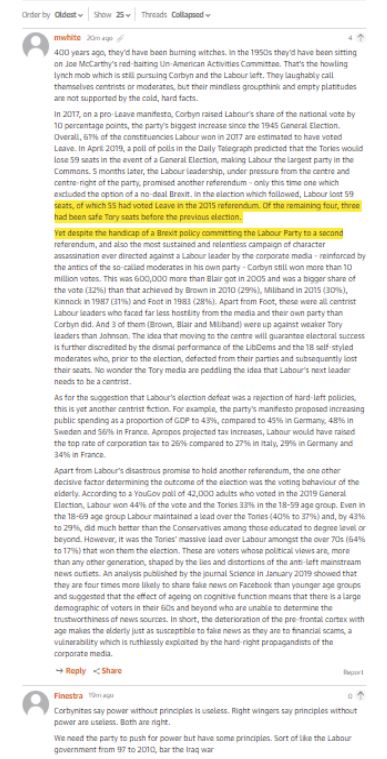
Since the comment is quite long, and the image possible difficult to make out, here is a transcript:
There is nothing more ludicrous than the spectacle of Jeremy Corbyn and the Labour left being lectured by the same so-called moderates who enabled Johnson’s victory and whose empty rhetoric is not supported by the cold hard facts.
In 2017, on a pro-Leave manifesto, Corbyn raised the Labour Party’s share of the national vote by 10 percentage points, the party’s biggest increase since the 1945 General Election.
In April 2019, a poll of polls in the Daily Telegraph predicted that the Tories would lose 59 seats in the event of a General Election, making Labour the largest party in the Commons. 5 months later, Labour centrists forced the party leadership to promise another referendum – only this time one which excluded the option of a no-deal Brexit.
In the election which followed, Labour lost 59 seats, of which 55 had voted Leave in the 2015 referendum. Of the remaining four, three had been safe Tory seats before the previous election.
Yet despite the Labour’s Brexit policy reversal and the most relentless campaign of character assassination ever directed against a Labour leader by the corporate media – reinforced by the antics of the supposed moderates in his own party – Corbyn still won more than 10 million votes.
This was 600,000 more than Blair got in 2005 and was a bigger share of the vote (32%) than that achieved by Brown in 2010 (29%), Miliband in 2015 (30%), Kinnock in 1987 (31%) and Foot in 1983 (28%). Apart from Foot, these were all centrist Labour leaders who faced far less hostility from the media and their own parliamentary party than Corbyn did. And 3 of them (Brown, Blair and Miliband) were up against weaker Tory leaders than Johnson.
The notion that moving to the centre will guarantee electoral success is further discredited by the dismal performance of the LibDems and the 18 self-styled moderates who, prior to the election, defected from their parties and subsequently lost their seats. No wonder the corporate media are peddling this idea so enthusiastically.
As for the suggestion that Labour’s election defeat was a rejection of hard-left policies, this is yet another centrist fiction. For example, the party’s manifesto proposed increasing public spending as a proportion of GDP to 43%, compared to 45% in Germany, 48% in Sweden and 56% in France.
Apropos projected tax increases, Labour would have raised the top rate of corporation tax to 26% compared to 27% in Italy, 29% in Germany and 34% in France. And polls such as the Opinium poll (September 2019) – which found that only 12% of voters and 6% of Labour defectors rejected its economic policies – consistently showed that Labour’s policies were popular.
Apart from Labour’s disastrous promise to hold another referendum, the one other factor which decided the outcome of the election was the voting behaviour of the elderly. According to a YouGov poll of 42,000 adults who voted in the 2019 General Election, Labour won 44% of the vote and the Tories 33% in the 18-59 age group. Even in the 18-69 age group Labour maintained a lead over the Tories (40% to 37%) and, by 43% to 29%, did much better than the Conservatives among those educated to degree level or beyond.
However, it was the Tories’ massive lead over Labour amongst the over 70s (64% to 17%) that won them the election. These are voters whose political views are, more than any other generation, shaped by the lies and distortions of the anti-left mainstream news outlets.
An analysis published by the journal Science in January 2019 showed that they are four times more likely to share fake news on Facebook than younger age groups and suggested that the effect of ageing on cognitive function means that there is a large demographic of voters in their 60s and beyond who are unable to determine the trustworthiness of news sources.
In short, the deterioration of the pre-frontal cortex with age makes the elderly just as susceptible to fake news as they are to financial scams, a vulnerability which is ruthlessly exploited by the hard-right propagandists of the corporate media.
…and here, is the gap where it used to be:

So: Which of the Guardian’s “community standards” did this comment break?
- Did it? “misrepresent the Guardian and its journalists”?
- Is it “persistent trolling or mindless abuse”?
- Is it “spam-like”? Or “obviously commercial”?
- Is it “racism, sexism, homophobia or hate-speech”?
- Is it “extremely offensive or threatening?”?
- Is it “flame-wars based on ingrained partisanship or generalisations”?
- Is it not “relevant”?
If none of the above – why was it taken down?
See our archive of censored comments. And if you see any egregious examples of the Guardian censoring its “free” comment sections – email us at [email protected], and send us screen caps if possible
Thanks for reading...
You can help us keep doing what we do. Every little helps and is hugely appreciated.




For other ways to donate, including direct-transfer bank details click HERE.
 wpDiscuz