This Week in The Guardian #1
Our inaugural edition sees the return of Syrian hospitals, how censorship is good for public health and the dangers of "conspiratorial thinking"
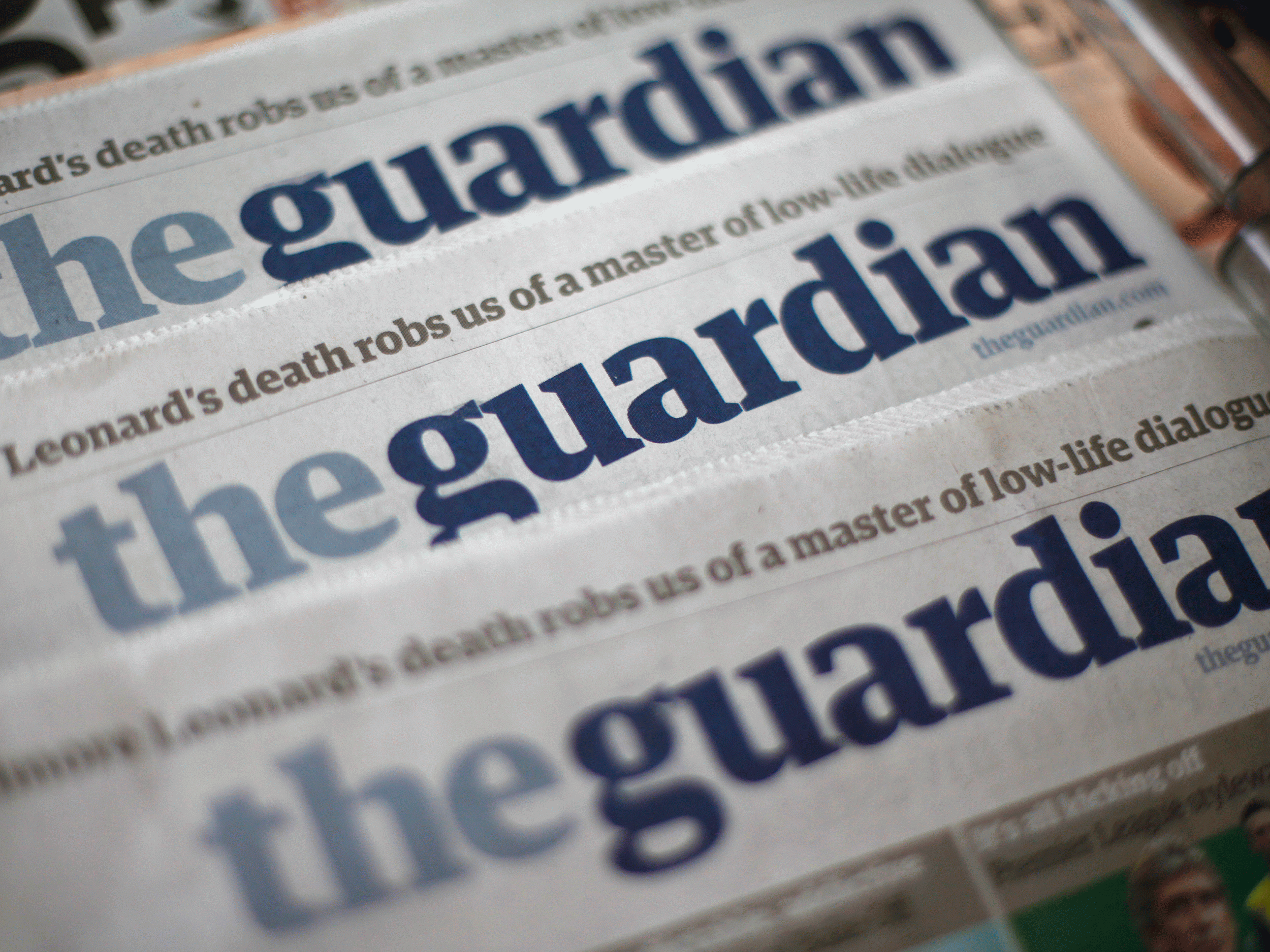
Five years ago this month, OffGuardian posted its first article. Since then nearly 4000 more have been posted, all with pretty much the same aim – fact-checking the media, countering propaganda, highlighting concealed agendas. Trying to be honest.
As a bulwark of establishment dishonesty, and the catalyst for this site’s creation, The Guardian has always had a special place in our hearts. It’s not just personal either, its (unearned) reputation for being reasonable and and “liberal” make it the thin end of a lot of wedges.
Every future dystopian nightmare will have started with an op-ed in The Guardian written by an outraged woman in big glasses.
As such, it was always fully deserving of its own category – On Guardian. In that category, we have hundreds of articles seeking to provide a counter-balance. Answering hysteria with reason, baseless assertions with careful research, and pointing out the sheer numbers of complete lies.
But sometimes you don’t need all of that. Sometimes you just need a headline, a summary, and little call-out of the all-to-obvious agenda. To that end, welcome to This Week in the Guardian.
Essentially these will be weekly articles that shine a brief spotlight on the establishment narratives that tick over behind the scenes. These won’t be big headlines or breaking news, but throw away articles and opinion pieces. Mood testers and trend setters that need to be called out.
Every week, on a Sunday, we will highlight three or four of these stories.
We will also encourage reader-participation here. The Guardian has dozens of new articles every day, making it too easy for something potentially dangerous to slip through the cracks, so if you come across something you feel should be included in the next edition, post a link below.
Our aim here is to keep a nice, comprehensive archive of how The Guardian is steering discussion, spreading propaganda, and foreshadowing the future big agenda.
That said, let us begin. As it’s our first edition, we’re doing a bumper 2 weeks-worth.
“The Guardian view on Idlib: nowhere left to run“
We start with something of a Golden Oldie. Apparently, there are still some hospitals left standing in Syria, which by our count had more than one per person before the war started.
You know this article before you read it. It’s anonymous (although it has the air of Simon Tisdall about it), it’s full of the same lies we all know by heart (refugees this, Rebels that), and off-handed acceptance of NATO-backed illegal activity (in this case Turkey has invaded Syria and is killing Syrian soldiers).
It’s half-hearted, to be honest. A tired, aged rock band playing their old chart-topper, one last time. The war for Syria is over. Both the literal war and the information war. That’s the political reality. The media and the political class haven’t admitted this yet, but they know it. The only question is whether they will simply keep the conflict on quiet simmer, or try and tear the temple down on top of all of us.
The agenda here is really setting up talking points for next time, if they kick up enough fuss about “the cost of Western inaction” in Syria, they can use it as a terrifying example next time they want to invade somewhere and the public is reticent to let them.
“Idlib’s despair won’t end bloodshed in Syria“
The Guardian, and their masters, are not done with Syria just yet, as another opinion piece which appeared to today suggests. It’s written by Hassan Hassan director of “non-state actors” at the Washington-based “non-partisan think tank” Center for Global Policy (I can’t find out how they’re funded, but can take an educated guess).
The article tells us:
Freed from the need to defend their last stronghold, the jihadists there will be well placed to regroup and take the struggle underground
….and doesn’t remotely seem to suggest the author considers this a bad thing.
You would be forgiven for thinking it reads like a combination of a threat and a mission statement.
“Misinformation on the coronavirus might be the most contagious thing about it“
This piece is interesting in a couple of ways. Firstly, the fact it seems to exist purely on the basis of a pun – a (claimed) virologist talking about things “going viral” on the internet. Outside of the pun, the author has no training or expertise in information technology.
That doesn’t stop him praising the idea of censorship and dystopian information controls:
Last year, Pinterest announced it had rewired its search results to make it harder to find vaccine misinformation. It had struggled to remove the content completely – the equivalent of finding all the cases during a disease outbreak – so instead focused on reducing how many people might be exposed to harmful content. During the current outbreak, Google is attempting to reduce people’s susceptibility to misinformation by displaying links to reputable health sources when users search for information about the virus.
Suppress dangerous opinions, boost government sources, to protect “public health”. Very Guardian.
Ironically enough, this article IS misinformation about the coronavirus, and – we have to agree – it is far more dangerous than the disease itself.
“The Trump era is a golden age of conspiracy theories – on the right and left“
This is a great one, one of those Guardian editorials that claims to be about one thing but is really about something else.
On the surface it’s your standard ad hom attack on “conspiracy theorists”, trying to encompass both the left and right. The authors do a brilliant job of at once a)admitting conspiracies happen, b)saying only irrational people believe in them and c)saying Russia got Donald Trump elected. Which seems to go one better than Orwell ever imagined and emerge into a wonderful new world of TripleThink.
But deeper than that usual craziness is the warning:
The only way to fight the spread of conspiracy theories is to reduce the conditions of social inequality that produce them
This is the kind of coded language that members of, and supporters of, the elite use with each other. It’s not really meant for us. It’s essentially saying “the ever-increasing and deepeningly desperate poverty experienced by the working class is stoking up resentments and building doubts in the current power structures. We need to put a halt on the widening inequality, or people will further question the system, leading to possible actual revolution.”
Which is very possibly true.
Caroline Flack, Domestic Violence and Shutting Down Social Media
This is a nice little interplay of Guardian themes.
Firstly we have Julie Bindel asking “Why do men keep getting away with killing women?” an interesting question, considering they don’t. Not really.
In 2018 there were around 700 homicides in the UK, which is a very small number, and women being killed by men made up less than 25% of that (149, according to the author). That’s a tragedy for 149 families, but in a country of near-enough 70 million people, it’s not really anything to get worked up about, and certainly doesn’t speak to some kind of society-wide problem with gender-based violence.
All in all, people in the UK live in one of the least violent countries in the world, and certainly, it’s safer in terms of violent crime than it has been for 99% of human history.
It’s also true that over two-thirds of the homicides in Britain are men, but when that is discussed the “femicide” sites claim it’s different because men are killed by strangers, but women are killed by partners or ex-partners. The problem they say, at its heart, is domestic violence.
What’s interesting about that, is pairing this with articles about TV presenter Caroline Flack’s suicide, blaming the press and social media for her death. There’s no real discussion of the accusations of domestic violence against her, and not one use of her (alleged) victim’s name.
Instead, we’re treated to a lot more “social media = bad” commentary, and some buzzphrases about mass psychology.
For those of you who had been wondering about The Guardian‘s priorities, it seems they are OK with domestic violence if it’s female on male, and certainly if you can use the aftermath to criticise social media in a plea for more regulations about what you can and cannot say.
It’s interesting to imagine what would be different had Caroline Flack been a man, accused of beating his much younger girlfriend with a table lamp. Would The Guardian oppose the prosecution then? They certainly didn’t have a problem with the social media “witch hunt” against Harvey Weinstein.
RUSSIA! RUSSIA! RUSSIA!
Just an update for anyone who likes to keep track, this last week the Russians have been very busy engaging in information warfare. First they were boosting Donald Trump’s bid for re-election. Then they were helping Bernie Sanders win the primaries, and now they’re spreading misinformation about the coronavirus.
On top of that, Putin’s “regime” is going after poor, vulnerable billionaire bankers who did nothing but embezzle from their businesses and defraud their customers. It’s all go at the Kremlin these days.
BONUS – The Dissident Artist Strikes Again
In case any of you were wondering whatever happened to the “brave dissident” artist/arsonist Petr Pavlensky who used to set police stations on fire and nail his scrotum to Red Square. Well, he’s in legal trouble in France for a sex-tape scandal involving a French politician. This is after being released following a jail term for setting fire to a Paris bank. No word yet on whether or not his latest artworks will be reviewed favourably by Jonathan Jones.
* * *
All told, a busy week for The Guardian, we didn’t even touch on the persistent efforts to redeem Tony Blair, the “problem of whiteness” or the fact Sanders is better than Corbyn because he voted to bomb Kosovo in 1999. Did we miss any others? Tell us about them in the comments below, and keep an eye out for articles that should go in the next issue.
Thanks for reading...
You can help us keep doing what we do. Every little helps and is hugely appreciated.




For other ways to donate, including direct-transfer bank details click HERE.
 wpDiscuz