Dr. Richter’s Diabolical Experiment
Todd Hayen
Ever heard of Dr. Curt Richter? Neither had I.
During the time in the United States where nearly anything was done in the name of science (these days, not so much, now anything is done in the name of money) Dr. Curt Richter, a renowned physiologist and behavioral scientist, conducted his seminal experiments on rats. He presented his most famous experiment sometime in the mid 1950’s at Johns Hopkins University.
These tests aimed to uncover the effects of despair and hopelessness on the survival rate of rats.
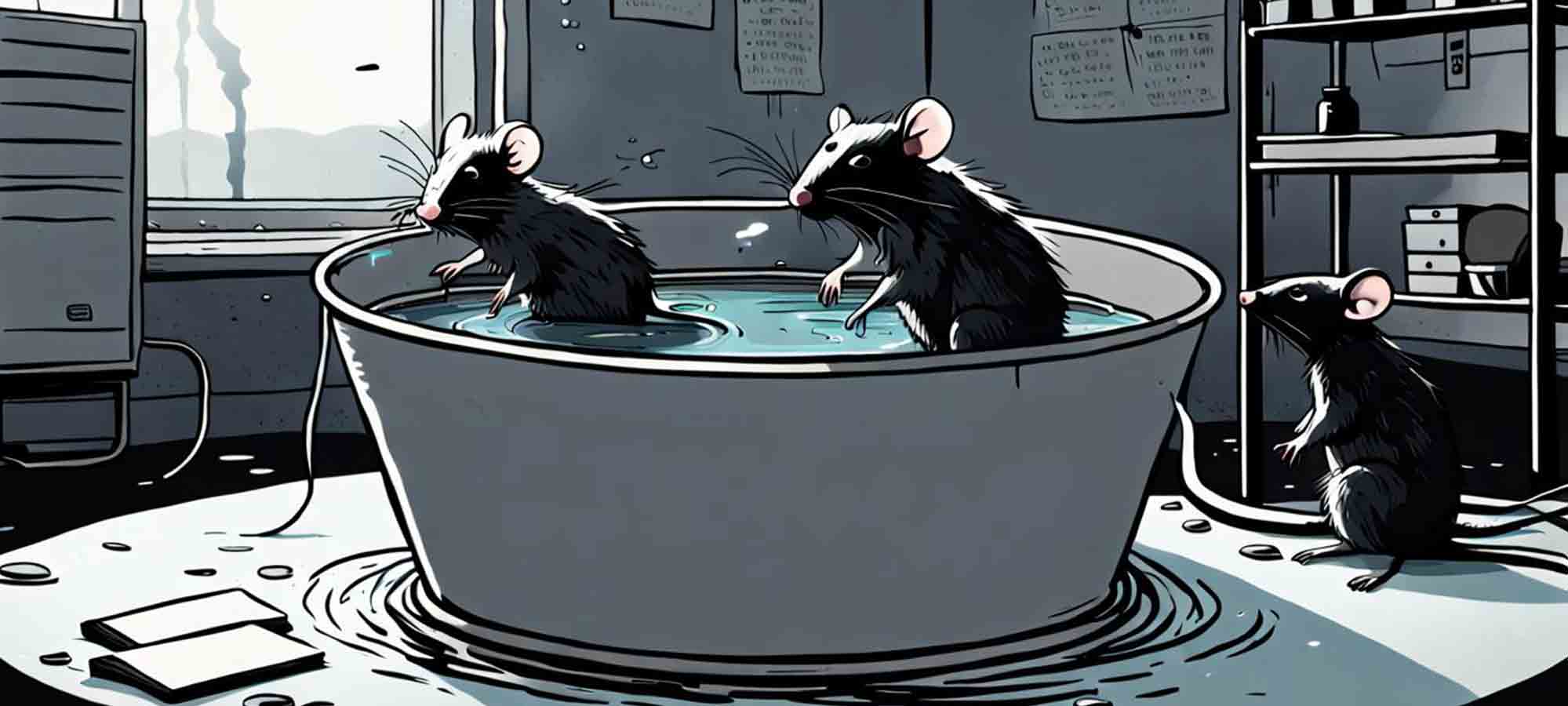
Apparently, the kindly scientist placed his beloved rats into buckets of water and began timing their frantic swimming. You see, the rats believed they were going to drown, and did whatever they could to save their pathetic lives.
They didn’t realize that the good doctor had a gentle soul and would rescue them before their watery demise. But he didn’t. Not at first at least. And many rats met their maker after about 15 minutes of futile paddling.
The next round of rats were the lucky ones, although some would say unlucky. These pitiful fellows were observed until the indicated exhaustion time but then plucked up out of the water in the nick of time to be daintily dried off and set out to rest. Saved.
A miracle for sure. And oh, what a relief.
After a brief stint of R&R, the rats were dumped back into their buckets, which ultimately turned out to be their watery grave after all—but not in the afore determined 15-minute exhaustion time, but rather an impressive, and miraculous SIXTY HOURS! Oh, wonders of wonders, how could it be that these tiny creatures could extend the fleeting energy it took to stay alive for so long?
Hope! Hope you say? Yes, it was hope.
They had been rescued before, so surely, they would be rescued again! They had indubitable faith in Dr. Curt, and knew he would, at the last minute, pluck them from sure death. But he didn’t. No, the good doctor wanted to see how long hope would sustain them. How long that glimmer of belief in the goodness of man could glow in the hearts and muscles of the poorest of poor beasts.
But that savior never came, and after about 60 hours (give or take a few minutes), they all finally succumbed. Once the 60-hour mark was made, surely some creatures were removed from the bucket for humanitarian reasons. But maybe not. Teaches you to have faith, eh? Well, faith in humans at least. It is hard to tell if rats are aware of God’s mercy. Maybe they are all sipping margaritas in rat heaven. Who knows.
Dr. Richter was a hero in the science world, of course. What he determined in his little reprehensible experiment is that at least rats were capable of expending energy to stay alive if they were led (falsely) to believe they would at some point be saved, i.e., their efforts to stay alive could continue almost indefinitely if they believed those efforts would pay off.
Psychologists often cite this experiment as evidence of the power of hope. It turns out our perspective can be incredibly powerful. When we are hopeful that our circumstances are temporary and change is possible, we can achieve extraordinary feats. Hope can be the factor that changes an outcome from really bad, to really good, at least with rats.
I wonder if Dr. Richter wanted (at least secretly) to try out his experiment on humans, but he was not fortunate enough to be in the middle of Germany 10 years before. The Nazis would have surely been happy to oblige.
Is that the only thing he discovered? I don’t think so. He also discovered that if you give a creature some slack, meaning if you stop torturing them for a moment, and then make them think you have saved the day, you can go back to torturing them and they will keep on taking it—happily—until they drop dead.
I am reminded of the BF Skinner experiment with pigeons. Although I cannot find documentation on this particular experiment I am going to describe, I am pretty sure it happened, although, considering my dubious state of mind these days, I very well may have made it up.
It goes like this (or so I think):
Dr. Skinner gave his little feathered friends corn kernels (or some other delicacy pigeons adore) each time the critters pecked a lever. After quite a while of brain washing the pigeons into believing that pecking the lever miraculously produced a tasty morsel, Skinner stopped providing one. The pigeons kept pecking.
After a certain number of pecks, they grew tired, and bored, and decided that maybe the lever pecking just didn’t do anything so miraculous. Then, just at the right moment, Skinner started providing corn in response to the near exhaustive pecking. (Normally, right before they would typically stop the pecking. See, he had all this figured out by keeping meticulous notes and knew exactly when that last peck would fall before the birds would give up. He was a good scientist.)
Then he would stop the corn again, once the poor birds thought they had it figured out. They would again keep pecking for a while, and ol’ Skinner would start shooting the corn out again as soon as they were about to give up. After a few rounds of this on and off again peck and corn play, the pigeons would never stop pecking. Never. Even though no corn ever came out again, peck, peck, peck.
Now THAT’S hope!
Combine these two experiments together and you’ve got something interesting. Let’s not call it “hope” but rather call it “trust”…and a strange sort of trust indeed.
The rats trusted Richter to save them after a long while of paddling. Which he did the first time, right before he was pretty certain they would die. Skinner “saved” his pigeons the same way, but with not as high a price to pay. The bird’s lived, albeit in a strange state of psychosis. They never gave up. And if the sheer exhaustion didn’t get to Richter’s rats, they would not have ever given up either.
How do we apply this to today? Well, think about it. When the great Covid scare began, our kindly government told us we were all surely going to die if we didn’t continue to swim or peck the lever. We went through all sorts of gyrations with the Covid experiment—lockdowns, social distancing, no gatherings, missed weddings, funerals, church services, businesses closed—peck, peck, peck, but no corn. And when the vaccine came out even more paddling and pecking.
Then, suddenly, we were saved! It all paid off! The corn flowed, and we were plucked out of the bucket. Covid ended, the summer was pleasant, warm (uh, no, it was boiling, wasn’t it? Oh, that’s a different story…sorry.) All was back to normal.
So how long will it be before we are thrown back in the bucket? Start paddling folks, but don’t worry, we’ll be saved again! The kind doctors have good hearts. Surely, we will be rescued.
Peck, peck.
Todd Hayen is a registered psychotherapist practicing in Toronto, Ontario, Canada. He holds a PhD in depth psychotherapy and an MA in Consciousness Studies. He specializes in Jungian, archetypal, psychology. Todd also writes for his own substack, which you can read here
Thanks for reading...
You can help us keep doing what we do. Every little helps and is hugely appreciated.




For other ways to donate, including direct-transfer bank details click HERE.
 wpDiscuz