Architecture is always Political – Part Two
Simon Elmer
This is the second part of a two-part article, you can read Part 1 here.
When did new buildings start being identified not by the names of their owners, tenants or addresses but by the object they most resembled?
‘Crystal Palace’, erected in London’s Hyde Park for the Great Exhibition of 1851, was one of the first. The ‘Flatiron’ building constructed in lower Manhattan in 1902, was another. But the habit has become more pronounced in recent decades, something like the architectural equivalent of the ridiculous names, such as ‘Oval Quarter’ and ‘Kidbrooke Village’, with which estate agents try to rebrand London’s working-class districts and neighbourhoods undergoing gentrification for unwitting middle-class mortgagors.
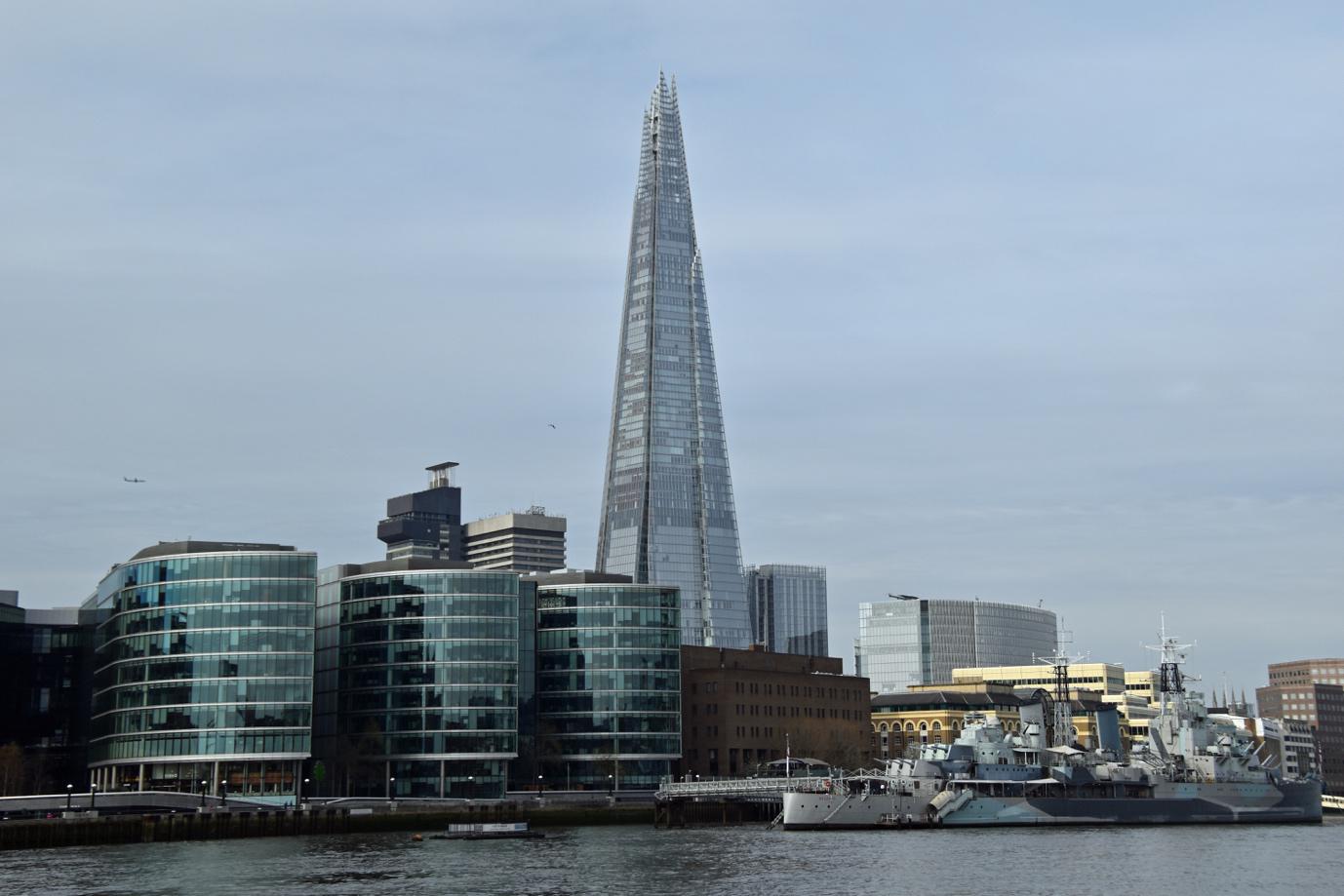
As one of the great global centres of property speculation, London has more than its fair share of such nicknames for the architectural expressions of corporate capitalism whose cold ruthlessness they try to familiarise and even domesticise with names like The Gherkin (designed by Foster + Partners, 2003), The Shard (Renzo Piano, 2012), The Cheese-grater (Rogers Stirk Harbour + Partners, 2013), The Walkie-talkie (Rafael Viñoly, 2014), The Boomerang (Ian Simpson, 2018), The Scalpel (Kohn Pedersen Fox, 2018), The Can of Ham (Foggo Associates, 2019) and The Pinnacle (PLP Architecture, 2020).
Now, all these buildings — which owe much to the corporate architecture of I. M. Pei to which Tucker Carlson referred — are home to some of the most predatory companies and corporations in the City of London, the global headquarters for the laundering of dirty money; but it’s about their form, and not their function, that I want to write here.
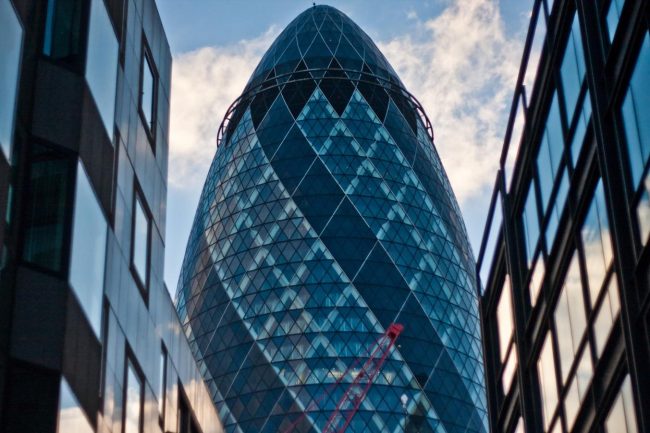
The Gherkin, 30 St. Mary Axe, City of London, 2003. Photograph by Garry Knight, 2011
In one of his last texts, ‘The Fabric of the City’, delivered in November 2018 as a lecture to Policy Exchange — a neoliberal think tank that has written much of the housing policy of the UK Governments of the past two decades — Roger Scruton, the conservative philosopher and aesthetician, took aim at this architecture of objects. And he did so, not for their role in turning London into the laundry for global capital, but for their architectural form. Indeed, he even claimed that what he called the housing question ‘is not at root an economic, social or political question but an aesthetic one’.
Everything in my book demonstrates how mistaken this view is, which is endemic to the conservative view of the world. Scruton may think the Georgian and Victorian architecture of the British Empire he so valued is free of an economics and politics, but those who lived in its shadow in, for example, the waterfront of Shanghai would laugh bitterly at such naivety. In my article on what I call ‘the aesthetics of social cleansing’ I hold Scruton to account for this naivety — if that is what it is — and the predatory capitalism for which it continues to be a front today; but that doesn’t mean that Scruton did not have some interesting things to say about the failings of contemporary architecture.
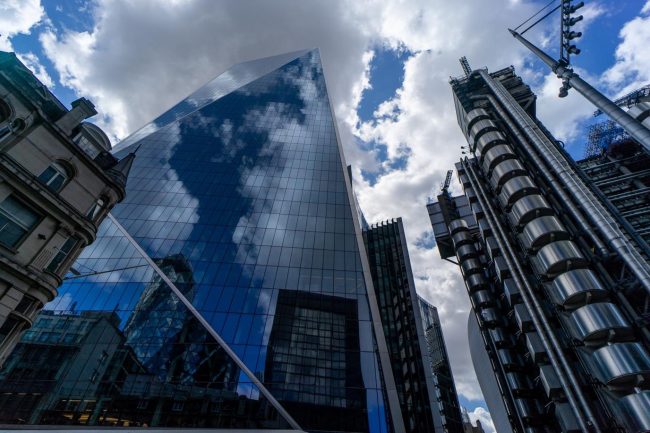
The Scalpel, 52 Lime Street, City of London, 2018. Photograph by Paul Hudson, 2020
So that it’s clear, Scruton’s criticisms were levelled against all modern architecture, and above all the model and influence of modernist architecture, which he saw as largely indistinguishable from the architecture of postmodernism and the corporate architecture on which I want to focus. One of the conceits of ignoring the economics and politics of architecture is that a history of architecture can be constructed uninfluenced by the vast changes in the economics and politics of the last hundred years, and in particular the revolution in Western capitalism called neoliberalism.
In contrast, my history of architecture — which I have called ‘communist’ not only because it offers a historical-materialist critique of the relation between architecture and power but also because that critique comes out of social practice rather than academic theory — takes its point of departure from this relation, which my book seeks to record, document and demonstrate.
My purpose in recalling Scruton’s critique, therefore, is not to adopt his formalist and conservative view of history, but rather to use his criticisms as a formal framework through which to view precisely the role of finance capitalism and the politics of neoliberalism in shaping contemporary architectural practice.
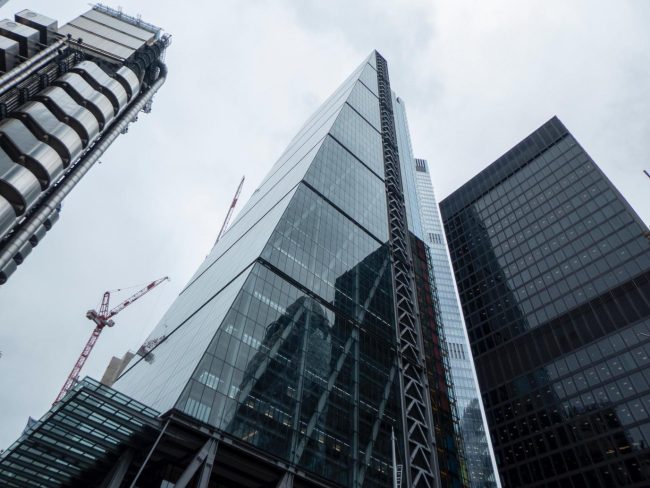
The Cheese-grater, 122 Leadenhall Street, City of London, 2013. Photograph by Sebastian Doe, 2021
The failure of modernism, Scruton argued in his lecture, was that even its more successful buildings — he cited Le Corbusier’s Chapel at Ronchamp and the houses of Frank Lloyd Wright — did not produce a model with which builders could integrate modernist buildings into the existing urban fabric, and in particular into the city street and the facades of the other buildings with which it has to share that street.
Scruton was right, though less because of the failure of modernism than because modernist architecture was predicated on the erasure of the street, which the architects of the early Twentieth Century associated with overcrowded slum housing, unsanitary living and work conditions and the consequent revolutionary upheavals that came to characterise European cities in the Nineteenth Century.
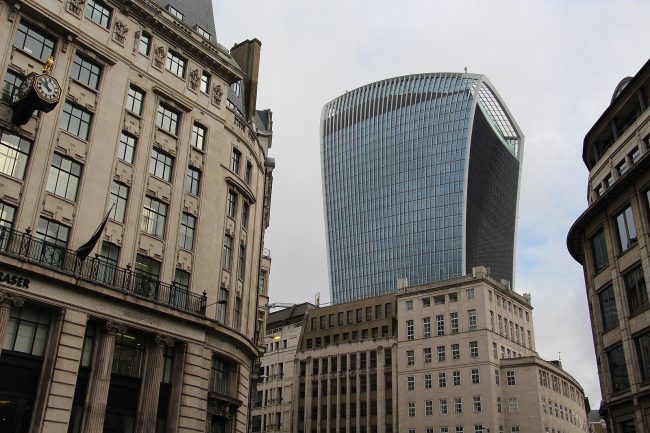
The Walkie-Talkie, 20 Fenchurch St., City of London, 2014. Photograph by Fred Romero, 2016
From this failure, however, Scruton extrapolated the causes of the failings of the more contemporary architecture with which I began this section, some of whose buildings he used to illustrate his lecture:
Success in architecture is a matter of “standing out” from the surroundings, creating an unforgettable presence, an “iconic” structure that will advertise itself and its contents to the wider world.”
It’s hard to understand how Scruton could divorce this observation — with which I agree — from the commissions for which the members of the architectural profession must compete in the market of finance capitalism, in which the state has almost entirely handed over the construction of the urban environment to the private sector. But for Scruton, who ignored this economic context, there was no or little difference — and a historical relation of cause to effect — between the formal qualities he lamented in the architecture of modernism (‘the stack of horizontal layers’, as he described it, ‘with jutting and obtrusive corners . . . blank and detached surfaces, bounded by edges, with no welcoming apertures to mark the boundary between inside and outside . . . it faces in no direction and therefore in all directions, requiring light on all sides’) and the contemporary architecture of corporate capitalism (‘the fluid and gadget-derived forms that are beginning to dominate our cities, trashing the sky-line of London’).
Pausing from this blanket denunciation of the modern architecture of the last hundred years, Scruton made another observation about architectural form with which I agree:
If buildings are to be composed then they require a vocabulary and a grammar: in other words, parts that have an independent significance and rules, conventions and customs that govern their combination.”
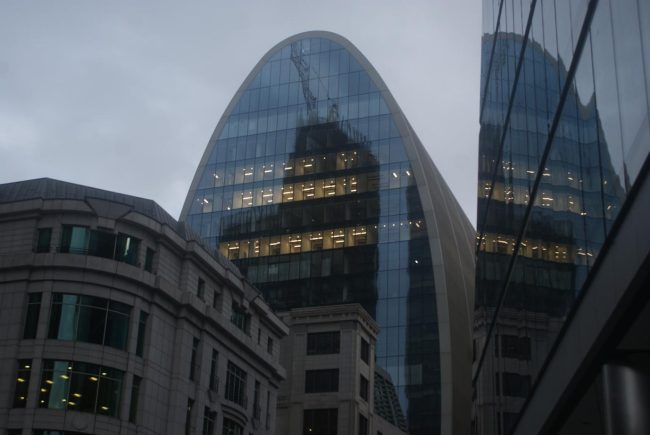
The Can of Ham, 70 St. Mary Axe, City of London, 2019. Photograph by Robert Lamb, 2019
For Scruton, modernism reduced this shared, consensual and historically-determined grammar and vocabulary to a purely mathematical view of space and proportion in which steel frames were draped with glass or alloy panels. As an example of which, he cited Mies van der Rohe’s Seagram Building — which I write about more approvingly in one of my articles — as responsible for the ‘faceless blocks that followed his lamentable example’, among which we can include the ‘glass boxes’ of I. M. Pei and other architects denounced by Carlson. For me, however, it is precisely because modernism created a new language of architecture — although one that often produced a blandly international grammar with a correspondingly crude vocabulary — that it was as successful — and, perhaps, as subject to these criticisms — as it was.
Indeed, the evidence of modernism’s language is that, even when its buildings were designed by architects who didn’t subscribe to its social dimension, it was written, as it were, into its grammar and its vocabulary — as it isn’t, in contrast, in the so-called ‘New London Vernacular’ that has succeeded it in the housing estates of today. In contrast to the language of modernism, the speech of contemporary residential property — that justifying it and that dictating its design — has been written by the estate agent, the developer and the investor, and is spoken exclusively in order to realise the potential uplift in the value of the land on which it is built.
In the articles collected in this book it will become further apparent where and why I disagree with Scruton’s criticisms of modernist architecture. Here, however, I want to focus on what, for me, is his far more interesting critique of the contemporary corporate architecture at which his fellow conservative, Tucker Carlson, levelled his criticisms. To this end, I want to look at Scruton’s analysis in which he attributes the abandonment of a shared vocabulary and shared grammar in contemporary architecture to two factors:
One of the factors responsible for this is the arrival of “smart” design tools, which enable a building to be sketched, planned, simulated and presented on the computer screen.
The other factor is the dominance of the plastic gadget, the household object, such as the hair-drier, the coffee-maker, the iPod or television, which is moulded out of coloured plastic and which expresses in its streamlined form and folded perimeter its refusal to relate to anything in its neighbourhood. The household gadget is designed to look aesthetically complete and self-contained, to stand apart from the furniture . . . The outer shell is smooth, poured, self-contained and without observable boundaries. . . . Such objects are easily represented by the smart software now used by architects, and the visual education of the architect has been altered accordingly.
Increasingly plans for new buildings emulate the plans for household gadgets, with smooth modelled parts and edgeless perimeters. Examples are proliferating, and of course London’s hideous Walkie-Talkie is familiar to you all.
Increasingly the big commissions are going to architects who design buildings in this way, using computer simulation to translate moulded gadgets into enlarged versions of themselves, which can then be transplanted from the screen to the street.
But perhaps the real defect in this fluid architecture lies precisely in the originality that it advertises. Each gadget is entirely new, an expression of its own self-contained aesthetic, which is an aesthetic that no other building can share, unless it is simply a repeat performance. Each gadget is the complete formula for its own style, and the architect who wishes to put something next to it . . . is forced to produce another self-contained gadget and another aesthetic that is unique to the building in question. The gadgets are attention-grabbing in an adverse way, and their lack of compositional grammar forbids us from relating them to anything around them. Their message is that they do not belong. And in their presence nor do we.
It’s a long quote, but I include it here in full because there’s little in it with which I disagree, and I want to end by discussing its analysis. Most of the nicknames with which the towering corporate office buildings of London are compared to diminutive household gadgets were given to them by journalists or acquired by public coinage; but it’s unlikely that the architects themselves weren’t aware of the possible associations in advance, and used them to advertise and promote their proposals for the highly lucrative contracts such buildings attract. The architect Ian Simpson, for example, who designed The Boomerang (the 170m-high One Blackfriars), said his design was inspired by Timo Sarpaneva’s Lansetti glass vase of 1952 (which is 27cm tall). It’s hard to believe that the canny corporate operators who designed the other buildings didn’t have other familiar gadgets and objects in mind.
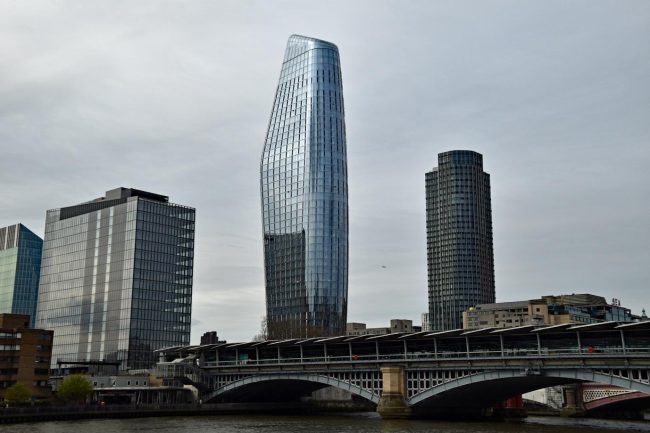
The Boomerang, One Blackfriars, London, 2018. Photograph by Thomas Dahlström Nielson, 2023
Scruton was doubtless right that the practice of digitally modelling buildings on a computer screen has contributed to the lack of consideration by architects about what happens when the form of a household object is enlarged to the size of a skyscraper; but this is less a cause than an effect of the economic and political circumstances from which this form of architecture has emerged, a form which I would characterise as speech without language.
Doubtless, too, Scruton was right that the need for originality is partly a result of the advertised genius of the famous architect — who was typically described in the 2000s as a ‘Starchitect’; but it has far more to do with the commodity form to which such architecture has been reduced and the requirement to be always new in the market in which those commodities compete for a buyer. But as someone once said — Eliot, Pound or Picasso, possibly all three — an art that is not founded in tradition is mere imitation and pastiche, and how quickly these initially surprising or mildly amusing essays in the art have lost both their glitter and their humour. How grim they look now, as they loom over us like the armed security guards and CCTC cameras that stand at their entrances. How heavy and oppressive do their metallic exoskeletons feel as they cast their long shadows over our lives. How well do their reflective glass shells deflect our attempts to hold to account those perpetrating the crimes committed inside.
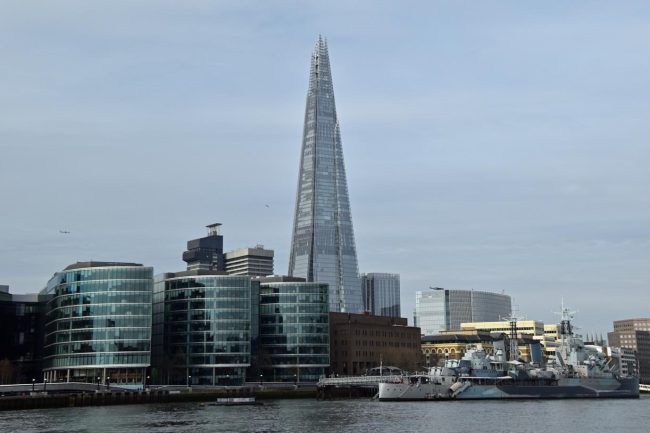
The Shard, Southwark, London, 2012. Photograph by Thomas Dahlström Nielson, 2023
Above all, their architectural legacy is precisely nothing. They speak no language that can be learned by others, their grammar a corporate advertiser’s corruption of the social aspirations of modernism, their vocabulary reduced to tedious boasts and vicious snarls, the popping of champagne corks from ever larger bottles. As Scruton accurately said, under the imperative of a facile ‘originality’ each is forced to invent a new language from scratch; but since language evolves over hundreds and sometimes thousands of years from innumerable speech acts, the language they speak is barely articulate, at best childish (it’s not by chance they resemble giant children’s toys), conveying nothing more than the threat of a violent tribe, without community even with their equally primitive peers.
This is the speech of capitalism red in tooth and claw, in which — as Hegel described the impasse faced by those who try to enslave others — masters compete for recognition from those they refuse to recognise, a members club of mutual admirers exposing themselves to the public.
They don’t even speak the language of money. Their ridiculous competition to reach ever greater heights is compensation for the absent value at the heart of finance capitalism, the Tower of Babel on which our so-called fiat economies have been built, and which is evaporating into nothing before our upturned faces. If this architecture, as Scruton argued, does not relate to its neighbours, it’s not only for their formal failings but because the buildings only stand where they do physically, while the corporations they house exist legally in numerous offshore financial jurisdictions, as free from the taxes of the nations through which they wash global capital as they are from scrutiny by their laws.
Despite this — or, more likely, in compensation for their ethical vacuity — examples of this gadget architecture have received no end of awards in the endless ceremonies of self-congratulation with which the profession tries to convince itself that it is not a minor arm of the building industry or fawning courtiers for money launderers.
The Gherkin won the Stirling Prize, the London Region Award and the Council on Tall Buildings and Urban Habitat Award; The Shard won the Emporis Skyscraper of the Year Award, plus the Royal Institute of British Architects London and National Awards; the latter two of which were also won by The Cheese-grater; The Walkie-Talkie won the Architecture Masterprize; The Boomerang won the International Property Award and the Tall Buildings Award; The Scalpel also won the Tall Buildings Award, as well as the Chicago Athenaeum International Architecture Award, and — as further demonstration of the role of environmental fundamentalism in the profession — was awarded an ‘excellent’ rating under the BREEAM sustainability standard; and The Pinnacle (a name subsequently discarded) won the London Design Award, the LABC Building Excellence Award, and — most absurdly of all — the WAN Female Team of the Year Award.
The result, as Scruton said, is a financial district made of attention-grabbing gadgets, priapic erections of the egos not only of their designers but also, and above all, of the bankers, financiers and corporate lawyers who occupy their offices. Their failings, however, are not merely architectural, in the various ways described by Scruton. There is, perhaps, no more perfect meeting of form and function in the history of architecture than the architecture of finance capitalism; and if there’s anyone left to make it, the future will judge this generation of architects as the worst in history, as the betrayers of everything modernism tried to achieve with architecture.
One might think this judgement, and the articles in which I make it, overly harsh on the profession. It’s my contrary opinion that the profession is and has been far too easy on itself for far too long, and this book doesn’t pull any punches in reversing this critical trend, which has contributed to the comfortable relationship architecture has with the corporate world. This is a product of the book’s origins, which are not those of academic research but of a decade’s political practice opposing the assault of capital on working-class homes and communities, and in which architecture and architects have played such an important and unforgiveable part. If architects reading this book are offended, they should be, not by what I have written but by what it reveals about their profession.
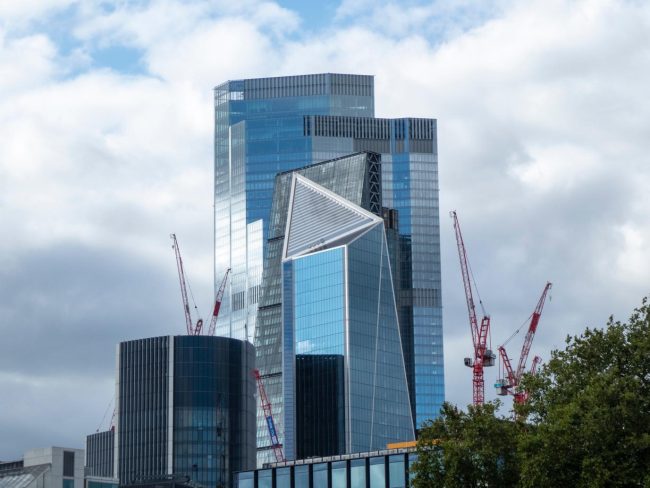
A cacophony of corporate architecture in the City of London. Photograph by Sebastian Doe, 2021
* * *
Written between 2016 and 2019, before the watershed of lockdown and the Great Reset of the West into stakeholder capitalism it initiated, the articles in Architecture is always Political were originally published on the website of Architects for Social Housing, the company and practice founded by the architect, Geraldine Dening, and myself in 2015 and for which I am Head of Research. They were written, therefore, against the background of the crisis of housing affordability created by the Global Financial Crisis of 2007-08 and the collusion of the architectural profession in how the financial institutions responsible for it turned what should have been their accountability and regulation into a financial stepping stone to where we are now.
Many of these articles came out of the various practices of Architects for Social Housing in exposing and challenging this collusion, which gives this book a practical foundation in the relationship between finance capitalism, government policy and property development largely absent from academic studies based on other academic studies. So although its case studies look back, in one article, 900 years to the origins of current land ownership in Britain, and include some key moments and buildings in the history of architecture — including the Sacré Cœur in Paris, the Narkomfin building in Moscow, the Sachsenhausen concentration camp outside Berlin, the Unité d’habitation in Marseilles, the Seagram building in New York, the reconstruction of post-war Dresden, modernist housing estates in the UK, the New London Vernacular and international corporate architecture — the focus of this book is how the practice of architecture can move beyond the impasse at which it finds itself today. This begins with identifying what has produced it.
There is another reason why I have subtitled this book ‘a communist history’. The history of architecture is inseparable from the history of community — the struggle to create it and the struggle to contain its revolutionary threat. In the Twentieth Century, for better or worse, that struggle was engaged around the meaning of the word ‘communism’. My communist history of architecture focuses on moments in which the stakes in that struggle — which continues in the Twenty-first Century, though on more unequal terms than it has since the dawn of modernity — reached their greatest clarity in the theory, practice and use of architecture.
Architecture is always Political: A Communist History is the first volume in a new series titled the ASH Papers, which will collect in book form the more important articles published on our website. The projected next two volumes will be titled, respectively, The Housing Crisis: Finance, Legislation, Policy, Resistance and Case Studies in Estate Regeneration: Demolition, Privatisation and Social Cleansing.

Thanks for reading...
You can help us keep doing what we do. Every little helps and is hugely appreciated.




For other ways to donate, including direct-transfer bank details click HERE.
 wpDiscuz