On Independence Day, Foreign Agribusiness Will Be Told Get Out, “Quit India!”
Colin Todhunter
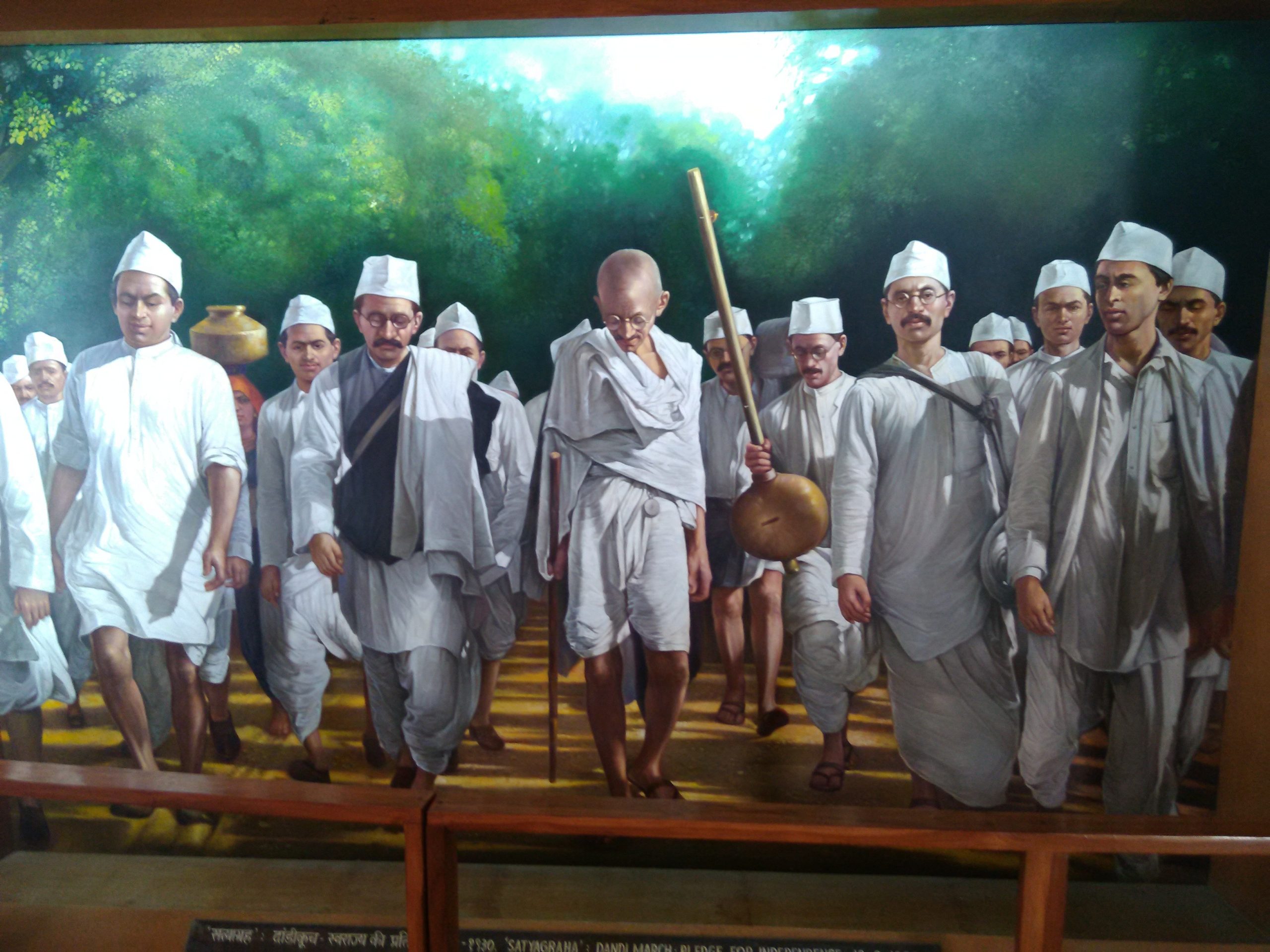
"Quit India Movement" artwork, Gandhi Memorial, Ahmedabad
On 15 August, India will celebrate its Independence Day. There will be the usual celebratory flag-waving and flypasts in Delhi along with sound bites about ‘the world’s biggest democracy’. But what has ‘independence’ come to mean?
Placing an X on a ballot paper every now and then does not constitute democracy. If people are misinformed, misled and manipulated to think and act in a certain way, while backroom deals are carried out without their knowledge, then what value ‘democracy’? Then there is no freedom, no self-determination. Someone else is determining the agenda.
The Quit India Movement was launched by Mahatma Gandhi and the Indian National Congress on 8 August 1942, demanding the immediate end of British rule in India. It inspired a mass civil disobedience campaign featuring strikes, demonstrations and sabotage, despite the British arresting Gandhi and many Congress leaders immediately after the movement’s start.
The movement saw remarkable nationwide participation—including women, students, workers and peasants. Although it was violently suppressed by the colonial authorities, it galvanised the struggle for independence. The Quit India Movement significantly weakened British authority, promoted unity among diverse groups and set the stage for India’s eventual independence.
Now, in 2025, the spirit of the Quit India Movement is being explicitly invoked by today’s farmer protests to inspire unity, resilience and a nationwide call to action.
The Samyukt Kisan Morcha (SKM)—a coalition of 40-plus farmers’ unions across India—is at the forefront of a continuing struggle against government policies that are eroding rural livelihoods, national sovereignty and federal governance. Their concerns centre on an emerging authoritarian central government controlled by corporate interests and international finance capital, which threatens to subordinate the role of India’s states and dismantle vital protections for farmers and rural communities.
SKM, alongside allied organisations such as the All India Kisan Sabha (AIKS), argues that the Union Government’s push for agricultural reforms under slogans like ‘One Nation, One Market’ jeopardises the constitutional federal structure. These reforms—including the draft National Policy Framework on Agriculture Marketing (NPFAM)—seek to unify India’s disparate agricultural marketing systems into a centralised, corporatised national market.
According to the SKM, this transformation will severely diminishe the decision-making power of state governments over agriculture, land, industry and markets—domains constitutionally assigned to them.
The NPFAM draft envisions a rescaling of agricultural marketing, replacing state-regulated wholesale markets (mandis) and rural haats with private, corporate-controlled entities integrated via Digital Public Infrastructure (DPI) and blockchain technologies. Under this model, powerful private corporations, including conglomerates like Adani, Ambani, Tata, Cargill, Pepsi, Walmart, Bayer and Amazon, would engage directly with farmers, bypassing traditional state-regulated market structures. The consolidation of storage facilities and marketing channels under corporate control raises fears of price manipulation and diminishes farmers’ negotiating power.
This change will essentially fundamentally restructure India’s agri-food sector and is aimed at integrating it deeply into global supply chains controlled by agribusiness and international finance capital. This is little more than a neocolonial strategy that would hand over India’s food security and agricultural governance to transnational corporations.
In 2025, farmers are still protesting. The roots of the protests can be traced back to the three farm laws introduced and subsequently repealed in late 2021 following widespread protests. The SKM and the AIKS warn that the NPFAM is effectively a rebranded return of those laws, seeking to achieve their objectives through new policy frameworks.
Key elements of the NPFAM echo the earlier laws’ intent to deregulate markets, permit private agribusiness entry and promote contract farming under conditions favourable to corporate interests. The absence of legislative guarantees for a legal Minimum Support Price (MSP) for agricultural produce and minimum wages for agricultural workers remains a still-unaddressed primary concern, as is the lack of accountability mechanisms to regulate corporate practices.
Farmers face the prospect of becoming mere producers of raw materials for corporate supply chains, with prices dictated by powerful processing industries and exporters. The AIKS stresses that central government proposals, including deepening financialisation via futures and options markets, will enable global corporations and financial firms to assert dominance over the food industry, intensifying farmers’ economic vulnerabilities.
The critique extends to dismantling of India’s longstanding food security frameworks:
- Mandis and Marketing Boards: mandis, regulated by Agricultural Produce Marketing Committees (APMCs), provide farmers with auction-based sales platforms ensuring some degree of fair price discovery and market access. The NPFAM’s corporatisation proposals threaten these markets’ survival.
- Public Distribution System (PDS): India’s PDS, facilitated by state and central governments, supplies subsidised essentials to millions, underpinning national nutritional security.
- Food Corporation of India (FCI): the FCI manages procurement at MSP, storage and food distribution, acting as a stabilising force in the agriculture sector.
Facilitating corporate interests, the government seeks the withdrawal of state involvement in these key institutions, exposing India to volatile international markets controlled by global agribusiness, thereby undermining food sovereignty and rural welfare.
In response to this proposed neoliberal shock therapy, the SKM has launched a series of coordinated protests to press their demands and safeguard farmers’ rights.
Quit India
On ‘Quit India” Day on 13 August, symbolically invoking the historic Quit India Movement, farmers nationwide will conduct vehicle and tractor parades, public demonstrations and the burning of effigies representing Donald Trump and Indian Prime Minister Narendra Modi. This protest specifically targets proposed Free Trade Agreements (FTAs) — particularly with the US — fearing they will exacerbate corporate dominance and market flooding with (GMO) cheap imports.
The date, 13 August, comes two days before Independence Day celebrations. Something that may appear increasingly hollow as time marches on and we see the recolonisation of India’s economy by foreign interests.
From 15 August, the campaign will include public hearings, grassroots mobilisation and awareness drives culminating in a large-scale worker-farmer protest action in Delhi and various state capitals on 26 November, marking five years since the historic farmers’ protests at Delhi’s borders.
The movement’s core demands include a constitutionally or legally enforced MSP aligned with recommendations from the Swaminathan Commission, ensuring farmers receive at least 50% above the cost of production, loan waivers and financial relief tailored for farmers.
Farmers also want the withdrawal of bans on using 10-year-old tractors in the National Capital Region (NCR), the restoration of fertiliser subsidies, regulation of spurious agricultural inputs. Stronger state infrastructure to maintain food security is called for along with support for small-scale producers and meaningful dialogue involving farmer organisations and state governments.
Many of the key demands are long standing, but official responses to the protests and farmers’ demands have sometimes involved tear gas, water cannons and other harsh measures, reflecting attempts to suppress dissent and reassure international investors of a stable climate for foreign direct investment. In late 2021, SKM leader Rakesh Tikait noted that around 750 protesters had died in the prolonged struggle.
Various officials have been recorded endorsing harsh crackdowns on demonstrators, further fuelling resentment and mistrust. This marks a broader trend of state suppression intended to clear the path for a corporate-financial takeover of the agricultural domain.
The SKM and the AIKS protests and demands are well-founded.
In India, as elsewhere, we are seeing the erosion of traditional diets and farming practices, resulting in an increasing reliance on ultra-processed foods and global corporate supply chains.
Moreover, underinvestment in rural infrastructure and agriculture over decades has been deliberate, portraying Indian farming as backward and ripe for ‘modernisation’ that privileges corporate profit over food sovereignty.
The commodification and financialisation of food and agricultural land will serve to further embed corporate influence at all levels, from seed to store (or, increasingly, e-commerce platform), paralleling a global pattern of food insecurity and corporate dominance.
This corporate hijack is not unique to India.
In late 2024, British Prime Minister Keir Starmer met with Larry Fink, CEO of BlackRock, and expressed enthusiasm for partnering with the global investment firm. Business Secretary Jonathan Reynolds, in a letter, warmly welcomed this collaboration, stating that Labour looks forward to working with BlackRock to “change the face of our UK”.
But what kind of “change” is being envisioned? It appears to involve making life increasingly difficult for farmers, especially through inheritance tax policies designed to push them off their land. This would pave the way for BlackRock to acquire farmland that is treated simply as an ‘asset class’, leading to industrial-scale agriculture and subsidy-driven green investments that could see vast expanses of countryside covered by solar panels.
Given BlackRock’s global ambitions, Larry Fink is likely eager to replicate this strategy in India, especially as the country’s government advances development of a land market catering to international finance interests.
India stands at a crossroads. The 2025 protest campaign reflects deeper battles over food sovereignty, federalism, rural livelihoods and the democratic rights of citizens. The struggle is not merely against specific trade deals or policies but against an overarching neoliberal agenda that threatens to fully disempower farmers and reshape India’s agricultural landscape to suit global capital at the expense of millions.
For a deeper exploration of the issues discussed in this article, see the open access downloadable books available here.

Colin Todhunter specialises in food, agriculture and development and is a research associate of the Centre for Research on Globalization in Montreal. You can read his two free books Food, Dependency and Dispossession: Resisting the New World Order and Sickening Profits: The Global Food System’s Poisoned Food and Toxic Wealth here.
Bl
Thanks for reading...
You can help us keep doing what we do. Every little helps and is hugely appreciated.




For other ways to donate, including direct-transfer bank details click HERE.



We need a Quit United States movement. The PTB worldwide are attempting to centralize control of all aspects of human life under a surveillance Panopticon. The world’s elite are feeling out a coup of Humanity, enforced by their new technologies. Both Parties, since 1979 here in the US, have instituted a deconstructive schedule of austerity service and support reductions to a once serviceable Public Commons. They are treating us humans like farm animals. And we have little recourse to ask questions, suggest alternatives or design and ratify our own policies that satisfy society’s actual needs. We are at a real Turning Point and need to turn it over. It’s not a matter of can we do it. We must do it or every aspect of life, doled out at the lowest quality possible, will be dictated to us like landless serfs. Imho, we all need to realize, like India, we need a real democratic consent based form of self-governing, or any real freedom will be a goner. There is no bargaining with them possible. They and their system have nothing to offer Humanity anymore except contraction of our freedoms to fit ourselves into their warped view of a reality that does not exist. We need to dictate to them the terms and conditions of the future going forward. As they are doing with us. Imho.
Pesticides banned elsewhere widely used in the US:
https://substack.com/home/post/p-169873805
spurious agricultural inputs
This means fraudulent proprietary strains of crops, poisonous agro-chemicals. Besides approving them, the parasites in government assist with deliberately harmful regulations, evasion of harm and unfair practices by the behemoths, and land grabs..
In a word: Indian agriculture is still in the hands of individual farmers = many voters, unlike the US, the EU or PR China. In India there no income tax on agricultural income! Electricity for agricultural pumps is subsidized to zero payment. Products like rice have government guaranteed bottom prices. Trump’s tariffs have no traction on Indian farmers: too many voters. Hard to understand for dictatorial types.
Both MK Gandhi and J Nehru were London trained lawyers with mindsets alien to India. These two asuras assisted the Partition of united Bharat. Seeing Gandhi’s skinny beggar act face daily on all Indian bank notes is a satirical reminder of that. Both had never done a week of land labour or spend much time in harsh Empire jails, unlike others like VD Savakar, B Gosh or B Dutt.
Nehru was the fool who believed Zhou Enlai’s CCP Congress “friendship” and got rewarded with the 1962 war in the Himalaya. Both visited and admired Stalin in different degrees: from Fabian fantasy to hard core Barrel of the Gun. Nehru let the PLA take Tibet, unlike Putin who resists NATO in Ukraine ad wants a neutral buffer state.
Britain secured that all Indian natives could get a bowl of rice per day, and preserved India’s cultural tradition of keeping the cow as a holy animal.
We must all crawl before we can walk, and this independence talk takes time and a lot of school lessons and studies, and rupees, before India can do the same as we are doing.
Dunno about ‘Quit India’.
I prefer “FUCK OFF YOU GREEDY, TOXIC CORPARASITES!!”
the Raj may be gone but the poisonous imperialist spirit lives on as the centralized-corporate ghost in the machine of the modern state
the fighter jets tearing through the sky at the anniversary event should have the face of Gandhi painted on their fuselages, to drive home for even the most befuddled observer the Orwellian irony of a gargantuan nuclear-capable military machine mustered putatively to safeguard the legacy of that emblematic prophet of non-violence
a brutal irony
This is the kind of system they want to roll out for the entire world, minus the mountains of meat:
Food Inc. documentary
https://old.bitchute.com/video/HIu42vLGHxGf/
For those living in India: I would like to comment that what the farmers fear is exactly what happened in the United States beginning in the 1970s. The Agribusiness Cartels didn’t have the advanced technology then (they do now however). Most American farms and supermarkets are still nominally privately-owned, but Big Ag has almost complete control over pricing, distribution, and retailing.
The “advanced technology” brought alien crops, dead and eroded soil, various poisons, ruined farming communities and sick consumers.
Controlling the farmers means controlling much of our food – I recall the Dutch and British doing something similar with farmers in mind – governments now cater more to big business than they do to any other sectors of society – also as Trump (USA) and Starmer (Britain) – they said just what the people wanted them to hear, to get into office – once they are in office, they do what they want to do – and not what they promised in their manifestos.
This includes controlling our food via our farmers at the behest of their corporate buddies – I hope the Indian farmers movement is successful, however Modi is a sly old fox, and I’m sure if it comes it meaningless concessions will be made – to achieve the overall goal.