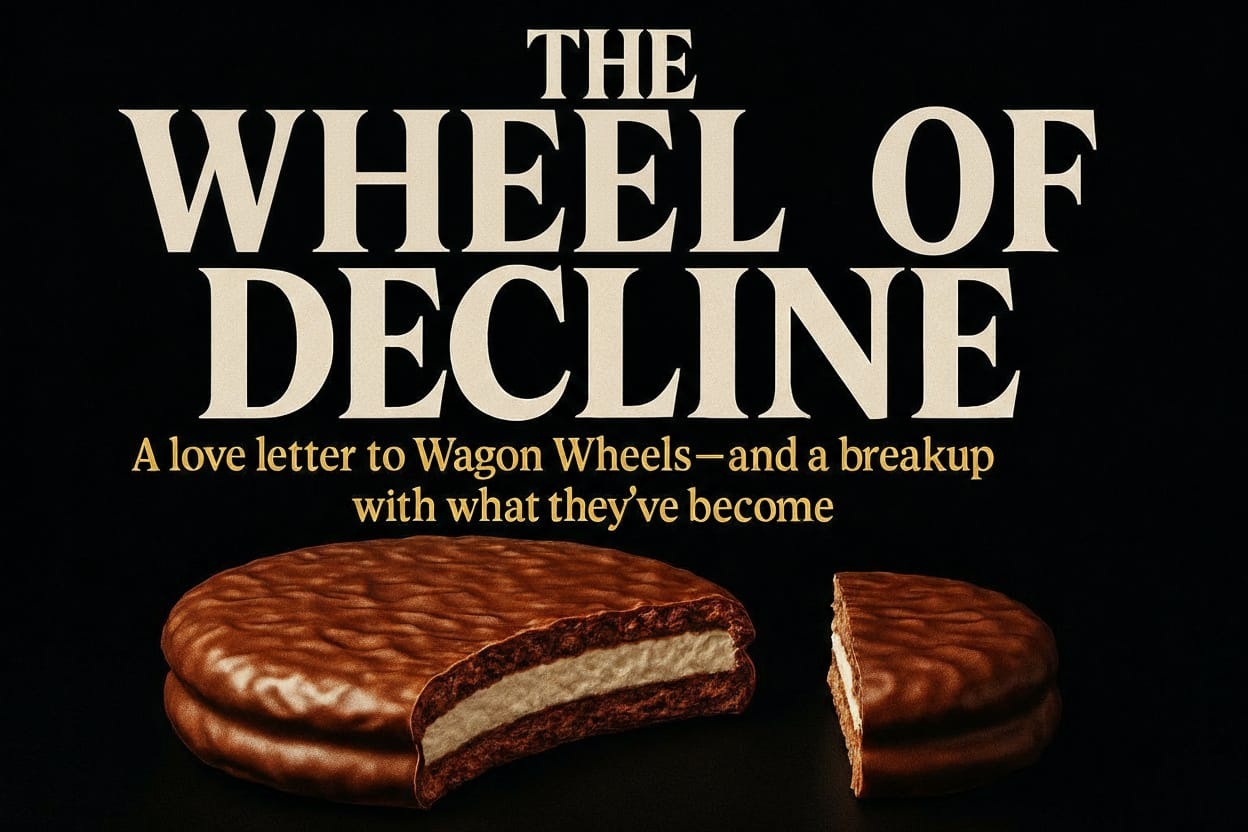
The Wheel of Decline
A love letter to Wagon Wheels—and a breakup with what they’ve become
JR Leach
Unlimited growth. It’s the logic that says a business making a tidy profit is, somehow, failing—unless next quarter is bigger, wider, taller, louder, forever. Growth without end. As if anything in the known universe behaves like that, beyond mould, death and taxes.
Once upon a time—and by that I mean from the dawn of bartering until fairly recently—you made a thing and, if other humans liked it, they gave you something for it. A shoemaker made shoes. If he sold two pairs in a month, that was a good month. No one turned up at his door to inform him that, because he’d sold two pairs in May, he must sell four in June or be a disgrace to the profession. He didn’t respond by thinning the leather, hollowing the heel and telling customers, with a brave little smile, that it was “the new lightweight range.” He just made good shoes and survived by being good at the thing he was good at.
But that’s not how it works now.
Now, we follow the model of perpetual growth. Profit must increase year by year, embroiling every business in a Highlander scenario where, if everyone follows this pattern through to the bitter end, there can be only one.
And if customers are finite—and they are—the growth eventually has to come from inside the business itself. Redundancy, “streamlining,” automating manual roles. Then onto the products. Subtraction as strategy: less mass, fewer ingredients, thinner layers, cheaper substitutes; change the recipe, redraw the packet, keep the name. Shrink the thing, save the margin, hope nobody notices—and if they do, tell them it’s always been like that. Then smile.
Enter: Wagon Wheels.
I love a Wagon Wheel.
Not a sophisticated love. Just the honest affection a child has for a circular object that promises chocolate, biscuit and marshmallow. They were, in memory, BIG; in that precise way childhood things are big. There was even a multipack phase with the cheeky innuendo printed right there on the plastic: “Size matters!” The sort of swagger that suggests a biscuit large enough to be a minor hazard.
And then, quietly, it wasn’t.
The Wagon Wheel slimmed down. The packet inflated with adjectives. The chocolate became “chocolate-flavoured coating,” which, as I’m writing it, is inflaming me no end. It’s incredibly common—have a look at chocolate snacks and see how often that phrase appears. These are the confectioners who make and sell “chocolate biscuits” and have somehow, along their long, miserly road, decided that genuine chocolate is a luxury tugging a little too aggressively on the purse strings. If it’s not chocolate, then what, on God’s green earth, is it? Meanwhile, the marshmallow turned foamy and rubber-like, while the jam—when present—developed a mysterious talent for being everywhere and nowhere all at once. It still said Wagon Wheel on the packet. The frontier canvas wagon quietly vanished from the branding, replaced with a bland, confident WAGON WHEEL. The price nudged north. The contents nudged south. Balance was achieved—if balance is the point where disappointment meets outrage.
It’s not just Wagon Wheels. It’s the Toblerone with a peak every twenty yards. The Yorkie that’s shed grams like a boxer at weigh-in. The bag of crisps that is half helium, half crumbs. Ice-cream tubs with concave bottoms so they look the same volume from the top. Cadbury’s Dairy Milk transmogrified by corporate alchemy into something suspiciously Hershey-adjacent.
“Same great taste!” they assure us, as I vomit quietly into my mouth, swallowing it back down to avoid embarrassment in the confectionery aisle.
Examples abound:
- Häagen-Dazs reducing US tubs from 16 fl oz to 14 fl oz.
- Toblerone bars trimmed from 200 g to 170 g (and later fiddled again with the gaps).
- Tetley teabags quietly travelling from boxes of 100 to 88.
- After Eights sliding from 200 g to 170 g.
- Cadbury multipacks (Crunchies, Double-deckers, etc) going from four to three.
- Cadbury Fingers losing two fingers per box.
- Roses and Heroes ‘tins’ shedding hundreds of grams while prices held firm.
- Pringles tubes lightened and shortened; crisps smaller, taste blander, price higher.
- Terry’s Chocolate Orange segments reshaped to smuggle in air.
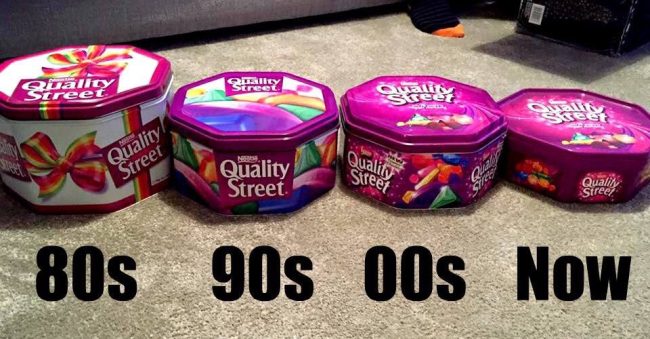
This is the phenomenon known as shrinkflation. One can hardly be surprised that, as things get more expensive, packaging gets smaller. But that isn’t the lie. The lie is that the product itself remains unchanged; it’s just the “portion size” that’s different. Sometimes, laughably, it’s sold as a public-spirited effort to combat obesity.
Equally rich is the argument that fluoride in UK drinking water is “to make people’s teeth better,” in a country that, in the past five years, has watched a record number of NHS dentists close their doors as we shuffle silently towards fully privatised dentistry.
Back to the Wheel.
There’s a moral vertigo to all this, because the companies aren’t necessarily lying in the way we want to catch them lying. They are doing something worse: moving the goalposts by millimetres, indefinitely, while we stare at the scoreboard. A percentage off the weight here, a millimetre off the diameter there, a new emulsifier with a whimsical codename, a “fresh” new wrapper. Or adding two more to the pack: “There you go—25% extra, free of charge—that’s what you want, isn’t it, you fat prick?”
You don’t see it happen; you wake up in a world where you need two snacks to equal one former snack, and you feel greedy for noticing. They claim, with a straight face—dutifully parroted at water-coolers—that “It’s just your childhood memory; you remember them being bigger because you were smaller,” which makes sense only if I were a moron without object permanence, still trying to squeeze into my old school jumper “because it used to fit.”
I’m not going to be gaslighted into thinking my perception is a by-product of nostalgic hands. Things are smaller—and not just smaller, shittier. Made of less while costing more.
Bread, for instance. Chalked bread used to be a punishable offence—stocks, fines, a day of public shame to discourage millers from blending economics into nutrition. Now, if a label says “fortified,” you suspect the medieval millers are back with clipboards: chalk (calcium carbonate, as listed in the ingredients) sold as “good for your bones.” If they can put rat poison in toothpaste and even the water supply “for dental health,” they can do anything—right down to permitting “safe limits” of arsenic in baby formula and soothing us with statements dense with caveats. We are the testing environment for someone else’s efficiency drive.
Am I overreacting? Or under-reacting?
Meanwhile, actual things are getting smaller. And stranger. And more expensive in ways that make you feel churlish for mentioning it. The cashier didn’t invent inflation. The teenager restocking the shelf didn’t re-specify the viscosity of the syrup formerly known as jam. The query has nowhere to go, so it goes back into the basket and becomes an apathetic sigh: “I suppose this is just how it is now.”
I keep coming back to the shoemaker. Not because I think economic history was ever pastoral—there were always tricks and punishments; fraud is as old as greed—but because the shoemaker could recognise his product a decade later. If he made boots in 1421 and, by 1431, those boots were one-fifth smaller, hollow-heeled and described as “heritage lightweight footwear,” somebody would have thrown the boot at him, not metaphorically. There were stocks. There were consequences.
Now there is customer service. You queue for forty minutes. You explain your disappointment to a pleasant person with no authority and a headset. You are offered a voucher: 10% off your next experience of the inferior thing you’re complaining about. The circle closes. The algorithm smiles.
This is the part where someone bright with a spreadsheet offers explanations. Fuel. Shipping. Global supply chains. Currency fluctuations. Wheat futures. Drought. Flood. Regulation. Deregulation. Some of that is relevant, sure, I’ll take their word for it. The planet is having a complicated century. But the answer to turbulence cannot always be “remove a gram and raise the price.” At some point the product ceases to be a product and becomes a branded accusation: “You’ll buy this anyway.”
We do, of course. Not because we are sheep but because we are busy, tired, distracted. Because, once you’ve shrunk the thing slowly enough, the old version becomes myth. Did Wagon Wheels ever really cover a child’s palm? Were the Toblerone peaks ever that close? Was chocolate ever, you know, chocolate? Memory is hazy. Marketing is not. They will always have the graphs and diagrams. You will always have the feeling. Guess which one wins.
There’s a future version of this that’s easy to picture because it’s already here in miniature. Picture 2050. Perhaps sugar is tightly controlled by then—rationed, taxed, redistributed as an occasional civic reward by Sir Jamie Oliver—and the Wagon Wheel survives as a concept. A commemorative token. A tiny disc the size of a blister plaster. The packaging describes a frontier treat of yesteryear. The disc tastes of sweetened air. A spokesman on a breakfast show assures us: “They’ve barely changed since 1980!”
We keep being told that choice is the cure for everything. Vote with your wallet. Very well. But what is the choice if every brand has learned the same trick? If the currency of trust is so eroded that the only reliable metric is the weight printed in tiny text near the barcode? “Compare unit price,” the frugal guides say, and just like that, snacks become a tax on fatigue.
And if you try to talk about it, you risk sounding like the man on a bench who corners strangers with long stories about how Mars Bars used to be a different species. You become the local historian of your own kitchen, a curator of receipts. It’s not a role anyone applies for; it’s a role assigned by a culture that keeps moving the line and asking you to ignore the chalk.
Does any of this matter? Only as much as taste matters. Only as much as honesty does. Only as much as the tiny, daily agreements between buyer and seller hold. If we keep accepting less and calling it normal, normal gets worse—incrementally, like a town that loses one bus route, then a post office, then the last decent pub, and wakes one morning feverishly proud of its new “artisan experience hub” and “cultural outreach centres,” which used to be a bakery and a library. No funding, no travel routes, and run by volunteers who resent working for free.
I don’t have solutions. I have a cupboard and a memory and a mild, continuous irritation threatening to become a hobby. I have a set of fingers that can tell, blindfolded, when a biscuit is thinner than it pretends to be.
So let’s end where we started: with the old frontier snack. The Wheel still rides on—thinner and faker—insisting it is the same as it ever was. Perhaps I am the one who changed: larger hand, larger mood, larger scepticism. Perhaps it’s all perspective, and the answer is to stop weighing confections and start weighing one’s soul.
Or perhaps the answer is simpler: weigh the thing anyway. Compare the numbers. Read the label. Keep the memory. Complain, if you have the energy. Laugh, if you lack it. Buy it, or don’t. But don’t let anyone tell you you imagined it.
Two questions, then, to end this polite little tragedy:
- What have you noticed change since yesteryear?
- And why is it shit now?

JR Leach is a fantasy author and graphic designer whose debut novel The Farmer and the Fald was published earlier this year. You can follow him on Twitter or Substack and see more of his work on his website
Thanks for reading...
You can help us keep doing what we do. Every little helps and is hugely appreciated.




For other ways to donate, including direct-transfer bank details click HERE.
 wpDiscuz