32

Jay Forrester & the Blueprints of Ecological Doom

David Fleming & Niall McCrae
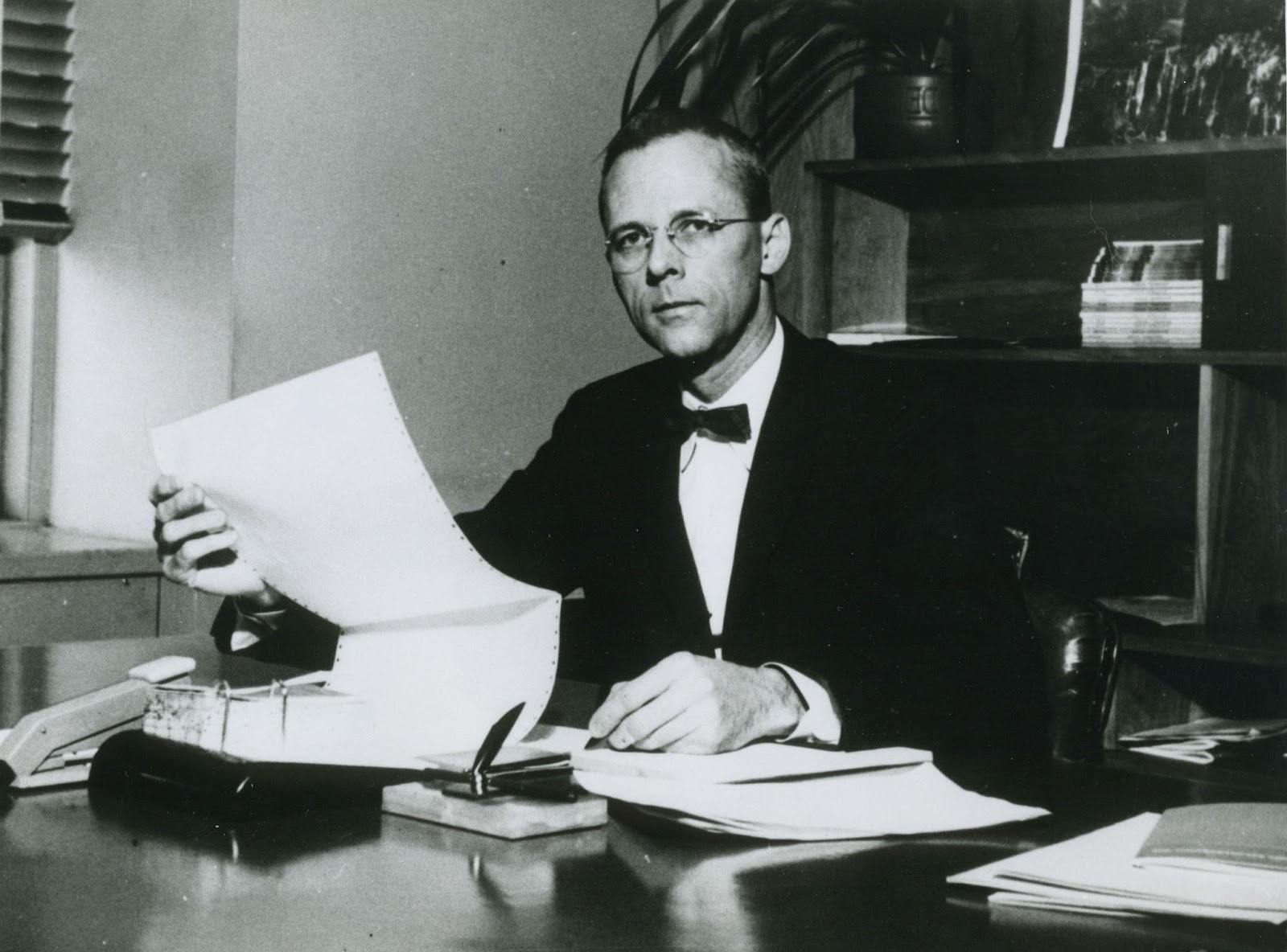
When the Club of Rome’s first report, The Limits to Growth, was published in 1972, the editor of the prestigious academic journal Nature was scathing. John Maddox criticised irresponsible scaremongering as ‘the Doomsday syndrome’, but he was rowing against the tide.

Broadsheet media and broadcasters publicised the report, and the Club of Rome succeeded in making ecological alarm the priority of the United Nations.

Arguably, Limits to Growth was one of the most destructive books ever written, although it was more a work of fantasy than fact. The report, produced by a team at Massachusetts Institute of Technology (MIT), was a development of the total world system dynamics of Jay Forrester.

Although Forrester was not one of the authors, he was the linchpin on which the narrative of planetary crisis revolved. His mathematical modelling produced a scientific basis for impending doom.

A spark from the plains

Jay Wright Forrester was born on a cattle ranch in Nebraska in 1916, and he lived till 98 years of age. He took an early interest in electricity, later graduating in electrical engineering at the University of Nebraska-Lincoln in 1939.

His first job was at MIT, where he completed a Master’s degree in electrical engineering, his thesis titled ‘Hydraulic Servomechanism Developments’. He developed flight simulators, and then led development of the Whirlwind computer, resolving some of the problems of limited data storage with his coincident-current magnetic core memory.

By 1956 Forrester was appointed to the new Sloan School of Management at MIT, where he pursued his interest in dynamic models of economic and industrial systems. In 1957 hereceived a research grant from the Ford Foundation to generatea scientific model of management and economics.

This five-year programme was later extended, amounting to fifteen years. His first output was the Industrial Dynamics, published in 1961. This book set the pattern for Forrester’s subsequent publications: the text is interspersed with flowcharts and formulae, giving his application of systems thinking a logical if not statistical precision.

Published in 1968, Urban Dynamics was the result of collaboration with John F Collins, former mayor of Boston. Major American cities were experiencing serious social problems by the 1960s, including high-density living, unemployment, crime and racial tension. Forrester argued that interventions were often ineffectual or counter-productive, because policy-makers were too simplistic, failing to understand the complex system of a metropolis.

Deliberately disregarding existing literature on urban policy and planning due to its limitations, Forrester proposed a new paradigm for determining how cities work and how to improve them. He concluded that ‘revival of the city depends not on massive programs of external aid but on changed internal administration’. Citing Kurt Lewin, founder of the action research model, Forrester’s solutions to problems entailing radical transformation of the city from how it had developed organically.

That the Ford Foundation was funding such social engineering was not unusual. Founded in 1936 to support research for the benefit of American society, it was the largest tax-exempt foundation. The Ford Foundation was prominent in René Wormser’s book Foundations: Their Power and Influence(1958), which described a heavy funding bias towards projects that undermined conservatism (often promoting collectivist ideology).

Also published in 1968, the workbook Principles of Systemsdefined a system as ‘a grouping of parts that operate together for a common purpose’. Forester’s focus was not on open systems but on those with a feedback loop (for example, inventory ordering). Feedback systems are purposive, with managerial input.

Going global

Forrester progressed from industry and society to all manmade and natural systems. World Dynamics was inspired by Forrester’s participation in a meeting of the Rockefeller-funded Club of Rome in Berne, on 29th June 1970.

In the preface to the second edition, Forrester linked the book, published in 1971, to Limits to Growth, which appeared nine months later. Indeed, he described the Club of Rome report as the ‘successor book’ to his own.

Like previous books, World Dynamics is replete with graphs and equations, and Forrester noted his surprise in the second edition (1973) at its wide reach, although it is unlikely that many readers of the highly publicised Limits to Growth also read Forrester’s turgid prose. The two books, he stated, became ‘the center of spirited controversy’.

Reaction was polarised, with environmentalists, social scientists and corporate leaders approving, while economists expressed concern about the costs of curtailing economic growth.

Twelve months earlier, Forrester had attended the Club of Rome meeting in Bern, which led to members of the group spending two weeks at MIT in Cambridge, Massachusetts, whereForrester demonstrated his total world system. The Club of Rome began its Project on the Predicament of Mankind with a statement on the ‘problematique’ by founders Alexander King, Aurelio Peccei and other members. The system dynamics modelling of Forrester appealed to the Club of Rome, which wanted to change from the open system of growth to a feedback system of managed equilibrium.

The Club of Rome instituted a research programme at MIT as phase one of their project. The team of seventeen was assembled by Forrester, led by Professor Dennis Meadows and sponsored by the Volkswagen Foundation to apply globalsystem dynamic to five growth-limiting factors: accelerating industrialisation, rapidly rising population, malnutrition, depletion of finite resources and pollution.

Although Limits to Growth is written in accessible language, it contains dozens of charts that are not easily decipherable to the lay reader. The authors were Donella and Dennis Meadows, Jørgen Randers and William W Behrens III. The foreword introduced the Club of Rome, which was until then hardly known: –

The Club of Rome remains an informal international association, with a membership that has now grown to approximately seventy persons of twenty-five nationalities. None of its members holds public office, not does the group seek to express any single ideological, political or national point of view. All are united, however, by their overriding conviction that the major problems facing mankind are of such complexity and are so interrelated that traditional institutions and policies are no longer able to cope with them.

Like the technocracy movement in the 1930s, the Club of Rome was avowedly apolitical, because its planned system would have no need for politicians or ideological debate. Arguably, with its similar agenda of total control of population and resources, it was Technocracy Inc revived.

The heat is on

The Club of Rome had been running for four years by the time of its first report, the initial membership of thirty gathering at the Accademia dei Lincei in Rome (as stated in the Limits to Growth preface), and at David Rockefeller’s estate at Bellagio(as not stated in the Limits of Growth preface). Despite his family’s prominent role in ‘Big Oil’, Rockefeller saw the potential of climate change in pursuit of one-world government, but he avoided any publicity.

Taking a stance against consumerism and free-market economics, the Club of Rome portrayed capitalism as the enemy of nature; radically restructured economic system, globally regulated, was necessary to avert breakdown of life on Earth. Iturged curbs on population and consumption, and an end to economic growth. Paul Driessen and Ron Arnold noted that Limits to Growth ‘introduced three fateful concepts to a mass audience: computer modelling designed to predict future conditions; anthropogenic climate change; the notion that global catastrophes can be managed only by strong government’.

According to the authors, their model for a global system was tentative, and they avoided the sensational and extreme claims made in 1968 by Paul Ehrlich’s Population Bomb. They predicted that if no remedial action were taken, the limits to growth would be reached within a hundred years, when a sudden and uncontrollable decline in industry and population would occur.

The solutions would be sustainability and equality, neither of these goals achievable through existing structures of national governments and market forces Concerted global action was necessary.

The report ended by urging creation of ‘a world forum where statesmen, policy-makers and scientists can discuss the dangers and hopes for the future global system without the constraints of formal intergovernmental negotiation’.

In the same month of publication of Limits to Growth, the UN hosted the first Conference on the Human Environment in Stockholm. The bullish organiser was Canadian oilman Maurice Strong, a protégé of David Rockefeller, while Forrester and MIT were the scientific wing of the movement.

The Club of Rome hoped that the computer simulations by MIT, which quantified the hazards for humanity, people would awaken to their plight and demand action. A limitation of the first phase, though, was global aggregation of all factors. Limits to Growth was followed in 1974 by Mankind at the Turning Point. The second report was considerably more alarmist. It presented a world integration model in which data were disaggregated to show trends and predictions at national level.

Systems analysts Mihaijlo Mesarovic and Eduard Pestel described a hierarchical world, with interrelating individual, group, demographic-economic, technology and environment strata.

The Mesarovic-Peatel model was criticised by The Global 2000 Report to the President: Entering the Twenty-First Century, a bulky report produced by the Council on Environmental Quality and the State Department, commissioned by President Jimmy Carter:

The Mesarovic-Pestel world model is hard to keep track of. It is not a single entity but an evolving stream of integrating concepts. As with most large models, neither the pressures nor the incentives exist to document this stream in a fashion to make it easy and understandable to anyone other than those involved in the model-building process.

The biggest difficulty, however, was that the models and implications were, as the Global 2000 Report described, unpalatable to poor nations of the world operating in the hope that growth would eventually extricate them from their poverty’. This led to a more pragmatic approach with variable targets based on GDO and other factors, but this caused further controversy. There is only one planet, bt some countries would be allowed to continue industrial development fuelled by coal and gas.

Seeing the wood for the trees

When Forrester attended the Club of Rome meeting in Bern in 1970, global population was less than half that of today. By 1975 it reached four billion, and it is now between eight and nine billion. This is the one prediction that the MIT modellers got right. Their other predicted adversities, all related to population and consumption, were either overestimations or the impact was exaggerated.

Highlighted in the challenges described in World Dynamics is that of too many people. The prophecy of Thomas Malthus of population growth surpassing food production did not deserve its current discredit, Forrester argued: the conclusion was not erroneous but incomplete. Forrester omitted mention of Ehrlich, although the theme of The Population Bomb is writ large in World Dynamics. Ehrlich warned that food shortage would lead to wars, causing widespread famine and death of billions of people (by the 1980s, he believed).

Forrester made eight thousand million the crisis level for global population, as ‘the point beyond which the pressures become severe’. He asserted:

Population generates the pressures to support growth of population. But supporting the growth leads to more population. Growth will stop only in the face of enough pressure to suppress the internal dynamic forces of expansion.

In his conclusion to World Dynamics, Forrester warned of severe implications, although written in less sensational language than that of Ehrlich:

Social stress means loss of freedom, increasing futility, more conflict between the citizen and his government, and greater inter-group antagonism. Those who advocate technological advances as an escape from the growth dilemma may be taking a short-sighted view. They fail to see the internal transfers that occur in a tightly coupled social system. More technology can momentarily reduce physical stress, lead to continued growth, increase population density, intensify social pressure, require more governmental coordination, reduce freedom, overload the new technology, and require still more technological advance. The process is less and less effective at greater and great cost as the social and physical limits become more confining.

Yet the Club of Rome – and Forrester – must have known that global population had passed its peak of escalation. In 1964 the rate of increase slowed for the first time, and it has been reducing ever since. In the West, population had already stabilised by 1970, with fertility reduced by the contraceptive pill, legalised abortion, feminism, decriminalising of homosexuality and higher living standards. Population in the poorer regions of Africa and Asia continued to grow rapidly, where the birth rate was high and infant mortality was declining.

Several major countries are now in population decline: China, Russia, Germany, Spain, Italy, the entirety of eastern Europe, Japan, South Korea, Thailand and Cuba. This was predictable in the 1960s, because (apart from China, where the one-child policy was imposed in 1979) the statistical trend was already clear. The Club of Rome, Ehrlich and Forrester focused on the amount of people rather than the changing rate of growth. They implied a law of multiplication, when they (at least Forrester, as a scientific modeller) should have seen the parabola.

The case is closed

In 1989 the Club of Rome held a meeting at Hanover, and decided to take stock. Having sold ten million copies, Limits to Growth had achieved its objective of stimulating awareness and concern. By the 1980s the emphasis was on a new threat to humanity: global warming, The front cover of The First Global Revolution, a report written by Alexander King and Bertrand Schneider in 1991, had on the front cover an image of our planet in flames. The book has two chapters, on the ‘problematique’ and the resolutique’.

The First Global Revolution is an activist missive. Gone are the mathematical diagrams of Forrester and MIT, who had served their purpose. Unwittingly, their earnest statistical systems analysis was used for the message soon to be stamped with authority on climate change: ‘the science is settled’.

Forrester was undoubtedly a brilliant scholar, but his models were exploited by a misanthropic elite bent on creating a new world order that will impoverish, enslave and depopulate.

This is how and why the Club of Rome got its mits on MIT. Scholars tend not to be averse to large grants and the resulting career advancement and publicity. We are told to follow the science, but often the scientists are following the money.

We must conclude, however, that Forrester was a willing accomplice to the distortion of human prospect.

Niall McCrae is a social commentator and an officer iof the Workers of England trade union. He was previously a senior lecturer in mental health at King’s College London. His books include The Moon and Madness (2012), Echoes from the Corridors (with Peter Nolan, 2016), Moralitis: a Cultural Virus (with Robert Oulds, 2020) and Green in Tooth and Claw: the Misanthropic Mission of Climate Alarm (2024).  He writes regularly for The Light newspaper.
David Fleming is a writer and founder of Continuism, the philosophy of human continuity. His work explores how humanity can protect its life, knowledge, and spirit in the face of accelerating technocratic control. He writes regularly on his Substack about philosophy, culture, and the future of human continuity.

SUPPORT OFFGUARDIAN

If you enjoy OffG's content, please help us make our monthly fund-raising goal and keep the site alive.

For other ways to donate, including direct-transfer bank details click HERE.

Categories: latest
Subscribe
Notify of
guest

32 Comments
newest
oldest most voted
Inline Feedbacks
View all comments
NixonScraypes
NixonScraypes
Nov 3, 2025 7:17 PM

According to Richard Werner- growth is a statistical illusion. He’s the only economist I’ve found who works from facts not theories in the field of economics ie maximum deception and actually tells the truth. So I figure that “limits to growth” is just another of the ruler’s confidence tricks. I’m not an economist an academic or an accountant so this is not investment advice.

The Real Edwige
The Real Edwige
Nov 3, 2025 8:26 AM

The Fraud gets interested in depopulation when they can blame it on the “right”:

https://dumptheguardian.com/world/2025/nov/03/new-zealand-economy-record-numbers-leave-why-people-choosing-australia

sandy
sandy
Nov 2, 2025 6:20 PM

UNDER SAM’S “PENDING” CLOUD:

Ok, so let’s assume that anything that gets published by the capitalist oligarchy and pushed forward, for instance by the UN, is deeply flawed attempts to corral the behavior of humanity, to maintain their authority over the future. These “plans” are rolled out by the rich for the rich, because no one else can get a place at the table of public discussion so the public can vet ideas of value. Elites rule, they dictate policy, they dictate access and availability, they dictate the ecosystem of ideas. I get it. We get it. But isn’t it time to quit pointing out their stupid ideas, which now are every idea, and start offering up a discussion of viable ideas?

The problem here is that some of the idiot’s ideas merit discussion. “Limits to growth”, on it’s own, is one obvious good idea on a finite, resource limited planet ruled by capitalist oligarchy demanding infinite growth. But because of published propaganda efforts like “Limits to Growth” and “Agenda 2020” and other such treatises coin terms of value, like limits to growth, there is too much knee jerk reaction to evaluating each idea on it’s own merit. This becomes a form of false binary neutralization of public discussion of valid solutions. We need to stop reacting and start thinking and discussing.

Degrowth and moving from a growth economy to a maintenance economy seems an obvious next step for Humanity. Population voluntarily stabilizing to available resources with total consideration of all aspects to affect maximum equality of rights to survive and thrive, this includes flora, fauna and Earth’s ecosystems, is just a rational next step. However, this eliminates elite rule, and that is why we never hear discussion of these things. They have totalitarian control over what the public sees and hears. Their stupid plans like the Great Reset and different forms of cloaked eugenics (technocracy, transhumanism) theory are obvious throwaways for us. Getting to a just and equal solution of self-governing a fully occupied planet is our next step and all ideas should be openly explored and vetted.

(But after saying all this, here will come the system programmed intellectual nihilists who will say YOU can’t do this, your full of crap because humanity is just incapable, being mostly couch potatoes and worthless slackers. This, is the REAL BULLSHIT LIE the elite have engineered many people to believe. A total mindwipe of human history.)

[And Sam, I have NEVER entered into this space, or any online venue, under any other identity than my name, anywhere on the net, NO MATTER WHAT YOU ERRONEOUSLY THINK. Take me off this PENDING CRAP and disappearing and reappearing my posts.]

Whatever
Whatever
Nov 7, 2025 1:49 AM
Reply to  sandy

Well Sandy, I must say it is refreshing to read a post composed of grammatically correct and compete sentences that makes a convincing argument. So many of the comments on this site, and others, sound more like a baboon that has swallowed a dictionary. I basically agree with your sentiments, but even if I didn’t I would still give you kudos for your clarity.

sandy
sandy
Nov 7, 2025 7:30 PM
Reply to  Whatever

Thanks Whatever. Much appreciated. I do try to make coherent written arguments. Writing online has helped this visual artist wrangle words, so I can get by in this language oriented civilization. Now, if I can get Admin here to stop stalking me like a squirrel, all will be fine. 😉

You can see my visual art here…

https://sandys.art
https://www.saatchiart.com/sandysanders
https://www.flickr.com/photos/44388581@N05

Johnny
Johnny
Nov 2, 2025 9:43 AM

‘Everyone is 12 Now’

https://consortiumnews.com/

Really Caitlin?
Extrapolating from that, many of us were only 7 five years ago.

No wonder so many believed the LIES.

Chris_Mr
Chris_Mr
Nov 2, 2025 8:41 AM

The “space” eating monster has been h e r e ! Where did they all go?

The Real Edwige
The Real Edwige
Nov 2, 2025 8:40 AM

“Aurelio Peccei”

“Ex”-Fascist, implicated in Gladio and the man who secured for Argentina the Exocet missiles used in the Falklands War.

Good article.

tafeex
tafeex
Nov 2, 2025 8:38 AM

Now one can see the shilling in real time.
How the hell is this outdated, poorly constructed , weak crap of a cat litter tray article, and what does this have to do with anything in a 2025 and how is this going to inform us?
If Oz, New Zealand or Labour England had government shutdowns affecting hundreds of millions or Agenda 25 or Big Beautiful Bill, Kit would have published nine articles by now by all of his not very different clone authors.

I am visiting different blogs and comments to find out what is happening.

Maybe his handlers are that confident in covering up the latest that they ram in a useless bunch of articles and then flood pro-Jesus crap bots in the comment section.

Johnny
Johnny
Nov 2, 2025 9:24 AM
Reply to  tafeex

There are more things in Heaven and Earth Horatio _ _ _ _

Johnny
Johnny
Nov 2, 2025 7:55 AM

BTW. Is that Maddox or Forrester at the top?
Whoever it is, he looks like he’s got a radical punk hairstyle.

les online
les online
Nov 2, 2025 6:01 AM

BBB. ‘Bad luck, Bad Genes, but never Bad Medicine.’
Genetic determinism… The weaponization of genetics:

https://unbekoming.substack.com/p/the-genetic-alibi-how-wayne-bennetts

mgeo
mgeo
Nov 3, 2025 4:07 AM
Reply to  les online

Fixing your bad genes is the Next Big Thing.

les online
les online
Nov 2, 2025 2:52 AM

Australia’s economy is a consumer economy. It relies mostly on the non-stop
influx of migrants to keep buying things for its health, so the government can
tax their consumption; taxes, some of which the government passes onto me
as an Old Age Pension…
So, while i may privately think “There’s effin’ Too Many People !”, i refrain, because
if the government put the brakes on new potential consumers flooding into the
country – it could, it would, result in a pension cut, and probably a BIG CUT at that !!

Johnny
Johnny
Nov 2, 2025 3:13 AM
Reply to  les online

If they started taxing the multi national corporations (some of who pay zero tax) like they tax the working class, there would be enough money to double the pension.

And if they reduced our military budget (which is corporate welfare for the MIC) there would be enough money for social housing, hospitals and public education.

And _ _ _ _ so on and so on.

Lulu
Lulu
Nov 2, 2025 6:20 AM
Reply to  Johnny

Absolutely!
Why can so few people see this?!!!

mgeo
mgeo
Nov 3, 2025 4:17 AM
Reply to  Johnny

Holding the job/prosperity creators or big entrepreneurs violates the religion of greed and growth. The “science” of economics says so. Progressive tax, clean-up of environmental and communal poisoning, and jail for harmful/fraudulent products/services do not pply to those who have governments in their pockets.

tafeex
tafeex
Nov 2, 2025 9:00 AM
Reply to  les online

So, while I may privately think, “There are effin’ too many people !”, I refrain, because if the government put the brakes on new potential consumers flooding into the country – it could, it would, result in a pension cut, and probably a big cut at that!

Les online congratulations on seeing the reality. The whole system is built on that. Ten Pound Poms were British citizens who migrated immigrants to Australia and New Zealand after the Second World War , hence the name Pommy.

In Europe and the East, several businesses I know went bust during COVID, as most of their income came from tourists and migrants. The UK’s biggest and oldest travel agent went bust during COVID: Thomas Cook.

London died like most cities and was dead £$ for 2 years during COVID; ask the cabbies . All the monuments in the fake historical books need to keep the lie going by having tourists (migrants) from all over the world visiting them.

At my old uni, 70% of the attendees are upper middle class from other countries. Uni towns would be financially in trouble, and 70% of the businesses would be closed if they did not have the attendees . Apply this to migrants, and then you’ll see clearly why they add to the economy and help create it.

Rolling Rock
Rolling Rock
Nov 2, 2025 1:37 PM
Reply to  tafeex

The UK’s biggest and oldest travel agent went bust during COVID: Thomas Cook.

It went bust because PAYING tourists could not go on holiday. It’s business model was not based on migrants going for a taxpayer funded jolly to Benidorm.

At my old uni, 70% of the attendees….

So you went to Uni, which degree was it? Clearly not English language since you then write:

by having tourists (migrants) from all over the world visiting them.

You must have a strange dictionary – since when are tourists migrants?

Tourists visit for a short time and then go home. They PAY for their hotels rooms – unlike some migrants. Tourists spend their OWN money in local restuarants, bars and shops. In some places the economy is largely based on tourism. Swap those tourists for welfare (taxpayer) funded migrants and/or illegal ones without freebies and watch how the economy would collapse.

The foreign students that you talk of are also temporary. Unless they overstay their visa, which most do not. They too PAY for tuition fees, accomodation and living expenses.

tafeex
tafeex
Nov 2, 2025 3:16 PM
Reply to  Rolling Rock

Do they offer degrees in hanging out in Primark ladies’ changing rooms, Diddy Epstein of OG ?
No one asked for your opinion, now run along and screenshot every comment . If you’re fast enough , TK Maxx is closing in an hour. Go smell the ladies’ changing room there. You weirdo Perv.

Rolling Rock
Rolling Rock
Nov 2, 2025 3:42 PM
Reply to  tafeex

I see you are giving your main ID ‘Hail’ a rest today.

No one asked for your opinion

Did anyone ask for yours?

So, other opinion is not welcome here Miss Hail if it does not agree with yours.

You’re psychotic schizophrenic loon, who needs so many IDs to give your boring, repetitive opinions. Same shit, different day with a different moniker.

Now Leroy your pimp told me that he wasn’t happy with you wasting time on here. You should be out performing tricks. Now off you go to the local migrant hotel to blow some of them and see if they think you’re worth a few coins from their benefits.

Earn your keep Miss Hail, otherwise no crack for you until you do. Your junkie mates will be disappointed if you arrive back at the squat empty-handed.

Veri Tas
Veri Tas
Nov 2, 2025 8:41 PM
Reply to  les online

It looks more like Australia’s economy is houses (debt to the banksters) and holes (profits going to multinationals overseas), plus the export of everything useful they can extract from this land, including live animals. And let’s not forget disease – the disease industry is Australia’s No. 1 employer and accounts for the largest slice of the government’s budgetary spending. Ordinary buying of things does not appear to be the biggest money spinner.

The influx of Africans and Indians – let’s not blame them, either; every human reflex is to try and do better for themselves and their family, isn’t it? – as I said, the influx from overseas is so as to hike the housing/investment market even further by tightening supply.

And then there are the bought and paid for (from big industry) universities who receive a tidy sum from overseas students from whom they can extract extra high fees compared with fee from Australians. Centres of true learning no more.

Erik Nielsen.
Erik Nielsen.
Nov 2, 2025 1:10 AM

It confirm my own idea that the guilt or responsible for much of the bs we face today is a system. It is some ideological structure, not a single President nor group or sheeple.

We (should) fight against stupid ideas who dont hold any water. Take for example Global Warming later renamed to Clima Change, which is quite simply the ‘weather that change’.

The earth circulate around the sun and come sometimes a little closer, and sometimes a little far from the sun, it cant be a perfect circulation all the time.
Then we have tropic ages of +40C and opposite we have ice ages of -40C.

The regulating planets are securing this system remain within this closed frame. So what can you do? The keyword is Adaption. WE adapt ourselves to this system!

When it rains, we take a raincoat on, and so on and on.

But when you are a Professor inside a closed university laboratory and your connections are only to people who have their nose down in global economic affairs, your sight become too narrow and you miss the overall view you would have got if you were a believer!

Did you know the design of the fresh water cycle to all living on the earth is described in the Bible as the ONLY book of all books. NO other book describe it!

Proverbs 1:7 MSG Start with GOD — the first step in learning is bowing to GOD; only fools thumb their noses at such wisdom and learning.

Johnny
Johnny
Nov 2, 2025 12:53 AM

Taking care of planet Earth is just common sense. We are part of the ecology so it’s only logical that we shouldn’t shit in our ‘nest’.

The economy is another thing altogether. A truly successful economy is not about growth, it’s about equality of distribution.

Limits to growth? Didn’t see any signs of that among the oligarchy during the $camdemic.

mgeo
mgeo
Nov 2, 2025 7:32 AM
Reply to  Johnny

As others pointed out here earlier, a principal purpose of the global scam was to
(a) rescue the biggest transnational speculators (drowning in the jammed financial economy for months) with huge handouts of government/public money
(b) keep this money out of the productive economy (to prevent hyper-inflation) by practically locking it down.

Veri Tas
Veri Tas
Nov 1, 2025 10:39 PM

Mathematical modelling is a scientific basis for anything?! Well, my crystal ball tells a different story. The population is in decline except in a handful of countries. However, give the war mongers and vaxx fascists a chance, will ya, and you’ll see the decline progress even faster.

les online
les online
Nov 1, 2025 9:56 PM

“Equality: All slaves are Equal. No slave shall be More Equal than others” … (anon) ,,,

Clutching at straws
Clutching at straws
Nov 1, 2025 9:40 PM

Wikipedia says that the Club of Rome is a non-profit organisation dedicated to discussing global problems.

And all you can do is pour scorn on their philanthropism.

Shame on you !!

Republicofscotland
Republicofscotland
Nov 1, 2025 8:29 PM

The Club of Rome, and the Ford Foundation, are both entities of the super rich and the deep state – reducing the population of the planet would be right up their street.

https://wikispooks.com/wiki/Club_of_Rome

https://wikispooks.com/wiki/Ford_Foundation

Aloysius
Aloysius
Nov 1, 2025 7:36 PM

Oh, population is still going up. Just not europeans and their relatives on other continents.

Erik Nielsen.
Erik Nielsen.
Nov 2, 2025 12:43 AM
Reply to  Aloysius

Crawling from small boats ashore on our borders, walking like zombies into our cities, stealing our houses, raping our daughters, taking our jobs, and drinking our beers.

Only because they get more and more people and we get less and less, a white minority group of sweet nice people exploited and used for THEIR benefit, and not for our.
America and England after the invasion!comment image .

Johnny
Johnny
Nov 2, 2025 3:16 AM
Reply to  Erik Nielsen.

Tis Karma.
We invaded them to exploit their resources and labour.
They ‘invade’ us.