Experts agree: There is no such thing as “Super Flu”.
Kit Knightly





Currently, the headlines all across the United Kingdom, and a handful of other nations, are full of references to “Super Flu”.
There is no such thing as “Super Flu”.
It is a term with no scientific meaning or even a solid definition. To confirm this we need look no further than this report from Channel 4 News:
NHS England is calling it a ‘super flu’, which is in fact its own phrase rather than anything scientific.
Or, even more tellingly, there is Devi Shridhar — the High Priestess of Covid hysteria herself — whose Guardian column is headlined “Don’t Call it the Super Flu”, and begins:
I should start by saying “super flu” is not a scientific term or one used by any academics or clinicians I work with. It’s a colloquial phrase that’s been used by various NHS England bosses and taken up by Wes Streeting, the health secretary, and Keir Starmer.
That’s that then. The experts have spoken: “Super Flu” is a colloquial phrase with no actual meaning.
So why does everyone keep describing the incipient flu season in those terms?
To quote Shridar again:
Amid all the noise, it’s difficult to know how bad this flu really is – and how much is political spin.
Isn’t it just?
Maybe it’s time we found out how bad this flu really is, and what about it (if anything) is “super”.
First, we should ask: Doe this flu have different symptoms? Or are the symptoms more severe?
It doesn’t, and they are not, as Dr Giuseppe Aragona tells the Independent [emphasis added]:
The symptoms and severity of H3N2 illness have been similar to seasonal flu, including fever, cough, runny nose, and possibly other symptoms, such as body aches, vomiting, or diarrhoea.
Ok, so its symptoms are common and not unusually severe. Then maybe it’s more transmissible? Or deadly?
Nope. At least, not according to the WHO experts quoted in Politico [emphasis added]:
While hospital admissions have been rising sharply due to the early arrival of flu season, there is currently no evidence that this season’s variant is more deadly or transmissible, experts at the World Health Organization (WHO) and the European Centre for Disease Prevention and Control (ECDC) told POLITICO.
OK, let’s sum up what we know so far:
- This flu has no unusual symptoms.
- Its symptoms are not unusually severe.
- It is not any more transmissible than normal.
- It is no more deadly than normal.
It seems there is nothing even odd about this flu, let alone “super”.
A lot of the news coverage is focusing on the potential danger to the NHS, with headlines warning this is “beyond catastrophic” and “pushing the NHS to the brink”.
But anyone with a half-decent memory, or the ability to Google, will tell you that headlines warning of overcrowded hospitals or a “winter crisis” are a yearly tradition in the UK:
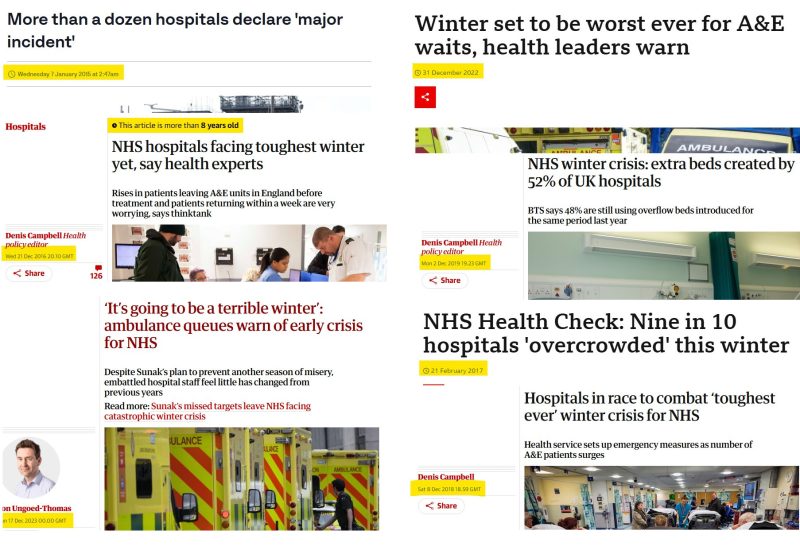
The BBC explainer Flu in five charts – how this year’s winter outbreak is different even quotes experts who point this out, and notes that the NHS isn’t close to breaking point [emphasis added]:
Health experts at the King’s Fund think tank have said talk of an “unrelenting flu wave” has become worryingly familiar over recent years. But Chris Streather, the medical director for the NHS in London, said the situation was “well within the boundaries” of what the NHS could cope with.
So, it’s not an unusual flu, the NHS is not unusually strained, and there’s no overcrowding at all (so far).
The only aspect that seems even vaguely out of the ordinary is the timing. The BBC’s first graph displays this:

Looking at this graph (supposing it’s based on actual data) you can see the flu season spike starts roughly a week earlier than recent years. Some outlets are calling this unprecedented, but they are only comparing it to the last three or four years, so we have no idea if that’s true. The rate of increase is inline with the past, and it appears to be peaking already.
The government figures show the number of people visiting their GPs with “influenza-like illness” is basically normal, if again spiking slightly earlier than average:

A little search engine research will get you similar figures going back to 1999/2000, all spiking in-and-around week 49.
Likewise, the number of people being admitted to the hospital for flu is normal for the time of year:

Let us summarize one last time. The super flu:
- Has common symptoms.
- Of regular severity.
- It isn’t unusually infectious.
- Or especially deadly.
- The NHS isn’t more crowded than normal
- And is well within thresholds.
- A normal number of people are going to the GP.
- Resulting in a predictable rate of hospitalization.
Hardly “super”, is it?
None of this is “conspiracy theorist” stuff either, it is all mainstream data. These are the “experts” we’re supposed to listen to and the “science” we’re encouraged to follow.
And yet we’re faced with this bizarre situation, where the news in general is telling everyone to be scared, while the specifics go out of their way to highlight the fact there is, as yet, nothing at all to be scared of.
It all feels oddly familiar, doesn’t it?
Thanks for reading...
You can help us keep doing what we do. Every little helps and is hugely appreciated.
For other ways to donate, including direct-transfer bank details click HERE.



I will beg to differ. Something, I don’t know what, kicked my butt worse than anything I’ve ever had. It’s been 3 weeks now and I am finally getting a bit better. I won’t go into details other than to say I truly felt like I was dying. And no – I am not vaxxed. I was very healthly. For about 8 days I couldn’t eat or sleep. I’ve lost 15 pounds and feel weak as a newborn. Whatever it was it sure felt like something out of a lab. Prob was.
Are you covid and or flu vaccinated?
Can I see their isolation paper for this H3N2 bollocks disease cos I bet the methods used are just the same as for all their other claimed “strains” and “variants” of other made up viruses.
Dancing nurses.
Free cheeseburgers.
People “dropping dead” on Chinese streets.
Government backing.
The gullibility of the masses still makes me chuckle today.
It is all super-flu-ous! A.k.a. a load of bollox (yet again).
https://alphaandomegacloud.wordpress.com/2025/12/14/double-whammy-of-flu-and-strikes-a-risk-to-patients-streeting-says-bbc-11-december-2025/
Gubbermint mandated “Oxygen deprivation therapy”….a simple method to make morons retards.
Not Safe, Not Effective — 376 Ways That Face Masks Are Known To Harm The Wearer
They want you dead…please obey and show your solidarity. Thank you.
https://www.lewrockwell.com/2022/01/allan-stevo/not-safe-not-effective-376-ways-that-face-masks-are-known-to-harm-the-wearer/
YOU are the disease, our pharma cartel death squirts the cure. Get the shots and be boosted. The life you save won’t be your own.
Ministry of Bullshit
Onward to the long overdue co££ap$€ of their worthless fiat filth……. and their next virUS!
https://goldprice.org/gold-price-per-gram.html
I will still never forget that David Sencer, the serving director of the U.S. CDC b/w 1966 and 1977, admitted in an on-camera interview that the impetus and haste – and consequential accompanying media fear mongering – to roll out ‘Swine Flu vaccines’ in 1976 was predicated on “several”, “unconfirmed”, “media reports” originating in Australia.
David Getoff (Youtube Channel) | “60 Minutes CBS News Swine Flu 1976
” | 14m:21s | [ https://youtu.be/mPCmDF9db5U ]
“do masks actually work against the flu?The short answer is that the evidence remains surprisingly weak” (love that “surprisingly”!)
“this strain is quite different from the one used in this year’s vaccine.”
“They also concluded that N95 masks (tight-fitting, high-filtration masks) were no better than surgical masks in everyday settings”
“Better-quality studies, such as randomised trials, generally found little or no benefit. In contrast, weaker study designs were more likely to suggest that masks worked.”
https://theconversation.com/as-flu-cases-spike-is-it-time-to-start-wearing-masks-again-271904
So altogether, masks of whatever type don’t work, only junk science ever said they did and neither does the vaccine. Only five years too late….
P.S. Just returned from my third trip out Christmas shopping in the last week and I finally saw one person wearing a mask.
With RFK Jr and Trump they have now made medication cool again
I do honestly wonder if this is because the uptake on flu shot offers has been very low, to the extent that this soon turns into an expensive failure, as the Use by dates are exceeded and batches get binned.
I don’t think the poison jabs have a use by date but it is a good excuse to dump it somewhere to poison the water instead.
I’ll never forget that psy op and going to the hospital cos I’d come off my bike, it was like 28 days later, completely empty. Yet the teevee were painting a different picture. I knew is was BS before I even went in, but it was nice to have it confirmed. “Oh this isn’t a big hospital, the big city ones are heaving” lol right, that makes sense for a worldwide emergency..
“Long covid” = “vaccine” damage.
Cold and flu = ordinary seasonal detox.
I’ve had neither since leaving the office, despite breathing in all manner of crap on building sites.
Offices with air-conditioning can be bad, even downright dangerous. Cost-cutting (bean-counting) means less periodic maintenance. For a centralised system, even such maintenance does not addess the insides of the ducts going all over the building. Indoor renovation allowed while you are work is another danger, e.g., fumes from the adhesives used when replacing floor carpets.
“Ottawa is full of highly educated individuals.”
‘A city of a million: Ottawa by the numbers
Jun 16, 2019
https://www.cbc.ca/news/canada/ottawa/ottawa-by-the-numbers-1.5163982
–
Health officials brace for a severe flu season, urge people to get vaccinated
Elizabeth Payne
Oct 30, 2025
https://ottawacitizen.com/news/severe-flu-season-vaccinated
–
‘Flu blamed in deaths of 3 children in Ottawa area this month
With files from Jayden Dill and Andrew Foote
Dec 15, 2025
https://www.cbc.ca/news/canada/ottawa/ottawa-eohu-flu-child-deaths-2025-9.7016118
–
“Three children between the ages of five and nine died from complications of influenza this month, health officials from Ottawa Public Health and the Eastern Ontario Health Unit said in a statement on Monday.
Officials aren’t releasing further information on the children, including whether or not they were vaccinated against flu or had any underlying health issues, but did note all three lived in the Ottawa area.”
‘Flu circulating at ‘sky-high’ levels among kids, teens as experts brace for worsening wave of infections
Lauren Pelley
Dec 16, 2025
https://www.cbc.ca/news/health/kids-teens-flu-deaths-ontario-9.7018018
–
On the Wildness Children
https://carolblack.org/on-the-wildness-of-children
–
Robert Miles – Children
https://youtu.be/DvyCbevQbtI
Hyperbolic fear porn – absolutely normal.
Is it a bird? Is it a plane?
I’ve never seen a wild animal with a cold or flu. Only injury or manmade poison slows them down. We can be just as healthy. Don’t take poison – in food, pill or injection form. That’s all you have to do. Cold and flu come from poison intake and lack of otium. Otium is also necessary for maximum good health.
Only one niggle: I am afraid of the NHS or whatever it calls itself.
If you’re around the age of life expectancy and die with a positive flu test…
The flu gets the credit even though age is the factor.
If you have multiple comorbidities and die with a “virus”, the virus gets blamed.
Virology is horse shit.
Flu is a fallback or default to explain deaths from scientific medicine. E.g., heart meds may damage the kidneys. Prolonged meds for both illnesses kill essential microbes, causing (a) phlegm in lungs (b) poor thinking due to lack or mess-up of neuro-transmitters. For someone who died recently, specilaists could not resolve phlegm that persisted for over a year.
I have never in my life attended a GP because I have “flu-like” symptoms. Why do stupid sheep do that? Just have a hot-whiskey with honey and cloves and rest a bit.
> I have never in my life attended a GP because I have “flu-like” symptoms. Why do stupid sheep do that?
Ditto – what’s up with these people?
The NHS is based on a failed, drug-based medical system which is largely ineffective, and (through adverse drug reactions, discounted as “side effects”) causes serious illness and disease. So each winter, for a long as I can remember, the NHS has a ‘winter crisis’. Rather than admit that it has no treatment, and it’s vaccines are ineffective, it constructs a new disease to deflect blame from its total failure. Since the bonanza of drug taking since the NHS was established in 1948 we have become progressively sicker, evidenced by epidemic levels of chronic disease, from allergy, arthritis, autism, dementia, diabetes, et al. Most (if not all) chronic diseases are known to be a ‘side effect’ of pharmaceutical drugs – it is in conventional medical literature, and printed on Patient Information Leaflets. Yet the medical profession, the NHS, Government, and the mainstream media omit to tell us this. I wonder why?!!?
The “vaccines” are the major means to sustain the illness and profits. Pills are no better.
Isn’t it the case that government has the power to ahnilitate anyone spreading mis/pis/dis information…of the kind “beware the”superflu(ous)”?
Yawn , modernity
More and more people are not taking vaccines, so they are just trying the fear tactic to get people to take the Flu vaccine. It’s a big business, with a lot of money involved.
Here in the Northeast USA Walgreen’s is offering a 20% discount on your purchase (whatever it is you purchase) with a covid vaccine.
The stafff are wearing T shirts that say Get Your Vaccine (or some such drivel)
And of course, advertisements with old people smiling that tout “get your Covid AND flu shot together!”
And the beat goes on.
I see two big ads every day when I go to work (Germany), one for the flu shot, one for HPV I think. Don’t think I’ve ever seen big ads like these in public before 2020. There are also multiple ads for “organ donation”, which I also never saw in the old days, but maybe I never noticed them.
Sounds like the US want to invade European medicine, so they can bankrupt anyone needing medical treatment.
…And that’s how you know that alot of people are refusing them, and more and more every day. They are inadvertently revealing it.
“there is Devi Shridhar — the High Priestess of Covid hysteria herself”
From Green and Fazi, The Covid Consensus, p.219:
“This mainstream narrative was often created by drawing on scientific experts who strayed very far from their established fields of expertise: Devi Sridhar wrote over forty op-eds for the ‘Guardian’ intwo years, having no expertise in immunology, vaccines, or infectious diseases, but rather having trained in medical anthropolgy, with an MPhil which focused on malnutrition in Tamil Nadu”.
As pointed out by nobody who ever demanded to see your degree in Virology when you questioned the mainstream narrative….
Devi Lalita Sridhar anagrams to:
They say better the devil you know than the one you don’t….
Exactly. You can be sure that the Guardian and the BBC won’t be ‘fact-checking’ these claims of ‘experts’ or their fellow journalists, though, just the common sense of ordinary people.
Almost everyone’s to blame, except you know who:
https://www.globalresearch.ca/israel-exploits-bondi-beach-shootings/5909421
Yeah, Islam.
That peaceful radical ideology frozen in 632 BCE. Moh gave the good example: polygamy, looting, slavery, misogyny, pedophilia, corporal punishments etc. Bottom 7th century culture, subhuman in the 21th. The Romans had destroyed Israel in 70 BCE, so that excuse can’t be ponied up by the out of touch Leftover woke or Rightious Christ!ians.
BCE = CE
And all the other religions are supreme examples of Love and peace?
Gimme a fucking break.
Any ideology that is frozen in time becomes a hindrance later, including secular ones like capitalism, socialism and communism.
The problem is Homo sapiens’ govern-mental incapacitates and its emotional herd instincts. The way out is Intuition but to notice that one has to derail the former two old patterns. The solution is literally just above our heads.
They will always remain ‘frozen in time’ because they are hierarchical.
Authority IS addictive:
• Money
• Sex
• Control
All self destructive, pathetic substitutes for Love.
Yay, yay, have you read the Torah? Pony up man..
1921 was the first meeting and the koran came out then.
Grok has lost the plot. Deliberately:
https://dissidentvoice.org/2025/12/how-often-do-ais-lie-and-censor/
Ex aUStralian politician, and once the most senior Chosen person in aUStralian politics, Josh Frydenberg, has pointed the finger:
“Guns may have stolen the life of 15 innocent civilians, but it was radical Islamist ideology that pulled the trigger.”
No mention of Netanyahu’s ongoing genocide in his accusation of Islamist ‘incubators of hate’.
Short memory perhaps. Very short.
More here:
https://www.abc.net.au/news/2025-12-17/frydenberg-s-fury-at-bondi-attack-royal-commission-calls/106154546
Let’s cut to the scientific products being marketed or “mandated”:
Flu and pneumococcus jabs cause dementia and death.
https://www.thefocalpoints.com/p/study-common-vaccines-linked-to-38/comment/185287505
https://pubmed.ncbi.nlm.nih.gov/36542511/
Jabbed children (given 81 jabs in US) suffered more harm in 22 categories.
The increase was 26% for “Neurological disorder”, 54% for Cancer, 128% for Food allergy, 180% for Autism, 216% for Seizure, 250% for “Chronic illness”, 386% for Atopic disease, 412% for “Developmental delay”, 553% for Asthma, 696% for “Mental health disorder”, 803% for Speech disorder, 810% for Motor disability, 1,120% for “Autoimmune disease”, +1,254% for “Overall neurodevelopmental illness”.
Only the jabbed (and none of the unjabbed) suffered from “Brain dysfunction”, Diabetes, ADHD, “Behavioral disability”, “Learning disability”, “Intellectual disability”, Tics, “Other mental disability”.
https://www.globalresearch.ca/henry-ford-birth-cohort-study-finds-vaccinated-children-sicker-22-chronic-disease/5908854
Common (OTC) medicines are dangerous.
https://www.globalresearch.ca/tylenol-cause-chronic-illnesses-like-autism/5903827 <-OTC med. dangers
The information machine has transcended beyond the need for internal-coherence.
Instead of creating different sources for the Sheep and the tin foil hat conspiracy loons, the new approach is to satisfy all customers by writing everything into one story and repeating it everywhere.
The skim readers and headline listeners can go off and buy masks and jabs, and feel self-righteous.
The loons can refuse all that and fume and argue, and feel self-righteous.
And because each “side” is so entrenched they don’t even spot the inconsistency.
It is quite clever and efficient and a massive FU flex by the agenda setters
Super BS or SBS, the Guardian and BBC leap it up like a puppies do mother’s milk.
Just sack all staff there and use AI: way cheaper and less fake begging / indignation.
Or are they on it already: could well be?
Chocolate bars have gotten smaller – for the same price…
Christmas festivities time cometh and the Chocolate pushers are aggressively
promoting on tv their wonderous boxes of varied mini-chocolate bars… Comparing
prices, you’re paying more for less. These boxes of mini-chocolates seemed to have
become more popular with each shrinkage of standard cholate bars… Somehow,
having a box full of shrunken chocolate bars feels like compensation for the
downsizing of traditional standard size chocolate bars ?
Shrinkflation…
There is more sugar in the chocolate. So, they are being considerate by shrinking them.
When it comes to the severity of symptoms Experts should butt out. They
are not qualified; quantity is their field of expertise…
Everyone knows ‘Severity is a quality’.’ As such, ‘Beauty is in the eyes of the
beholder, and Severity is in the sneezes of the sneezer.’
Maybe that should read ‘Severity is in the experience of the sneezer’…
The ‘flu i had last time was The Worst Ever, and i’ll not let any bloody Expert
insist i’m wrong !!
And if you want Scientific Proof (Quantity), i used more boxes of tissues
than ever before…
Why not? Trump called it ‘a little worse than flue’ about ‘the Corona virus from China’.
A little worse than flue could quite possible be called a super flue among the guys in the pub.
So maybe we in the pub will continue to call it super flu, while you ‘experts’ or ‘scientists’ can call it what you want.
Coronary respiratory nano integrative electrolyte syndrome for example.
The five REAL plagues of the 21st century:
• Fear
• Greed
• Gullibility
• Social Media
• Ai
Billionaires/trillionaires.
politicians
What? I’m flabbergasted.
Next they’ll be telling us there’s no Superman either.
When i complained to The Doctor that this year’s bout of ‘flu
was severer than last year’s, he told me “It’s all in your head !”
Brilliant Diagnosis, And to think he paid thousands to qualify to
make that Diagnosis… (I’m gonna be a Doctor in my Next Life !!)
You must admit you cant say anything against it. It requires a loooong thinking pause to relate to that one.
But, Super Flu rhythmn with Supa Glue, So it Must be True !
that should be ‘rhymes with’…
For Christmas i want the ‘edit’ function re-installed !! Please, Santa !!
So it must be … super-true? 😉
This is no such thing as any virus!! Virology is a fraud and germ theory is a lie!
Yes, but this theory is good for BigPharma business. Here’s a lighthearted, yet thought-provoking expose on germ theory by Steve Falconer.
And, Santa Claus’ ?
Deja vu with covid. The hysterical predictions weren’t confirmed by the actual statistics. And that was so even right from the start.
But on the topic of public gullibility, I had a depressing exchange today at work whilst discussing the oddities about the Bondi Beach shooting. I was pointing out all those ludicrous coincidences with e.g. Oct 7 survivors and my work colleague’s eyes got bigger and bigger and she said, “Wow what are the chances of that?” And I realised she was taking it all at face value. When I made clear to her how ridiculous it was, she instantly changed the topic to something news related but dumb.
And I realised she’d confirmed that theory about The Big Lie. Nobody wants to disbelieve a big lie. They can snigger at the little ones.
That’s why the news can spin as much shit as it wants over the major issues. “Oh they surely wouldn’t lie about that!”
Unbekoming recently posted an essay about that phenomenon:
The Mechanics of Stable Falsehood
https://unbekoming.substack.com/p/the-mechanics-of-stable-falsehood
I think the the idea explains why everyone supports Civilisation – They’ve
all got a stake in it; same goes for their support for the (bio-)security state…
They want to break the habit but their resistance wont let them !!
This essay was excellent. Oughta be republished here at Off-G
If that is a reference to the Plandemic, then I dont think that is the case this time.
During the Plandemic the MSM ran with fear porn headlines and stories which the so-called experts – those who were the preferred partners and therefore given airtime – backed up.
There were the likes of Susan Witchy Michie and her nudge unit along with Ferguson’s infamous modelling and the chuckle brothers Vallance and Whitty with their nightly grim reaper routine. This pantomime was repeated across the world with many countries having a similar routine and their own cast of characters.
Yet, now there are experts downplaying the flu headlines and they are given airtime by the MSM to do so. This includes experts such as Devi Shridhar and those from the WHO. These are not rengades, they are Agenda agents.
That begs the question, why?
So, either it has been decided that the flu narrative is a non-starter, since the public is not buying it, so it needs to kicked into the long grass.
Or, such agenda experts are being quoted to rebuild trust and credibility by rightly and honestly exposing the sensationalism of the current flu fear porn. Perhaps, such an exercise needs to be repeated a few times during as yet unknown (to the public) forthcoming events so that if and when Plandemic 2 gets the green light, the preferred ‘experts’ will once again be listened to.
You have to also remember with the plandemic that their “experts” were at first telling the public that masks were useless and no one should bother wearing them, then the next day flipping the script and saying masks were super effective and saved lives, and that it was everyone’s duty to wear them. I guess it’s some sort of psychopathic mind game technique to sow fear and confusion.
Not sure what’s going to happen, no one here does, but it’s worth noting that in late 2019/early 2020 covid’s supposed severity was downplayed by the “experts”, politicians and the media in the West. Then in March a switch was flipped and it was the end of the world. Virtually overnight all of the previous assessments counted for noting.
Sorry…counted for nothing.
This is a classic tactic in Information Operations.
Downplay, to gain credibility, is one aspect. Another is to push simultaneously contradictory narratives to create confusion and anxiety.
It would also make sense if the next step was, say, the merging of bird flu (H5N1) and this clade K (H3N2) in either an animal or human host, and then, the third leg of this unfolding psyop becomes more clear: why they’ve been laying the groundwork using the terms ‘super,’ or ‘catastrophic,’ and further explains the escalating narrative surrounding bird flu cases, specifically H5 variants, as it plays into a planned event.
Why now?
Exercise Pegasus, Bird Flu Summit, WHO exercises, NYC bird flu exercise, another in Texas, as well as Netherlands and elsewhere, as well as WHO IHRs passed, indicate (among other reasons), why this has a better than even chance of being their next planned event (it’ll play a little differently however, regional lockdowns, encephalitis, target kids, and significantly shorter than the ‘vid’).
https://open.substack.com/pub/thestraightjuice/p/is-bird-flu-the-next-pandemic?r=288p2b&utm_campaign=post&utm_medium=web&showWelcomeOnShare=false
It reminds me a bit of the fake ‘swine flu’ and ‘bird flu’ ‘pandemics’ about 15 years ago. They tried the fear tactic for a little bit, with a little bit of success (like the ‘vaccine’ that caused narcolepsy for oen of these fake flu exercises, I lost track at some point).
But the majority wasn’t buying it and you could see doctors on tv who called out the fear tactic and said there wasn’t much to worry about. Every year there was some new supposed illness and most people I knew made fun of it: “Oh, let’s see what flu they have for us this year. How about dog flu?”
With the first reports about this ‘Wuhan flu’ in December or so, it was the same. People made fun of it and nobody was worried. Then in February/March, like others have said, a complete turn, 24/7 fear porn. And all of the people who had made fun of it alongside me all of a sudden called the people who still didn’t buy it ‘Covid deniers’ or ‘conspiracy theorists’.
So maybe you’re right and for the next few winters it’s time for the ‘don’t worry about it too much’ card, before they bring out the big guns again.
https://grok.com/imagine/post/ae924fa3-243c-4ad3-8913-1c7afe53dee3?source=copy_link&platform=android
Think about it:
Even if you accept the official numbers, 1 in 2,600 kids who get the COVID shot develop myocarditis… that’s a life long, life threatening injury.
Now think Disney.
Top rides move 17,000 – 30,000 people/kids a day. At that rate, it’s roughly 11 kids a day ending up with sudden heart damage. If Disney rides were destroying the lives of 11 or more children a day, the parks would be shut down and investigated immediately, wouldn’t they? Harry fisher
Just trying to share something, man. I’m sorry, but pending for that I just don’t understand.
Big Pharma investors need their money.
The influenza vaccine market is on the cusp of a transformative era, driven by recurring seasonal demand, technological innovation, and a growing recognition of vaccines as critical tools for public health. For investors, this convergence of factors creates a compelling case for long-term exposure to pharmaceutical companies like Pfizer and Moderna (MRNA), which are at the forefront of flu vaccine R&D and production. Their stock performance and strategic investments suggest these equities could thrive as seasonal flu surges become a recurring revenue driver.
“The influenza vaccine market is on the cusp of a transformative era, driven by recurring seasonal demand, technological innovation, and a growing recognition of vaccines as critical tools for public health. For investors, this convergence of factors creates a compelling case for long-term exposure to pharmaceutical companies like Pfizer and Moderna (MRNA), which are at the forefront of flu vaccine R&D and production. Their stock performance and strategic investments suggest these equities could thrive as seasonal flu surges become a recurring revenue driver.”
The Flu Vaccine Boom: Why Pharma Stocks Are Heating Up With Each Seasonal Surge (6/13/25)
“The influenza vaccine market is on the cusp of a transformative era, driven by recurring seasonal demand, technological innovation, and a growing recognition of vaccines as critical tools for public health. For investors, this convergence of factors creates a compelling case for long-term exposure to pharmaceutical companies like Pfizer and Moderna (MRNA), which are at the forefront of flu vaccine R&D and production. Their stock performance and strategic investments suggest these equities could thrive as seasonal flu surges become a recurring revenue driver.”
“So why does everyone keep describing the incipient flu season in those terms?”
It’s pretty obvious –
The Flu Vaccine Boom: Why Pharma Stocks Are Heating Up With Each Seasonal Surge (6/13/25)
“The influenza vaccine market is on the cusp of a transformative era, driven by recurring seasonal demand, technological innovation, and a growing recognition of vaccines as critical tools for public health. For investors, this convergence of factors creates a compelling case for long-term exposure to pharmaceutical companies like Pfizer and Moderna (MRNA), which are at the forefront of flu vaccine R&D and production. Their stock performance and strategic investments suggest these equities could thrive as seasonal flu surges become a recurring revenue driver.”
Big Pharma is like the MIC, it’s a beast that needs feeding and the propaganda is like war propaganda, lies, deceptions, scare tactics, same playbook.
les online’s doctor above has a point: Its all inside your(people’s) head.
I have personally never experienced any flue nor influenza, only a few droplets from the nose in winter.
So from my perspective it seems to be a nocebo effect. So people imagine they have headache, fever, respiratory issues, and have it because they imagine they have it.
As God spoke the world into existence, people speak their symptoms into existence because they wanted them to exist.
I mean headache, fever, snotty nose, its all diffuse issues.
And Big Pharma? Off course they will give people what they need: A Nanny medicine.
“Your mom is back to her little boy with warm tea and cookies”.
The flu mystery resolved once and for all.
Its has the same hallmarks of the covid mSm alt media + lot who all had the worse
flu ever during covid. (translated: they believe it was weaponized engineered)
super flu exists to them types and they reckon there awake.