The Filton Six: The People Rule, OK? – Part 1
Iain Davis





Over this article and the next (published in a few days), we will explore the true significance of the ruling in the case of the Filton Six. Mainstream media propagandists, the government and the Establishment, their favoured social media commentator partners—whose reach is amplified by the algorithms, and the corrupted echelons of the judiciary, are desperate to deny reality.
The jury’s ruling in the trial of the Filton Six—six of the Filton Twenty Four—reaffirms the jury’s constitutional right to judge the application of the law of the land, in accordance with their conscience, based on the evidence.
The jury’s decision lays the constitutional truth bare: it is the people, through trial by jury, who rule the nation by judging the law.
For the UK government to continue to serve as a functional oligarchy, it is an Establishment imperative that the people never realise or, more importantly, never exercise their constitutional rights and liberties.
Consequently, the UK propaganda machine is in top gear, furiously trying to ensure the government gets its desired win-win from its prosecutions of the remaining Filton Nineteen—one of the Filton Six is still incarcerated on remand—and its desired retrial of the Filton Six.
We will discuss this political context in Part 2. First, we’ll focus on what happened during the trial of the Filton Six and, crucially, what didn’t.
The Jury’s Ruling
As Israel’s largest defence firm, Elbit Systems’ business includes selling munitions, drones, guided rocket systems, reconnaissance, and surveillance technology to Israel’s military. The ongoing genocide of the Palestinians by the Israeli government has seen Elbit Systems’ global revenue increase by 14%. Elbit Systems and its shareholders profited handsomely from the Israeli government’s mass murder of at least 17,000 Palestinian children.
Elbit Systems UK claimed that the allegation it supplied weapons and weapons technology to the Israeli Military were “completely false.” This was not true.
Elbit Systems UK sits within a UK-based weapons system manufacturing ecosystem. Through its joint ventures with multinational defence contractors like Thales, and by operating through its subsidiaries like Instro Precision Limited, Elbit Systems UK is able to export military technology to Israel both directly and through a kind of export licensing shell-game facilitated by the UK government.
The trial of the Filton Six began on 17th November 2025 in Woolwich Crown Court. That the Filton Six had broken into the Elbit Systems UK’s factory in August 2024, and that they used tools—chisels, crowbars, and sledgehammers, etc.,—to destroy as much equipment and weaponry as they could, was not contested by the defence.
The Six were charged with aggravated burglary (contrary to s.10 of Theft Act 1968), criminal damage (s.1 of Criminal Damage Act 1971), and violent disorder (s.2 of Public Order Act 1986). One defendant was additionally charged with causing grievous bodily harm with intent (contrary to s.18 of the Offences Against the Person Act 1861). The Six pleaded “not guilty” to all charges.
From the defendant’s perspective, aggravated burglary was the most serious charge. If found guilty they could and, in all likelihood, would have been sentenced to life imprisonment. The jury found all defendants “not guilty” of that offence.
Three were found “not guilty” of violent disorder. The jury was hung on the same charge for the remaining three defendants and on the charge of grievous bodily harm with intent for one of the defendants.
This means three or more of the jury could not agree to find the defendants guilty, or not guilty, as charged. A majority verdict either way could not be reached. The jury was also hung in respect the charge of criminal damage for all six defendants.
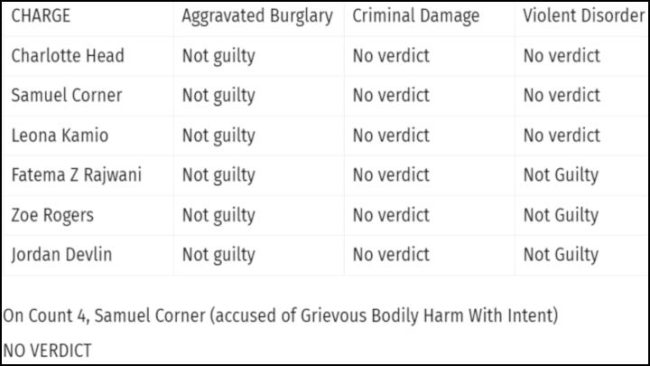
It is a fundamental principle in common law that everyone is innocent until proven guilty. None of the Filton Six have been found guilty of any crime. All are innocent. This is a fact.
Simon Myerson KC (King’s Council)—who describes himself as an “obnoxious Zionist”—was not involved in the trial but offered his opinion on the verdict. He said the jury was not convinced by the evidence that any of the Six had taken the sledgehammers, or any other tools, to the break-in with “the express purpose” of causing “grievous bodily harm.”
Myerson said it was not necessary for the jury to consider Elbit Systems’ complicity in genocide in order to find the Six not guilty of aggravated burglary. This was fair comment. Based solely on the evidence, the legal threshold for the aggravated burglary charge was not met.
The evidence indicated that excessive force was used by the former special forces private security contractors—Minerva Elite—when they initially tackled the activists. This included using whips and sledgehammers to assault the Filton Six. A spontaneous physical altercation ensued between a couple of the activists and security. The fracas continued when the police arrived. The evidence did not demonstrate that any of the Six had planned or intended to use sledgehammers, or anything else, as weapons.
The jury was shown footage of one of the defendants, Samuel Corner, striking a female police officer—Sergeant Evans—on the back with a sledgehammer. The prosecution used the term “fractured spine” to describe her injury. That description, conjuring images of life-changing injury and paralysis, was somewhat misleading. Sergeant Evans did, however, suffer a hairline fracture to one of her vertebra.
The jury learned that Sergeant Evans could walk unaided following the blows. They were told that doctors didn’t initially diagnose Sergeant Evan’s injury because it was not visible in initial X-rays nor in a subsequent MRI scan. The jury also heard that, following eventual diagnosis, Sergeant Evans was advised to take painkillers and undertake some physiotherapy to treat an injury that is unlikely to leave her with any lasting impairment—thankfully. The evidence did not to support the charge of grievous bodily harm.
The jury also heard that, prior to striking Sergeant Evans, Corner was sprayed in the face with an incapacitating and painful PAVA spray and was unable to see much from that point onward. The jury discovered that Corner said, at the scene, that he was trying to protect his friend and female fellow activist Leona Kamio.
Kamio had been tasered twice, handcuffed, and was being knelt on while Sergeant Evans assisted with her restraint. She was in considerable pain. Corner evidently responded to Kamio’s distress and, as described by another responding police officer, Kamio’s “blood curdling screams.” The jury heard evidence that Corner had acted in defence of another.
In short, irrespective of their reasons for participating in the break-in, there was no evidence presented to the court that the defendants had any prior plan to attack anyone with anything. The prior intention, required to demonstrate both aggravated burglary and “grievous bodily harm with intent,” wasn’t remotely demonstrated beyond reasonable doubt.
Therefore, it is not surprising that the jury declared the Six not guilty of aggravated burglary and could not agree on the grievous bodily harm charge. Similarly, their acquittal of three of the Six on violent disorder, and refusal to convict the other three on that charge is equally understandable given the evidence.
What is harder to understand is why the government’s Crown Prosecution Service (CPS) would prosecute the Six with charges that were not warranted in the first place. The truth is, this was done because the prosecution was politically motivated. We’ll cover this in Part 2.
Turning his attention to the hung decision on criminal damage, Myerson opined that it was “unlikely the jury were persuaded that what happened in Gaza was an excuse,” though he conceded “[s]ome of them may have been sympathetic to that argument.” His assertion that Elbit Systems’ conduct wasn’t particularly relevant to the jury’s ruling on criminal damage, and his insinuation that the part Elbit Systems played in genocide was not a factor more widely considered by the jury, is plainly wrong.
Though none of us are privy to the jury’s near 37 hour deliberations, enough of the jury clearly did see Elbit Systems’ participation in genocide as an important strand of the Filton Six’s defence argument.
Lawful Excuse
The only defence the Six had against the charge of criminal damage was that they had lawful excuse. To uphold this defence, the jury needed to be convinced that the defendants caused the damage in a lawful attempt to prevent a far worse crime. In this case, that worse crime was genocide.
The jury asked the judge, Mr Justice Johnson:
If we decide that they [the defendants] genuinely believe that they were performing life-saving action and were morally compelled to destroy weapons they believed were going to be used to kill civilians in what they believe to be an illegal genocide, would that amount to a lawful excuse?
In response, Mr Justice Johnson told the jury:
[T]hat would not count as a lawful excuse, and I will give you full directions on this issue at the end of the case.
Prior to the jury retiring to consider their verdicts, in his subsequent “full directions,” the judge informed the jury:
As I told you when you asked a question about this, if a defendant believed that they were morally justified in doing what they did to prevent what they thought was a genocide, then that would not amount to a lawful excuse. There is no evidence in this case of anything that is capable in law of amounting to a lawful excuse, so that is not something that you need to consider.
Thanks to RealMedia—who covered the trial in full—we have a record of the defence evidence and arguments. This includes the inspiring and brave closing statement, defending barrister Rajiv Menon KC addressed the judge’s ruling on the lawful excuse defence.
[T]he answer to the [jury’s] question was that the judge had already ruled as a matter of law, before hearing from the defendants, that they did not have a lawful excuse for damaging property belonging to Elbit Systems. [. . .] [W]hat’s happened is that His Lordship has withdrawn that defence as a matter of law, and that’s the true position that we find ourselves in. Their [the defendants’] challenge was lawful excuse and the court has withdrawn that as a lawful defence. So where does that leave you, the members of the jury?
Menon then outlined precisely where the jury found themselves. He was careful to frame his argument to avoid possible contempt of court charges. For his self preservation, Rajiv Menon KC artfully stressed that Johnson had not directed the jury to find the defendants guilty.
His Lordship is not directing you to convict. In fact, not only is he not directing you to convict, but he’s also absolutely forbidden from doing so as a matter of law. The law is crystal clear on this point. No judge in any criminal case is allowed to direct a jury to convict any defendant of any criminal charge, whatever the evidence might be. That is the law.
The case has now concluded and all of us are free to retrospectively criticise and comment on the rulings issued by Johnson. In my personal, lay opinion, Johnson clearly directed the jury to convict. Mr Justice Johnson told the jury to “follow the legal directions I’ve given you and not anything else.” He acted unlawfully in my view.
For example, With regard to the charge of criminal damage, in oral session, having denied their right to the statutory defence of lawful excuse, Mr Justice Johnson directed the jury as follows:
[The criminal damage charge is] unlikely to cause you difficulty, given there was no dispute that the defendants who had given evidence at least intentionally damaged property in Elbit’s premises.
In light of what I alone contend were Mr Justice Johnson directions to the jury to convict, Menon accurately described the jury’s constitutional lawful rights and liberties:
[N]obody, not even His Lordship, can direct you as to what factual conclusions to reach. Nobody, not even His Lordship, can direct you to convict. It’s as simple as that. That’s the law. [. . .] [O]ur system does allow judges to make comment and express opinion, even strongly, in certain circumstances. As long [. . .] as any judicial opinion or comment is not wrongly expressed as a legal direction that you must follow. So if His Lordship does decide to express an opinion on the evidence, please do not, under any circumstances, misinterpret that opinion as a legal direction, because it is not. Obviously, if you agree with the judge’s opinion, you may adopt it. But the opposite is equally true. If you don’t agree with the judge’s opinion, you may reject it. That is your right. That is your privilege, as jurors, because I repeat, you are the sole judges of the facts. Nobody, not even His Lordship, can direct you to convict in this case.
As a point of law, and as defined in our constitution, everything Rajiv Menon KC said is factually correct. A sufficient number of the jury were demonstrably convinced by the defence’s argument.
Despite apparently clear directions to convict—issued by Mr Justice Johnson—the jury ruled that justice would not be served simply by applying the relevant legislation, under which the defendants were prosecuted, without considering other factors. Manifestly, in the specific circumstances of the case, a significant proportion of jurors found that Elbit Systems UK’s complicity in genocide did provide the defendants with lawful excuse for their actions.
Again, contradicting the subsequent claims made by some commentators, and in defiance of the directions issued by the judge, the members of the jury who accepted the lawful excuse defence did so based on the evidence.
Rajiv Menon KC reminded the jury that Mr Justice Johnson had:
[R]estricted what the defendants have been allowed to tell you on what they knew about Elbit and what they knew about Elbit’s role on the Israeli attack on Gaza. The consequence of that is that you do not know everything that the defendants knew about Elbit before each of them individually decided to take that major step of getting involved in the action against the factory in Filton.
The jury learned that Elbit System was a “massive weapons company that has played a critical role in the killing of 10s of 1000s of Palestinians.” They were made aware of crucial evidence and the suppression of evidence and had both reason and just cause to believe that the activists’ lawful excuse defence was applicable.
Furthermore, the jury knew that critical CCTV evidence was “missing” and that the prosecution had selected footage from just five of the twelve available cameras. The jury was expected to believe that that the absence of the “missing” CCTV evidence was due to “slow frame rates” on all but the five selected cameras in the £35 million, highly sensitive and fiercely secured manufacturing plant.
They were also encouraged by the prosecution to accept that body-worn cameras, used by the elite military-trained security team, only worked intermittently. Under cross-examination, every single witness for the prosecution, who alleged aggravated burglary and violent disorder, changed their statements in court when presented with CCTV evidence that contradicted their initial accounts and claims.
The jury also learned that USB sticks sealed in Metropolitan Police evidence bags were found in Elbit Systems UK’s safe shortly before the trial began. When DS Sarah Grant was asked why she seemingly provided some of this evidence to Elbit Systems, many months prior to the trial commencing, she said she knew nothing about it and couldn’t explain it.
As reported by Craig Murray, the jury knew “evidence collected and apparently correctly bagged by the police had simply been handed over to Elbit, apparently for over a year.” Therefore, the jury had sound reasons to suspect “collusion between Elbit and the UK state, including the police.”
Regardless of the political context, and irrespective of whatever they were told to believe by the prosecution and the judge, the jury heard and saw the evidence that brought the prosecution into considerable doubt.
In the case of the Filton Six, the jury’s constitutional duty was to ascertain if the unmitigated enforcement of the Public Order Act 1986 and the Offences Against the Person Act 1861 would serve justice in the defendant’s case. The jury found that it would not, because the defendants did not intend to use violence and three of the activists were not violent at all.
Similarly, the jury did not agree that the Theft Act 1968 and the Criminal Damage Act 1971 could be used to justly punish the defendants. It is abundantly clear that a number of jurors found that the activists had lawful excuse for their actions.
The jury and only the jury judges the facts. The jury and only the jury determines the application of the law.
The people rule, OK?

Iain Davis is an independent journalist a researcher from the UK. You can read more of Iain’s work at his blog IainDavis.com (Formerly InThisTogether) or follow him on Twitter or subscribe to his SubStack. His book Pseudopandemic, is now available, in both in kindle and paperback, from Amazon and other sellers. You can claim a free copy of his new book “The Manchester Attack” by subscribing to his newsletter.
Thanks for reading...
You can help us keep doing what we do. Every little helps and is hugely appreciated.
For other ways to donate, including direct-transfer bank details click HERE.



This ruling by the High Court is encouaging, but, as always, we must remain open to the possibility that a narrative is beging played out and things are not as they Seem. Here is a word of caution Form Craig Murray: https://www.craigmurray.org.uk/archives/2026/02/postpone-the-celebrations/
The below of course isn’t true – at least 10,000 North Korean troops fought, and defeated a mixture of Ukrainian and Nato troops in the Russia province of Kursk, many North Korean troops were killed – as were Nato and Ukrainian forces – Kursk was liberated.
North Korean President Kim Jong Un has sworn to give more North Korean troops to Russian forces, if – and when they need them.
Then there’s China helping Russia with logistics and materials – not to mention buying a shitload of Russian oil and gas.
“EU’s Kaja Kallas to Mike Waltz:
When Russia goes to war, they go alone because they don’t have allies.
When America goes to wars, a lot of us go with you, and we lose our people along the way.”
BBC Palestine Action ban ruled unlawful but group remains proscribed for now.
Whilst our so-called government is controlled by FRIENDS OF ISRAEL they will fight to they get the verdict quashed.
Starmer and his Zionist pals are more interested in killing Palestinians than helping the ‘Hard Working British People’.
BASED
The English Secretary of State for Defence John Healy, has announced that the British taxpayer will give the Neo-Nazi dictatorship in Ukraine another half a billion pounds of their money, already English governments – have given the Neo-Nazi dictatorship in Ukraine, a whopping £22 billion quid of taxpayers cash – meanwhile poverty levels in Britain are at an all-time high.
God only knows – just how much the US taxpayer has sent to Ukraine, whilst millions of Americans struggle to heat or eat, and millions are just one paycheck away from ending up in Obamavilles, now called Trumpvilles aka Cardboard Cities.
I agree with you. Thanks for your comment. It is an outrage. Our government are now criminal Nazi organizations.
Yes Robert it is outrageous, I’ve read that some Ukrainians have turned up in the likes of Monaco in their Ferrari’s and Bugatti’s – well dressed and with a right few quid in their pockets – this comes after reading that many weapons given to the Neo-Nazi dictatorship were sold on the black market.
Of course, I’m in no doubt that British politicians have received kickbacks from the MIC, for weapons contracts.
RoS. It is the British Government. Dont think Scottish people are any different in politics than the English.
Sturgeon who let her so called husband take the fall for a half million pound theft. Is a prime example of an idiot acting as a puppet for the bankers who control it all.
Yes you are correct – the colonial admin at Holyrood under Sturgeon the Judas, when she was First Minster of Scotland – gave the Neo-Nazi dictatorship in Ukraine £67 million pounds of taxpayers cash – she also took in 27,000 Ukrainian refugees, and housed them on luxury passenger liner ships with their own dentists and doctors onboard – nearly all those Ukrainians managed to get a house (social housing) – whilst around 10,000 Scottish children are homeless and sleeping in B&B’s – early last year several cities in Scotland, including its biggest city Glasgow declare a housing emergency.
I have absolutely no doubt that the current colonial FM in Scotland John Swinney is, sending cash and aid to the Neo-Nazi dictatorship in Ukraine
The West’s war on Russia – is costing a fortune and Western citizens are suffering for it.
Well said, pal. We are supposedly all globalists now! My fkn arse.
I’m family first, Scottish second, British third and globalist isn’t in my repertoire.
How can you be British, there was no union in 1707, don’t believe me? well maybe Scotland’s top Law Professor and KC Professor Robert Black who was in Geneva last year with Liberation and Salvo – to get Scotland put on the UN’s C-24 colonies list, it might give you something to think about.
Below is Professor Black’s speech at Geneva.
Geneva Prof Robert Black KC
Did you know that – colonised people under a UN resolution are allowed to take up arms and remove their colonisers, bear in mind that there is nearly a million English folk now living in Scotland putting tremendous pressure on public services, (basically they are settlers) who were given no permission to settle in Scotland – other than that of a foreign country’s (England) Home Office – the same applies to other nations folk who came to Scotland without permission from a Scottish style Home Office.
My parents are mixed Scots English.
Perfect timing – Iran has just launched (successfully) with the aid of Russia, its first geostationary satellite called Jam-e Jam 1 – apparently it will take three-weeks to stablise it in a 34 degree orbit, before its completely functional.
If I recall there in solitary confinement on hunger strike in a main prison.
When someone is on remand pending court case there in a different part of the prison system.
The above have been made a serious example.
Well done for covering the story.
“In mid-September, my family and I fled to a house in Deir al-Balah. I hoped we would finally be safe in an area the Israeli occupation had declared a “safe zone.”
On the morning of 23 September 2025 I woke early, dressed my daughter, gently combed her soft hair, and prepared her to meet her grandparents who had arrived from Gaza City at midnight.
Then a violent explosion shook the entire place.”
‘Noor’s short life of unimaginable suffering
Somaya Nassar
12 February 2026
https://electronicintifada.net/content/noors-short-life-unimaginable-suffering/51220
–
What My Mother Taught Me About My Hair
Andrea Landry
May 17, 2023
https://chatelaine.com/living/real-life-stories/what-my-mother-taught-me-about-the-importance-of-hair/
–
“Atrocities are actions so horrifying they go beyond words. In people who experience or witness atrocities, there is a kind of silence that comes from not knowing how to put these experiences into words. At the same time, atrocities are the crimes perpetrators most want to hide. This creates a powerful convergence of interest: No one wants to speak about them. No one wants to remember them. Everyone wants to pretend they didn’t happen.” Judith Herman
Out Of The Ashes: Violence And Its AftermathAn Interview With Judith Herman
By Richard Marten•May 1998
https://www.thesunmagazine.org/articles/23151-out-of-the-ashes-violence-and-its-aftermath
–
https://youtu.be/DvyCbevQbtI
Nakba,1937 by Pablo Picasso
https://www.pablopicasso.org/guernica.jsp
–
What is the Nakba?
https://decolonizepalestine.com/faq/
–
Palestine in Pictures: January 2026
The Electric Intifada
10 February 2026
https://electronicintifada.net/content/palestine-pictures-january-2026/51218
–
‘Steven Spielberg’s First Sci-Fi Movie in 8 Years Gets a Stunning New Look at the Super Bowl
Adam Blevins
Feb 8, 2026
https://collider.com/steven-spielberg-emily-blunt-sci-fi-movie-disclosure-day-super-bowl-trailer/
–
I Wonder
Rodriguez
https://youtu.be/_W978zoLu1w
I don’t know if you’re aware, but canadian arm chair athletes are busy with their 2026 ‘Bread and Circuses’
‘Coffee or cold ones? Here’s where you can catch the early morning Canada-U.S. gold medal hockey game
https://www.cbc.ca/news/canada/toronto/men-s-gold-metal-hockey-watch-toronto-9.7100958
–
I am not canadian; I don’t even know what canada is. I am Indigenous of Turtle Island
–
“Together they created what we know today as Turtle Island.” Robin Wall Kimmerer
Ancient Green
https://emergencemagazine.org/essay/ancient-green/
–
‘The Brutal Bull-and-Bear Fights of 19th-Century California
It’s hard to imagine now, but cruel bloodsport was once part of people’s Sunday routines.
by Jake Lee Hanne
October 23, 2017
https://www.atlasobscura.com/articles/bull-and-bear-fights-california
–
EU sanctions German journalist in shocking first over Gaza reporting
Ali Abunimah
19 February 2026
https://electronicintifada.net/blogs/ali-abunimah/eu-sanctions-german-journalist-shocking-first-over-gaza-reporting?utm_source=EI%20readers&utm_campaign=2aa8598937-EMAIL_CAMPAIGN_2026_01_19_01_06_COPY_03&utm_medium=email&utm_term=0_-091b30d9e7-1431713500
–
CBC has whitewashed Israel’s crimes in Gaza. I saw it firsthand
Working for five years as a producer at the public broadcaster, I witnessed the double standards and discrimination in its coverage of Palestine—and experienced directly how CBC disciplines those who speak out
by Molly Schumann
https://breachmedia.ca/cbc-whitewashed-israels-crimes-gaza-firsthand/
–
Amerika V. 6.0 (The Best We Can Do)
https://youtu.be/qucvehojtJM
Security cameras not working and highly-secure premises broken into are both red flags that we’re not being given the full truth
Anyway, what gives the lawmakers and their enforcers the right to pass judgement above and beyond the wisdom and Life experience of twelve citizens?
What arrogance and hubris they possess.
What contempt they have for the classes below them.
What an incestuous, self serving club they have built.
How easily corruptible they are.
Let them wallow in their own turgid arrogance.
The law is (wilfully) blind.
While head of The ME Genocide State is feted by Australian
politicians:
https//michaelwest.com.au/as-herzog-commemorates-bondi-idf-desecrates-australian-war-graves/
https://michaelwest.com.au/as-herzog-commemorates-bondi-idf-desecrates-australian-war-graves
All hail Jury Nullification!
The Palestine “genocide”: if you call that a real genocide than the Brits have caused dozens of them and are still at it in places like Russia with their missiles.
“Progressive” circles have their own compulsive group memes like any tribe, hypocrisy or logic be damned. Was there ever in History a group growing in numbers while being “genocided”? Only for a religion of “peace” sanctioned by liberal mud heads.
You’re a fuckhead. A lying fuckhead.
And a firestarter. A twisted firestarter.
On your first sentence – its definitely a REAL genocide – cutting-off the water supply and food supplies to 2.1 million people – killing them indiscriminately men women and children whilst blowing up hospitals school and residential areas, along with murdering over 200 journalists – who were reporting the truth, pretty much looks like genocide to me and millions of others, not to mention the Zionists using chemical weapons on civilian populations, such as White Phosphorus, which the WHO states violates Protocol Three of the use of incendiary weapons.
Yes the Brits have carried genocide such as the Tasmanian one.
Genocide: How Britain Massacred the Tasmanian Aboriginal Natives in Australia – Makewetalknow
As for your paragraph below your first sentence – genocide is genocide regardless of the religion of the people being slaughtered.
Re my above link – this is another informative link on the British genocide of the Tasmanian indigenous people.
The Tasmanian genocide | Abagond
The Law is an external imposition, and it constantly seeks to undermine custom…
Notice how it came from outside , ie God handed The Law to Moses to impose it
on those whose customs was debauchery, carnality, and adoring golden cows…
And the kids were commanded they had to love their parents, no matter how
undeserving the parents….
There is more than one “people”!
https://www.turbulenttimes.co.uk/news/front-page/politics-are-we-colonised
Politics: are we colonised?
By Richard North – February 13, 2026
I had a feeling when I started writing yesterday’s piece that the Ratcliffe intervention was going to be big. At that time, I hadn’t seen that it had already made the front pages of a number of newspapers (and the Daily Express).
As yesterday progressed, the story seemed to get bigger as many of the odious filth who infest the Labour Party lined up with their leader to denounce a British citizen who, in their eyes, had committed the ultimate sin of telling the truth on immigration.
As one commenter on X put it, “You’re watching the full weight of the regime media machine brought into action against a prominent white man’s observation of the social reality of our country, something we can all see for ourselves in any case”.
He went on to write that “Britain is a country where speaking the truth is going to produce ever more ferocious denunciations from the regime. You will, he said, be bullied to apologise – not that the regime wants or accepts apologies”.
“You will be smeared and silenced, as a warning to anyone else not to speak out. This will see Starmer in his element, because the thrill of persecuting political opponents is what all lifelong communists get up in the morning for”.
Excellent article, thank you. The idea that trial by jury allows citizens to pass judgement on the law itself had never quite occurred to me. An interesting idea. I’ve heard the UK plane to remove trial by jury for criminal cases where the likely sentence is “only” three years. This would appear to provide an opportunity for corrupt prosecutors to frame charges in a way which ensures trial by judge alone. Looking forward to the second instalment, cheers
POTUS TACO !!
Reminds one of the days when Comintern, Agitprop, Ingsoc, Comecon. etc
were current…
Is there any other kind?
‘The law is an ass’
Perhaps that old maxim could be added to.
The law is an assassin.
(An assassin of Truth, common sense and humanity).
it is not the Law that is the problem, this is the legal system. Law comes from the Creator, the legal system appears to have been created to keep the slaves in their place and protect the rich as they get richer. Do not confuse them.
If only the world could fit into a courtroom (with at least a jury that’s incorruptible).
Interesting when “the news” and real life converge and you realise you actually know one of the defendants. That’s one way to become famous.
Excellent analysis and looking forward to part II. The law is just so complex (and tedious) as is all other aspects of modern life. Maybe one day we’ll revert to simplicity.
Civil disobedience only occurs because their are social issues, caused by the neglect of authorities, requiring redress that society has been blocked from resolving. Assembly, speech, noise, demands, and property damage are the tools of the unheard. Weapons of bodily harm and bodily harm is the spectrum and tools of police and state oppression of redress. Media, politicians, police, declare property damage “violence” justifying police bodily violence in response. Police, 99% of the time, are the only bearers of “violence” (bodily harm). One can call graffiti, broken windows, burning dumpsters, tires and cars, “violence” but this is an opportunistic conflation at best.
This court case is an excellent example of juries becoming arbiters of social justice. Our elite run capitalist systems are malfunctioning at an epic pace, self evident to an attentive public. This is a form of the public self-governing, self-protection from a harmful overlord minority. More, please.
Do not forget the State had the 6 counties war was a test bed to try to perfect their policies of collusion between the judiciary and state political plus security apparatchiks ie Pat Finucane, Birmingham 6, Guildford 4 and many many other cases !
The bottom line is – that a huge swathe of Westminster politicians are in the pocket of Israel with many members of (CFI) Conservative Friends of Israel and (LFI) Labour Friends of Israel – many judges are also compromised or pro-Israel, Netanyahu wanted Palestine Action proscribed and Starmer jumps when he speaks, its not just Elbit that’s supplying weapons to Israel to commit genocide – the Westminster government is also supplying parts openly and weapons tacitly.
In Scotland Craig Murray is trying to challenge England’s proscription of Palestine Action – Scotland has different laws to England – reading Murray’s blog there’s a suggestion that he might actually pull it off.
Proscribing Palestine Action, but Western political leaders have fallen over themselves – including UN officials, to meet and greet Al Jolani – the proscribed leader of the headchopping Western sponsored terrorist group (HTS).
With respect RoS, just to add that the UK’s Sovereign Base Territories (SBT) based on Cyprus have, reportedly been fully involved in logistical dynamics, the insinuation of err Military Advisors and conducting round the clock spy-flights in support of the pariah State’s egregious actions. Finally, from Iain and Craig’s reportage it does not seem a million miles away from suspecting that Johnson is owned, compromised or also an obnoxious zionist as he doesn’t appear to demonstrate the ‘neutrality’ that one might expect of a presiding Judge.
That’s right at the British RAF airbase on Cyprus Akrotiri – a British spy plane flew countless missions over Gaza collecting targeting data and sending it to the Zionists – who bombed women and children – some time ago last year, Grayzone reporter Mark Kennard – estimated that at least £18 million quid of British taxpayers money had been spent on those spy flight over Gaza.
You dont get into any position of power until you’re vetted by Israel
Perhaps the plots in the TV series Judge Deed was not so far-fetched all. Thank you Iain.
┌───────────────────────────────┐
│ Living Man (You) │
│ │
│ – Real, physical, conscious │
│ – Exists outside law labels │
│ – Cannot be directly forced │
│ by statutes or councils │
└───────────────────────────────┘
▲
│ Indirect link via legal person
│ (only if you use/claim legal person rights)
▼
┌───────────────────────────────┐
│ Legal Person (ID) │
│ │
│ – Statutory construct │
│ – Administers rights, duties │
│ – Target of courts, councils│
│ – Represents the living man │
└───────────────────────────────┘
▲
│ Recognised by law
▼
┌───────────────────────────────┐
│ Law │
│ │
│ – Enforces statutes, taxes, │
│ licenses, contracts │
│ – Operates only via the │
│ legal person │
│ – Cannot act directly on the │
│ living man outside legal │
│ person identity │
Ah well AI musnt be worth a fuck