Realism is Mysticism: Against Nihilism
Jordan Henderson
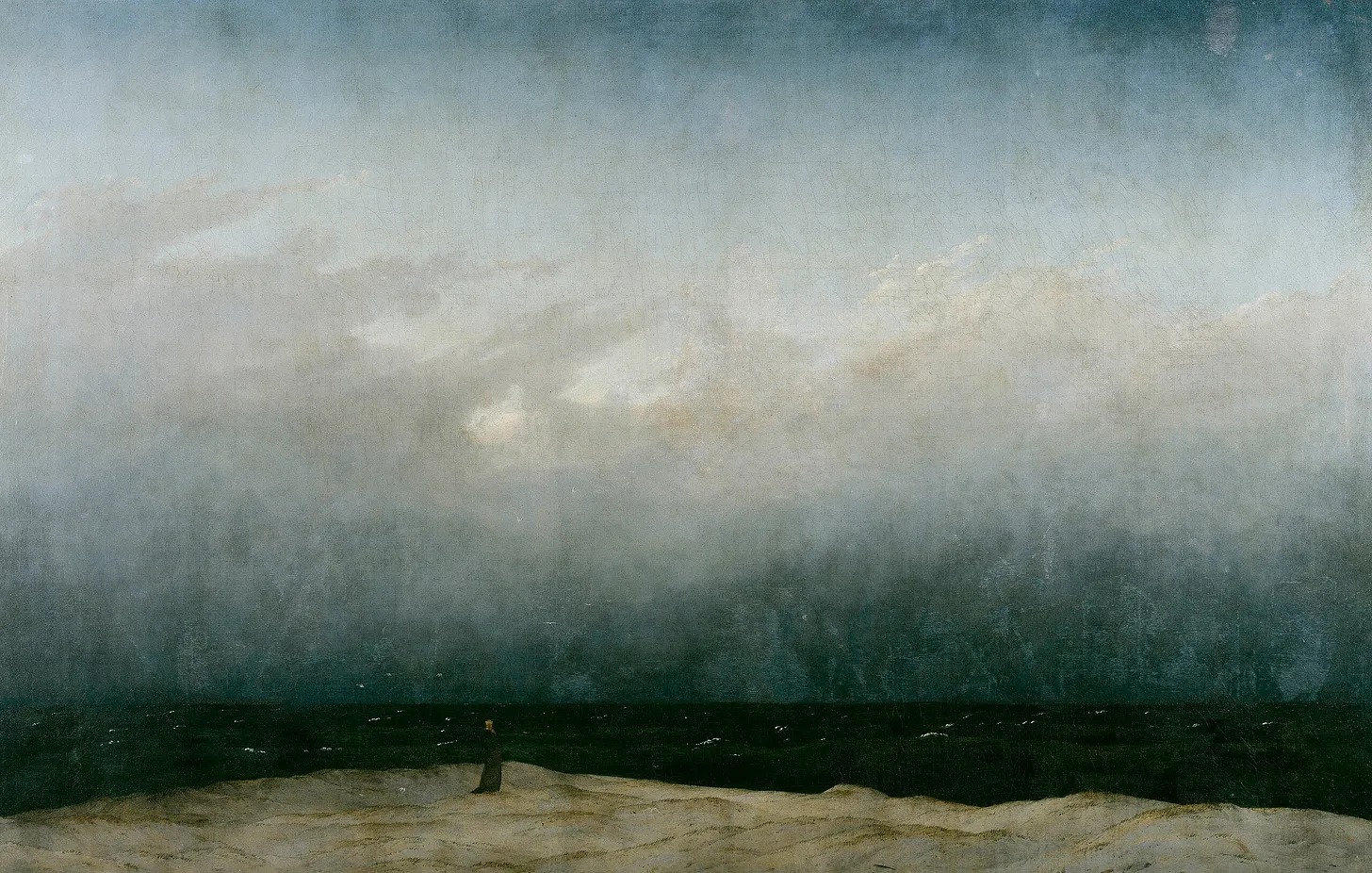
The Monk by the Sea - Casper David Friedrich - Painted sometime between 1808/1810 - Image Source, Wikimedia Commons




My claims upfront: We are born into an extraordinary mystery, with too few clues to realistically hope to solve it in this lifetime. We have been given a compass (moral compass, and intuition), so we do have something to guide us through this mystery, but we don’t know who gave us this compass, and we cannot prove in material terms its existence or reliability.
All the most important things cannot be proven by us here and now, and appear to belong to an ethereal realm that is intertwined with the material realm; the knowledge that life is meaningful has been given to us, and our only option is to either dismiss this knowledge that we access through subjective processes, or make a leap of faith by trusting it (which is what I mean in the title by ‘mysticism,’ and for my purposes here I could just as well have called it ‘spiritualism,’ or ‘romanticism’). Agnosticism is not an option in response to this unknown because life compels us to act, and our actions reveal our beliefs.
In an attempt to have certainty some people put on knowing more than they do, by claiming they know the moral compass to have material origins in behavior selected by natural selection through survival of the fittest. In addition to false certainty, this belief leads to nihilism because matter alone is soulless. There’s no sense in wasting time on any road known to lead to nihilism, since those roads are known dead ends.
The choice to believe in what we already seem to know through subjective processes does not lead to a lack of concern for objective truth because we must be objective about the information we submit to the judgment of subjective processes, if we want the subjective processes to point us in the right direction.
The realist does not bury their head in the sand and reject a whole realm of knowledge (subjective knowledge) just because it is mysterious, and appears to be (and may very well be) ethereal rather than material in origin. The realist accepts the mystery and then uses what little they do know to navigate the unknown as best they can.
Those are my claims up front, now I’m going to proceed to not prove an ounce of it. I’ll just show you that you already know I’m right.
There is a narrative arc, in my life, that mirrors a centuries spanning narrative arc of our civilization.
This being the journey that starts from solid foundations in Christian faith, then proceeds to initial doubts, and then to wandering out beyond the Church. This is a story that plays out at both an individual and civilizational scale. I know this story then at a personal level.
Like our civilization I grew up Christian (analogous to how the whole West was enveloped in Christianity for some centuries, and in places, well over a millennia), I had a solid foundation for my belief system: the word of God, bound between two covers, nice and neat. A divinely inspired instruction manual for life – perfect. Likewise the West, when it all came under Christendom, was confident it had the truth.
Then the West began to question its previously held beliefs in Christianity and the Bible. Doctrinal disputes here and there and what not, were the first pebbles of the eventual avalanche.
Christianity is still a significant force, of course, and its mark on the West, for both better and worse, remains visible everywhere. But The Church and the Bible have been dethroned. Most people do not accept an appeal to the Bible or church doctrine as valid argument.
Furthermore, the Church specifically has been singled out for exclusion from the halls of power, with the secular doctrine of the separation of Church and state, all the while, other belief systems are embedded within the state, such as scientism, Zionism, and up till recently, and perhaps soon again, Woke (which is a type of living dead, Christian/Un-Christian, zombie Christianity, that is based on the social gospel and the Beatitudes, all while vilifying its very own foundations by being anti-Christian. But Woke/zombie-Christianity, wasn’t seen as ‘The Church’ so it was allowed into the halls of power).
As with the West questioning Christianity after being immersed in it, I too had questions about the authority of the Bible and the legitimacy of Christian doctrine. Tugging at those questions ultimately unraveled the beliefs that I had at first thought would serve as the foundation for my world view. This set me adrift. I went from a believer who had the answers, to a wanderer seeking them.
At a societal level we haven’t handled this uncertainty very well at all. In fact we’ve generally refused to accept uncertainty, and have opted instead to end our wanderings at the first available opportunity by clamping down prematurely on conclusions. We’ve decided we must have certainty, and we must have it reducible to hard proof that can be physically measured by our instruments. This petulant response to uncertainty, has led us to insist that what lies beyond the capacity of our scientific instruments to measure, does not exist at all.
Our most fundamental experiences such as consciousnesses, and the exercise of our will, cannot be measured by our scientific instruments, and so the “scientific” view insists that they aren’t real at all – that they are mere illusions.
This insistence on only measurable matter being real is philosophical materialism, or in popular parlance atheism, which leads to excluding such ethereal concepts as a spiritual realm and the soul.
Most people profess some religious or spiritual belief but based on how I see people in our society act and argue I think that philosophical materialism has been the most prestigious belief system for well over a century, because arguments based on The Science (generally understood to limit itself to materialist explanations) are the most socially acceptable.
Matter alone is not meaningful, and so nihilism flows logically from philosophical materialism. You can see this in anything that philosophical materialism touches – it becomes dead and meaningless, or at least the modernist, whose unstated default position is philosophical materialism, tries to flatten whole fields of endeavor and reduce them to matter alone, and thereby deadens the field to the degree that they gain influence over it. Take art for example. Art, music, and poetry, are means of tapping into ethereal realms. They are to the ethereal, as the sciences are to the material.
Modernity Meets Art, Makes Surprising Discovery That Paintings Are Actually Just Paint Stuck to a Flat Surface.

No. 2, 1950 mixed media – Jackson Pollock
Recent centuries have seen a flowering of great art (thanks to romantic streaks that have survived “progress”), that serves as a medium channeling the ethereal and mysterious elements that flow through landscapes, and nature, and the human form. But this is something you detect by feeling it, and letting it speak to you on another level, not measuring it with a scientific instrument, and so of course from the materialist view, what the art channels doesn’t exist at all.
So what does a modernist mindset, where philosophical materialism is the prestigious viewpoint, look for in a painting? The measurable things, the physical paint itself, the flat surface, etc.
Read carefully the following excerpts from modernist art critics, and immerse yourself in their mindset:
– On the Materiality of Painting By Sam Powers 2019
“The painter no longer approached his easel with an image in his mind; he went up to it with material in his hand to do something to that other piece of material in front of him. The image would be the result of this encounter.”
“The big moment came when it was decided to paint…just to PAINT. The gesture on the canvas was a gesture of liberation, from Value—political, aesthetic, moral.”
The American Action Painters Harold Rosenberg – 1952
With modernist painting we get a nice encapsulation of what happens when you reduce things to physical matter only – painting became liberated from value, or we could say value free, valueless, pointless, nihilistic: flattened in more ways then one. The same happens at the macrocosmic level; when your world view is reduced to only believing in what is measurable with scientific instruments, then the world becomes to you about as shallow and surface level as Jackson Pollock’s No. 2.
(The supportive critics, and painters, of this kind of art may or may not be philosophical materialists themselves, but their approach, in which the physical matter itself becomes their focus, and they exhibit deafness and dumbness to the ethereal, is consistent with the physical materialism infused modernist outlook, and would be a very dense, dim, way of looking at art for someone who believes in an ethereal realm. That’s why I see philosophical materialism as the dominant belief of people who talk like these art critics do, even if they profess some spiritual beliefs)
Painting just for the sake of painting is meaningless. But the physical materials that make up a painting become meaningful when they are used as a medium that channels something else. Paint and panel that serve as portal, threshold, or liminal space. Matter that thins the veil. Likewise the whole material world becomes mysterious, and at least potentially deeply meaningful, if the physical world is not just itself, but is serving as the medium for the soul and the ethereal world.

The Abbey in the Oakwood – Caspar David Friedrick – painted 1808/1810, image source, Wikipedia
Our civilization’s flip from Christianity to nihilism is somehow built in as a sort of mutually assured destruction between Christianity and the West. At an individual level I have known many Christians to defend their belief in the inerrancy of the Bible by insisting that life would become meaningless to them if the Bible is not really the word of God; that if they don’t have the Bible as the bedrock of their faith, they have no reason for faith in anything. The Bible or nothing.
What I think this is, is a type of persuasion where you try to make someone (including yourself) believe something by making the alternatives seem unbearably awful.
Happens all the time:
Don’t believe in Covid? Well then you are going to die! Or…well…your grandma is going to die and it will be your fault!
Don’t believe in the Bible? Well then you are going to burn in hell for all eternity, muahahaHAHA!
Don’t think you need to convert your friends and family? What then, do you want them to burn in hell?
All the Abrahamic religions present themselves to their target audience as the only way. Lamentably even the poetic gospel of John puts forth such an argument:
“I am the way and the truth and the life. No one comes to the Father except through me.”
John 14:6
Let us hope that this was just some unscrupulous scribe, trying to bully people into belief, who put that passage in, and not the venerable Jesus of Nazareth saying such things.
We can see then that Christianity, like other belief systems, has tried to browbeat people into believing it, by making them think that it is the only option. Salvation through Christianity, damnation outside of it. The Bible is worthy of one’s faith or nothing is.
To respond to the crumbling of one’s Christian faith by going straight to nihilistic beliefs such as philosophical materialism/atheism is to succumb to the emotional blackmail that clever Christian activists and apologists began putting into place the better part of two thousand years ago.
Our society did succumb to that trap, or at least that’s part of my theory for our societal level rejection of post Christian wandering in favor of flipping right over into materialism.
What We Really Believe

Magdalene Before Mirror – Georges de La Tour – Painted around 1635-40 – Image source, Wikipedia
We do not have definitive material proof that life is meaningful, or that truth and goodness exist, in any meaningful way.
We also don’t have definitive material proof that they don’t exist; we have no compelling reason that would justify ruling them out. Life might be deeply meaningful. Truth and goodness may both exist in a meaningful sense, and we might have the means of accessing them, and knowing what they are or at least getting closer to them.
Agnosticism, simply not knowing, and not pretending to know, is then the most intellectually defensible position to be in, in regard to these big questions. But agnosticism won’t do. We don’t have the luxury of being agnostics. You can be an agnostic only so long as you don’t take action. Once you start doing things you reveal what you really believe.
I’m going to paraphrase William James now. I can’t find the book I read this in, and can’t find the quote online by searching for fragments of what I think the passage read, but anyways, I’m pretty sure I read this or something like it, in some collection or another of William James’ essays. Here it is:
“Suppose that a man in a room proclaims himself an agnostic on the question of whether or not the room is too cold, too warm, or just right. He simply doesn’t know, he insists.
But then this man, of his own volition, gets up, closes the windows, puts on a coat, and starts a fire in the fire place. By his actions he has revealed that he believed the room was too cold. He was not an agnostic after all.”
Henderson paraphrasing what he thinks is from William James.
The man’s actions above do not prove that the room is too cold, only that he believes the room is too cold.
So let’s now apply this concept that taking action reveals what your beliefs really are.
We intuit that we are capable of knowing goodness and truth or at least getting closer to them by consulting what we call the conscience, the moral compass, or the little voice in our head. In other words, we believe that we can hone in on goodness and truth like a dowsing rod equipped water witcher hones in on water.
We also believe that other people have this moral compass, and that theirs too will point them towards truth, goodness, and right action. However, we think that these moral compasses work to some extent like a key in a field guide. Let me explain:
If you have, say, a mushroom field guide, it will have a key that you ‘feed’ information into. The key will ask things like:
“Does the fruiting body (of the mushroom in question) have gills on the underside radiating out from a stalk? If yes, go to page X. If no, go to page Y.”
Then let’s say you go to page X, because the mushroom meets that criteria. Page X will ask you another question like:
“Is the mushroom growing out of dead wood?” and if yes, it will send you to another page, and if no, there will be other questions that will send you to different pages.
And in this way the key, will use all the information you feed into it (by answering its questions), to point you in the right direction, that is, it will identify what type of mushroom you are looking at with the major caveat that you must give the key accurate information, and you must have enough information. If you feed inaccurate information into the key it will give you a wrong answer. If you don’t have enough information – say you don’t know what color the mushrooms spores are, you may need to go out and collect more information (such as taking a spore print, or digging up the mushroom to inspect the base to look for other defining features), before the key can give you a reliable answer.
Moral compasses have a similar aspect. They will point you in the right direction if you give them accurate information to work with, or at least that’s what we all believe.
Now you may think me very arrogant for believing that I know that other people believe these things too. But I do. By their actions they are showing what they believe.
If we thought other people didn’t have moral compasses, we wouldn’t waste time arguing over what is the right thing to do. But we do frequently argue as if we believe that there really is a right and a wrong in the moral sense, and that we have a means of knowing this, and that the other person has a means of knowing this too.
Furthermore, we think that the reason the other person’s moral compass isn’t pointing them in the right direction is either because they aren’t listening to their moral compass (in which case we try to get them to do so with exhortations such as: imagine if it were the other way ‘round, listen to your heart/don’t be heartless), or we see that they are listening to their moral compass (trying to do the right thing, their heart’s in the right place), yet their moral compass is still pointing in a different direction from ours.
In the latter case, we don’t shrug our shoulders and go, “guess our moral compasses just point in different directions.” No, we still think that both our moral compasses are designed to point towards truth, goodness, and right action. We assume that at least one of us has fed inaccurate information into their compass/field-guide-key, and because of that the key/compass is pointing them in the wrong direction. We think that this can be remedied by finding and correcting the inaccurate information, or providing critical missing information. That’s why we inspect their argument looking for where they went wrong in constructing their premise, or went wrong in building on their premise, then we challenge them on the errors we identified in the hope of getting them to correct faulty premises, which will then lead their moral compass to re-calibrate and point them in the right direction.
A vast amount of discussion, argument, and introspection, from personal quibbles, to society wide debates, is consistent with people either trying to get people to listen to their moral compasses to begin with, or getting people to re-calibrate their moral compasses by correcting false information/premises that they fed into the compass’s ‘key.’
In this way (by observing our choices) it is as clear that we believe these things, as it is that the man who chooses to close the windows, put on a coat, and start a fire, believes the room is chilly.
Let’s keep going in this vein, looking at things we all, or many of us, believe, but won’t admit we believe, but give away that we believe them, by acting in accordance with these beliefs.
We intuit that the ethereal sensation of consciousness and free will are real. Our anguish and pain and guilt at times are all consistent with our believing that we really are at least partly responsible, that we really do have real choices in how we conduct our life, and that decisions we made, we could, at least some of the time, have made differently.
We intuit that our physical, material, body is the medium of an ethereal soul.
This belief in the body being the medium of an ethereal soul isn’t just visible in obvious ways, like beliefs in ghosts, an afterlife, or reincarnation; this belief permeates our language so much that we’re unfazed by people talking as if they consist of not just their physical body but something else too. Very common expressions show this belief:
“He conducted himself well”
As if ‘he’ consists of not just his physical body, but also another self, different from his physical body, that is leading his physical body, as if this non-physical self were a conductor, and his physical self, an orchestra.
“She’s driving herself too hard, she’s gonna get burnt out, driving herself like that”
As if ‘she’ is something other than her physical body, and that she is driving her body (‘herself’) like a man driving an ox, and in this case she’s driving ‘herself’ too hard, potentially leading to ‘herself’ (her body) balking at her demands, and getting too tired to carry them out. And so on and so forth, with sentences like these, which indicate that we believe ourselves to be made up of our physical body bound with something else, with something other than our physical body, but that is also us:
“I forced myself to do it”
“I tricked myself into doing it”
“You need to listen to what your body is telling you”
My own working hypothesis for what’s going on here is that our body is governed largely by laws of matter and Darwinian instinct, but that our ethereal soul can hone in on truth and goodness by means of a moral compass accessible to the soul. The moral compass sometimes points in a different direction from where our body’s instincts might want to lead us, leading to internal conflict. I cannot prove this of course, but I do think it is a good working model with a lot of explanatory power. More on that in a moment.
Then, whether we admit it or not, we believe that: there is goodness and truth. That we have a moral compass that can point us to goodness and truth. That other people have such compasses too. That these compasses are a bit like keys in field guides, and need accurate information to give good answers. That our volition is real. That we have real choices. And, that our self is not just our physical body, but some other self of ours that is not the physical body, but is bound up with the physical body, together making up our self.
We go on believing these things, and professing our belief in them through our actions, but we won’t profess our belief in them through our words. Why not?
Well for one we overreacted. We’re still throwing our civilization-spanning tantrum, where we threw out not just The Church, but the entire ethereal realm with it. We only want to admit to believing in what we can prove and measure with our scientific instruments. Admitting to believing the things we can’t prove is a low class, backwards bible thumper way of doing things. We, modern man, the control freak, will only admit to believing the things we can prove through science.
‘Dumb’ people admit to believing things that they can’t prove, ‘smart’ people believe those very same things and also can’t prove them, but the smart people won’t admit they believe them, because they’re, you know, smart, and rational – guided by science and reason.
What if these things we believe, we don’t just believe: what if we outright know them? How humbling would it be if arrogant man were to be granted the ability to prove things only within certain limits like the material world, but the most important knowledge we have we were simply granted from the get go, and we don’t even get to know who gave us that knowledge or how we’re accessing it? Well, that appears to be the case.
Darwinian Just So Stories

Painting by Carl Jutz, 1882 – Image Source, Wikimedia Commons
Our most basic experiences and beliefs point beyond mere matter. This poses a problem for materialists. So they (materialists) need a means of explaining away the presence of these experiences (i. e. that consciousness is an illusion, that just sorta happens once you get a big enough computer/brain going), or flattening these beliefs into matter only.
If you read materialists such as New Atheists and evolutionary psychologists, you will find that when they come up against something they don’t know and can’t prove, they often won’t just say “It’s mysterious: who knows what lies behind this?” Because they would find themselves leaving doors open right and left, and even opening doors that had before been thought sealed shut – doors that might lead to ethereal, non-material explanations, ugh, and they need the doors to the otherworldly shut tight, so that they can feel secure and confident in their materialist outlook.
At best they’ll acknowledge it’s an unknown, but that they know already that if the answer is ever found the answer will be a material explanation for the phenomena. This much they know, cuz . . . yeah, it’s scientific you see.
Often they’ll go further though and spin a Just So story, of how matter alone leads to something that appears otherworldly (as in, influenced by something beyond just the material world). These Just So stories are unfalsifiable. You can’t prove them right, you can’t prove them wrong, they might be true, they might not be.
The materialist favors their Just So story though, because often their Just So story is the best explanation from a materialist standpoint, and since they believe that materialist explanations are the only valid explanations, they see their Just So story as the most likely explanation, which it is, if you have first dogmatically ruled out the ethereal world, leaving only material explanations.
For example, Darwin felt the gloriously long train of feathers possessed by the male peacock was so extravagant as to be a handicap, a hindrance. That bothered him (Darwin that is, not the peacock; the peacock is very pleased with his over the top feathers. He thinks himself quite handsome with them, and the ladies agree). Why hadn’t natural selection favored a fitter peacock with a more modest feather train?
Well, the popular explanation among evolutionary biologists these days is that the more encumbered by an extravagant feather train the male is, the fitter he really has to be, to survive with something so unfit, so the extravagant feather train signals to the peahens that the male must be very fit, because of all that unfitness he’s burdened with, but surviving anyway.
You can read the long version of the tale about peacock tails and evolution here.
Now what the evolutionary biologists have done there is give themselves a story where evolution selects for both the fittest traits, but also unfit traits, to signal to females that a male with unfit traits must be extra fit to survive with the unfitness. Survival of the most unfit, that’s still fit enough to survive. What is going on here? Just So stories are being spun, that do nothing to truly advance our understanding; they just give a false sense that something mysterious has been explained through a Darwinian framework.
Something similar is done with our moral compass. Evolutionary psychologists create two opposite categories, and any evidence that contradicts one category they put into the other, making their theories unfalsifiable Just So stories. Stories that make it seem as though another unknown has been accounted for in Darwinian terms.
Moral imperatives are explained by evolutionary psychology to be a set of behavioral instincts, selected by natural selection, because those instincts led to the highest fitness at either the individual or the group level.
What about individuals sacrificing their own interests to do what they feel is right, such as monks, and nuns dedicating themselves to charity and piety, and sacrificing their own reproductive interests by doing so: how is that fit from an evolutionary standpoint? Well, they would say, it is evolution working at the group scale. Sacrificing for the good of the group makes the group fitter, and is a behavioral trait that natural selection would select for at the group level.
What about selfish behavior that benefits the individual but is detrimental to the group? Well, of course they would say that is evolution working at the individual level.
What about selfless behavior against one’s own group? Such as a whistle blower jeopardizing the success of their own side, and putting themselves in danger of retribution, because they feel their own side has acted wrongly? Well you know evolution is blind: sometimes you get runaway selection; it must be some trait that in other circumstances would have benefited the survival of the individual or the group, and here it just went awry.
Any data that contradicts one part of the story is just put in another, opposite category. Selfless behavior contradicts self interest so it just gets categorized at the group fitness level; selfish behavior that harms the group is moved to the individual self interest level. And if the behavior cannot be explained still, it is assumed that it must at one time have served at either the group or individual fitness level, and evolution being blind couldn’t foresee how it would be applied in a different circumstance, so it went awry.
Now let’s say that this were true, that moral imperatives really do just boil down to behavioral traits that ultimately just serve to enhance the fitness of the individual or the group. That would mean that right and wrong, good and evil, don’t really exist, in any sense other then being synonyms for fit and unfit. There would only be fit and unfit.
The little voice, the conscience, the heart’s whisper, would actually just be the voice of the survival of the fittest, of evolutionary instinct. The inner voice telling us something is good would really just be instinct pointing us towards behavior that is fit. The conscience warning us that some behavior is wrong, is really just instinct trying to prevent unfit behavior.
Now that we know this we should be able to replace all our of language about good and bad, and right and wrong, by just saying, that’s fit, or that’s unfit. In fact right and wrong couldn’t help but collapsing into just fit and unfit.
Let’s say country A, a more powerful country overruns country B, and exterminates the genetically different inhabitants of country B. You can’t possibly say that’s wrong, you could only say whether it’s fit or unfit, and it looks pretty fit actually (from an evolutionary standpoint), and if fit is the basis of morally right, then we would even have to say it was the morally right thing to do.
Or take a fertility doctor substituting his own sperm for artificial insemination without his patient’s consent: is that wrong? Well if right and wrong ultimately have their basis in fitness and unfitness, we’re going to have to say what he did was right. Take this guy, 94 kids at least, that makes him fitter than almost anyone else alive (from an evolutionary standpoint), doesn’t matter what happens to him now, he has been extremely fit, he fulfilled the purpose that morals are apparently serving too. I’m afraid we’re going to have to consider him one of the most morally good men for his deception. He excelled at the thing that evolution selects a sense of morals for to begin with – evolutionary fitness.
How about the biblical story where Moses orders the Israelites to slaughter all the Midianite men, boys, and married women, but keep for themselves the virgins (whose mothers, brothers, and fathers, they had just massacred): was that wrong?
“They fought against Midian, as the Lord commanded Moses, and killed every man. Among their victims were Evi, Rekem, Zur, Hur and Reba—the five kings of Midian. They also killed Balaam son of Beor with the sword.
The Israelites captured the Midianite women and children and took all the Midianite herds, flocks and goods as plunder. They burned all the towns where the Midianites had settled, as well as all their camps. They took all the plunder and spoils, including the people and animals, and brought the captives, spoils and plunder to Moses and Eleazar the priest and the Israelite assembly at their camp on the plains of Moab, by the Jordan across from Jericho.
Moses, Eleazar the priest and all the leaders of the community went to meet them outside the camp. Moses was angry with the officers of the army—the commanders of thousands and commanders of hundreds—who returned from the battle.
“Have you allowed all the women to live?” he asked them. “They were the ones who followed Balaam’s advice and enticed the Israelites to be unfaithful to the Lord in the Peor incident, so that a plague struck the Lord’s people. Now kill all the boys. And kill every woman who has slept with a man, but save for yourselves every girl who has never slept with a man.”
Well clearly we would have to say it was the most morally right thing they could have done, that it was good, nothing wicked or evil about it, because it was fit, it was very fit.
The reason we don’t say these awful behaviors that I listed above are good, and morally right, is because we know very well that the basis of good, and right, is not fitness. Darwinian morality is an oxymoron.
The moral compass is above and beyond evolutionary instinct, not a product of it, as we can see from the way the moral compass is just as likely to condemn as condone our instincts.
Our moral compass will take two behaviors, both of which are evolutionary advantageous, and tell us that one of of them is good, and the other bad. We will affirm an instinctive behavior that is fit, such as a mother’s love for her child, and our compass reading will tell us that yes, that is very good. But another equally fit, evolutionarily advantageous behavior, such as the Israelites’ treatment of the Midianites (above) our moral compass will point us away from; we recoil at it. If we’re listening to our heart then, we don’t want that done, not even if the one’s doing it were genetically our twins.
Even the Israelites’ who carried out the Midianite massacre, had to either ignore their moral compasses (behave heartlessly), or corrupt the reading of their moral compasses by feeding their compasses’ ‘keys’ wrong information; that God made them do it, and that the Midianites deserved it, because they had been very bad, worshiping the wrong gods, and other, you know, just somehow bad things that justified their being treated this way.
Remember my working hypothesis that I introduced earlier in this essay:
“My own working hypothesis for what’s going on here is that our body is governed largely by laws of matter and Darwinian instinct, but that our ethereal soul can hone in on truth and goodness by means of a moral compass accessible to the soul. The moral compass sometimes points in a different direction from where our body’s instincts might want to lead us, leading to internal conflict. I cannot prove that of course, but I do think it is a good working model with a lot of explanatory power.”
See how nicely my model can account for our moral compass condemning one behavior, and condoning another, even when both behaviors are fit and evolutionarily advantageous?
Of course my working hypothesis is as unprovable, at least for now, as the materialists’ Just So story, but at least I don’t have to engage in verbal acrobatics and mental contortions, saying things like,
“Well you see my dear, Watson, it’s elementary; the feeling of right and wrong is an evolutionary adaptation, which also frequently condemns evolutionarily advantageous behavior.”
I can avoid the mental contortions on the matter of the peacock’s feathers too. Instead of saying that, “Well clearly the burdensome unfitness of the extravagant and cumbersome feather train displays the male’s fitness. The more unfitness the male is burdened by the more fit he really is, and so survival of the fittest has selected for these unfit traits.”
Instead of that, I can propose a much cleaner more straightforward hypothesis. I can take the appearance of two principals at work, and think, well you know what? Maybe it looks like two principals are at work because there are two principals at work.
The female is selecting for beauty, and her sense of beauty is informed by something more than just fitness – some other principal. The male must then display this beauty to fulfill the females’ demand for it, but natural selection through survival of the fittest still comes into play, as only the fittest males can pull off the unfit display of beauty and still make it. The peacock is then a compromise, or maybe even a dance, between fitness and beauty, with beauty being a different principal from fitness.
The human I also see, I could put it this way, as a compromise, or a struggle, and maybe even, when we’re conducting ourselves especially well, a dance, between the Darwinian instinct driven material body, and the morally attuned ethereal soul, with the Darwinian instincts of the body, and the ethereal morals of the soul being separate principals.
Crossroads: Known Dead Ends Versus Destinations Unknown

Destination Unknown – Maynard Dixon – Painted in perhaps 1938? – Image Source, PaintingMania
We can choose materialism or other similar roads that ultimately lead to nihilism. These roads are dead ends, in that even if they were to turn out to be true they still wouldn’t lead us to anything worthwhile.
The only reason to choose the dead ends would be if the weight of the evidence came down so strongly in favor of materialism that we were compelled to see materialism, or some other path that leads to nihilism, as true if we wanted to remain honest with ourselves.
We don’t have to choose those roads though; we are not intellectually compelled in the slightest to take those paths, because the weight of the evidence is not in their favor. The best the materialists have done is make the world safe for atheism by creating a defensible intellectual framework around the dogma that only matter is real.
Defensible is not the same as likely though, and their perspective is no likelier then competing perspectives. The illusion that they have an edge is formed by making up Just So stories, which make it seem as though their perspective accounts for just about everything. But again, providing an account doesn’t mean your account is true, or likely to be true, in many cases it just means you spun a story, and in the case of Darwinian Just So stories, opposite effects (fitness/unfitness, selfishness/selflessness) are attributed to the same materialist principle, meaning no evidence can count against the story: it’s unfalsifiable, and unprovable. You could probably put a Biblical Just So story to the test more easily than a Darwinian one.
Now, the roads that lead off into mystery, that hold the promise of meaning, and goodness, we can’t prove those roads more probable to be true either, so why take them?
Well, if you were at a crossroads, and you knew that one set of roads were dead ends that led to meaninglessness, and another set of roads led off into the unknown, why wouldn’t you take the roads into the unknown? You have nothing to lose by taking them, and there you may find truth, goodness, meaning, and light. Whereas the known dead ends offer nothing.
This is why I think the materialists put on knowing more than they do, using Just So stories to paper over doors into the unknown, because unless the evidence were to be overwhelmingly in their favor, there’s simply no reason to waste time on the known dead ends. How much better, more exciting, and more promising to head down the unknown roads off into the mystery.
Now you might argue there’s a thousand unknown paths, how could we ever take the right one? The odds are against us, but no, to get going we’re not facing a thousand choices, we’re just facing one. Either, the means that we have been given to hone in on truth and goodness can lead us to the truth and the good or they can’t.
It’s something like the story in The Princess and the Goblin. The Princess Irene is given, by her great, great, grandmother, a ring, with a thin thread, woven from spider’s webs, attached to the ring, and to home. When she gets lost in the labyrinth of the goblin’s caves, she follows the faint feeling of the thin spider’s thread back to home.

Image Source MFLibra
We similarly are in some mysterious place; we don’t know where we are, how we got here, and don’t know the way forward, and to just pick a course of action at random sounds unwise, but we have a ring with a thin thread (the moral compass, our intuition, our conviction that life is indeed meaningful, and that there is good that we can hone in on, and so forth). Unlike Irene we don’t know who gave us the ring and the thread, but someone or something appears to be looking out for us.
My point here is that leaning into our beliefs (that we believe whether we admit to it or not, as revealed by our actions, as I went over earlier in the essay), is not to respond to uncertainty by just rolling the dice and picking a random course of action, it is to respond to uncertainty by leaning into the most promising things that we have been given, even if we don’t know how we got them or where they lead.
Options:
- Pointless course of action – to pick a road that is a known dead end, such as philosophical materialism which leads to nihilism.
- Careless course of action – to roll the dice and pick a random direction.
- Intuitive course of action – to place our faith in the tools we have been given to guide us, such as our moral compass, and use them to hone in on truth and goodness like a water witcher uses a dowsing rod, and hope for the best.
The third option of course is the only reasonable course of action, and so reason and romanticism re-converge, and intertwine, as they always should have.

The Ascension – Painting by Steve Henderson
Jordan Henderson lives in the Northwest of the United States. He works in oil paints, and charcoals. A portfolio of his works can be viewed at either of his websites: Original Paintings – Fine Art Prints.
Thanks for reading...
You can help us keep doing what we do. Every little helps and is hugely appreciated.
For other ways to donate, including direct-transfer bank details click HERE.



In appreciation of Jordan’s essay.
Dimensions.
Let’s dissect an object in microcosm
So smaller and smaller it goes
Until it fades from all reality
To a place that no-one knows
Now, let’s inflate this object in macrocosm
Again, bigger and bigger it blows
Soon vanishing beyond horizons
Of a place where bemusement grows.
The Pithy-Pocket Poet.
“This being the journey that starts from solid foundations in Christian faith…” – personally, I prefer the solid foundation of the Stoics; and it is often suggested that Jesus was a Stoic – many of His teachings echo stoicism philosophy.
The Ascension – Painting by Steve Henderson
is this your fathers art.?
Saying the bit we all know out loud.
illuminatibot (@iluminatibot): “Jordana Cutler saying that META has been banning content that claims Zionists run the world or control the media” | nitter.poast.org
The Kingdom of God is within you
Never watched it never will, but the MSM’s love affair with the series Stranger Things isn’t a coincidence.
Think Montauk Project – and you’ll see the connections.
Stranger Things & The Montauk Project: This True Story Inspired Netflix – Thrillist
Stranger Things 2: Meet the Real Kids Who Inspired Eleven – Thrillist
Every choice which is made within the fear structures of the ego, binds us and brings us towards nihilism.. Once the heart opens and we recognise the fresh choice we have in relation to appearances in this world, we move away from nihilism and into the realm of the soul, and the realisation of our infinite nature.. The ego has become so complex through generations of materialistic value systems and cynicism towards so called religious leaders who don’t live up to the dogma they enforce on the masses, that true spirituality has been lost.. True Self authorship of our life in direct alignment and communion with the Source Intelligence which is non-dual and effortless.
I wonder what is going on. Every single one of my comments has an equal number of plusses and minuses. If there is 2 ups, there is 2 downs. If there is 3 ups, there is 3 downs. Like it was some algorithm or something. I don’t really care. I mostly prefer the minuses. Badge of honour and all. But, just for the record, what’s up with that?
Dont stray of the what is allowed to be discussed.
stick to the topic in question.
Its probably more to do with whose topping up his bank account than religion.
illuminatibot (@iluminatibot): “US Ambassador Mike Huckabee demands that Christians understand they have a moral debt owed to the Jewish people. Huckabee says he can’t understand why so many Christians choose not to support Israel.” | nitter.poast.org
Huckabee himself still bear a big moral debt to pay to Israel and should give all his property and money to Israel until he has not a single dime left.
After that, Huckabee should pull his pants down and bend over for Israel and say Israel can with his behind as they want, because he has a debt to pay to Israel.
This is what I believe Ambassador Huckabee should do for himself and for Israel.
They always do this type of article with nihilism.
Rather believe in something rather than nothing.
The last one should obviously be Is-sham.
The last woke taboo?
Let me ask weegies and antonym. Who paid for the ‘Islamic filth’ and ‘Is-sham’??
Your Zionist friends in Israel. plus their British agents, their US military advisors, paid them, trained them, gave them their weapons free of charge.
Taught them how to decapitate people, torture people, kill women, elderly and children.
And now you are here to smear ordinary innocent Muslim people yes? Arent you?
You watch the manophere ?
No, manophere is new for me. I think opposite. The division between men and woman and the bs of each gender’s ‘rights’ is ……..pure bs, out on a blind gate.
Man and woman are one unit. You cant separate them, and each are disabled without the other.
The reason we have these stupid gender discussions is ideology, invented mostly on a finance investors writing table and agreed into politics.
Atheism
00
😔 Humility.
Sounds about right to me.
Thomas Paine (@Thomas1774Paine): “TORCH IT !!” | nitter.poast.org
Yeah why not. But, there is nothing new under the sun.
God did it twice, Noah’s Arch and Sodom and Gomorrah. But God promised us he would preserve mankind as divine specie.
Covid vaccines and blood clots…. problem solved!
https://theconversation.com/covid-vaccination-we-now-may-know-why-some-people-developed-blood-clots-277702
They start with a bare-faced lie. This is a strategy of con-men, to make an initial assessment of the credulity of their mark. The whole article is loaded up with NLP and numerology (e.g. release on 9/3). Scientism can only ever respond with more Scientism.
The vast majority of Christians, Muslims, Hindus, Buddhists, etc etc believe what they believe simply because they were born in a country where that belief system dominates.
Did their ‘God’ plan that for them?
And bad luck for all the heathens in the wrong countries?
Grow up, stop believing, and find the Truth.
It is as close as your breath.
OTOH, many control their brutish instincts only because of early brainwashing or traditional superstitions.
Not very cultured, are you?
Yes, you are right. Christianity, Islam, Hinduism, Buddhism are woven into the very warp and woof of the societies they arose in. Those societies would hardly exist at all without the color and sound and culture and tradition and history and beauty and art and consolation and brotherhood and joy that those ancient, time-honored, and ergonomic practices provide. You probably cheered when Notre Dame burnt down. Well, they built it back up. So much for that.
“No one comes to the Father except through me” (John 14:6)
This verse doesn’t seem as exclusionary it may first appear.
For Christians, Jesus is the Word of God through the whole Universe was made (the opening to John’s gospel says as much. (“In the beginning was the Word,.. the Word became flesh… through Him all things were made” etc).
With that in mind it makes perfect sense that the only route back to the Father (i.e. God) would be via the same being through whom humans were created in the first place. More a statement of what would naturally follow.
https://www.biblegateway.com/passage/?search=John%201&version=NIV
Thanks! One of the rare occasions when I see someone get it right.
I think it is more so allegorical. Christ means and represents Universal Love i.e. the love of Source and the fundamental “Oneness of the Whole”. The life of Yeshua was meant to teach this through personification. Hence, “I”, the example of perfect, universal love is the way to the Source as it is literally the only way to the Source because that is one of the fundamental attributes of the Source itself and Like ever attracts, begets, and resonates with Like.
In order to become as Source realized as the man Yeshua, we must live and choose in a similar manner, ever with universal love as our fundamental basis and core in intention, desire, action, non-action, thinking, and feeling.
This is a tall order for humans in general, as the ego and belief systems here teach the “value” and reality of separation. Time-space itself stresses separation and the seeming reality of same. But it (not individuality in and of itself) is an illusion, and I would posit, might be based on a collective belief system..a kind of distorted reflection of an original reality that those stuck in the reflection, are no longer perceiving clearly and directly.
Hence why some of us are partaking in retrieval, why we came into our siblings self created bad dreams, to try to help them to wake up from same.
Wise words 🙂
It strikes me that there’s a realm beyond the ‘moral compass’ (aka the ‘ethical’). Commonly known as ‘faith’. Mystical yes, but also involving a belief in the ‘absurd’ (in Kierkegaard terms) i.e. what isn’t naturally even possible.
Abraham’s belief that God could raise Isaac from death even if he slayed Him. Water being turned into wine. Five loaves and two fish feeding 5000. Jesus walking on water. Each of which defies science/materialism but also ethics (in Abraham’s case). It being against most moral compasses to make a burnt offering of your own son. Especially one that you love.
One reason why Abraham could tell no-one what he had planned for Isaac. Not Eleazar, not his servants, not even Isaac. A man alone with his God with a path that cannot be communicated to others and yet known to him (although its end-point wasn’t what he’d expected).
Yes the personal meeting with God is impossible to explain to others.
But generally God speaks with nature phenomena, letting people know that the Designer now stands in front of them. The Bible is full of these examples.
I think Abraham knew that God was love and capable, and therefore he had full confidence in what God would use the sacrifice for.
I’m not shocked – because I know they hate Christians, but many who still believe will be shocked.
Ragged Trousered Philanderer (@RaggedTP): “Israelis have proposed a bill to ban Christianity in Israel and make it an illegal offence to promote Christianity by word, internet, in the media, or via email… punishable with imprisonment of up to 2 years.” | nitter.poast.org
Wait, whaaat? The only democracy in the Middle East?
Israel could never do that. They are professional soldiers who gives small girls a warning 5 minutes before they are bombed and burned alive.
They literally spit on Christians and Muslims. A wonderful people.
I only needed to look at the length of the article to see this was written by a Jesus believer.
The only place you find Jesus is in prisons where the degenerates need something like this to get them a reduced prison sentence. Even the mental institution patients reject such a fallacy as Jesus. Now, some of the patients may think they’re Jesus and need help and support , and those places are there for that. When you have politicians proclaiming Jesus or God is supporting them, or that they’re doing it for Jesus, Allah, or Yeshua, it works like we see on alt-media TV, which they all promote.
Look at this site. Petrified to addresses this. Scared shitless like a church, it will lose its funding if it raises questionable reasons of whether Jesus exists . Ten years, one article, and terrified with a team of ADL specialists on trigger-happy censorship , making sure no one dares sway from the MSM + woke mind perspective. Mention the rapture, the end times, or quote their own books, and it’s like speaking to someone who has had eight vaccines and still believes in COVID, as COVID is Jesus for this lot.
Weak people need this. They can’t cope. You can’t cope. Conspiracy- minded people who proclaim to be awake still believe in some fake story that being nailed on a cross, who died for our sins; this is sickness, not spiritual. The Christendom Jesus digital crusade online , which this lot are a part of.
Post “Jesus is King,” and you’re algorithmically promoted like the recent “tells us something we don’t know” article, which sells an algorithmically promoted agenda narrative.
Like the NFL, you need to keep the fake script storylines (headlines) going to keep the season ticket holders and MSM newspaper watchers entertained .
Major professional sports leagues in the US and Canada-often called the “Big Four”-include the NFL (football), NBA (basketball), MLB (baseball), and NHL (hockey). NASCAR and WWE are owned by UFC.
Major religions-Jesus, Allah, and Jokeism-have the same application as the Big Four: the same script storylines.
SPORTS IS FAKE – JUST LIKE YOUR JESUS, ALLAH, OR YESHUA.
MSM- plus, like Arbramanic, like NFL-UFC, is entertainment- bread and circus for the masses; all the latest stories in the games align with the latest news feed in the world’s media.
Your Jesus that backstory is about as real as santa clause and the tooth fairy does not exist.
It will go into pending as it needs approval from the thought police men in cloth to see if it is allowed to shown to OG flock.
So what’s your grand alternative other than proud contempt for all religion and history?
His grand alternative to Christ is Schopenhauer: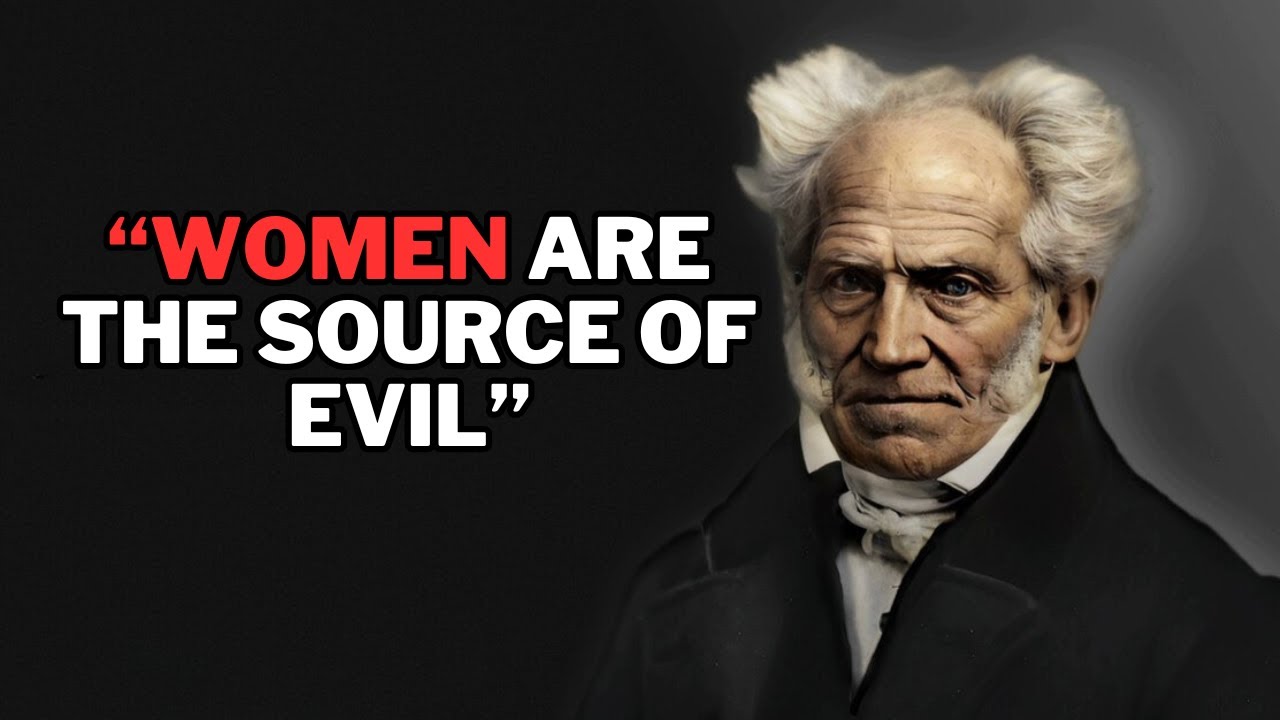
Non woke bigots might swallow : “Ju-ish women as the source of all evil”.
Never evil tests us all, only THEM ->
Why do you need an alternative?
To repeat the conversation:
Rawmilk say with reference to the 25% Christian elievers that Schopenhauer says they are idiots.
Vagabard ask him for his alternative to Jesus and religion.
ErikNielsen answer that rawmilk already answered that question at first: rawmilk’s alternative is Schopenhauer who thinks women is the source of evil.
No ErikNielsen doesnt need an alternative to Christ.
I hope you understand the discussion now.
Sport, if you could call it that, isn’t fake as such, but since the corparasites moved in it has been corrupted and distorted by over the top hype and gambling of course.
Jesus is dead. Mohammed is dead. Buddha is dead. Many of their words have wisdom in them, but words are only signposts.
When a person attends a church, a mosque, or a temple they are not being responsible for their own ‘salvation’. They are taking the easy way out, hoping some outside entity will save them. That is childish.
Life, Love and Truth are within. Where else could they be?
The search for Truth can take 10, 20, 30 years of deep introspection.
It is the Road Less Traveled.
”Jesus is dead. Mohammed is dead. Buddha is dead.”
No. These names or words are not personal names of some individuals, and there never were such men. These names or words have a profound meaning, and they all mean the same thing.
Jesus means ”God Saves”, Mohammed means ”Praiseworthy”, and Buddha means ”The Enlightened One”.
When these names or words haven’t been translated, it has created the impression of them being a person, which is just wrong. Like ”Adam”, which means humanity, all people, not one male person who is responsible for all sin.
All images, pictures, drawings and paintings of these are false.
Truth is not a person. Truth was never a person. It is impossible for Truth to be a person.
https://salawat.com/names-of-prophet-muhammad/
Mary Applesauce is not a name of a sauce, but actually a woman.
Jesus is not dead.
rigged as the selections and WWe UCF.
so rigged it unbelievably easy to see.
I am dissapointed your that naive Johnny.
Why would I take religious advice from an illiterate?
Jordan Henderson lives in the Northwest of the United States. He works in oil paints, and charcoals. A portfolio of his works can be viewed at either of his websites:
Id rather watch paint dry.
Yeshua shows up more than just in the NT and in religion. I was never (and still am not) religious myself, but of a metaphysical, “spiritual”, and universalist bent. With that said, I don’t throw the baby out with the bathwater either. Turns out, Yeshua can be found in several non religious sources. Let’s qualify religion here first before I dive into these. Religion and religiousness meaning believing in a codified set of beliefs promoted by others vs direct, experiential experiences with the nonphysical, spiritual, etc.
Yeshua shows up more often in NDE’s than any other spiritual teacher/figure, even cross culturally some.
The most vast and verified psychic-intuitive work on this planet so far, the Edgar Cayce work and it’s source, constantly states that the NT is mostly correct in the main about Yeshua i.e. he lived an exemplary life of loving service to others (as a pattern/example for others of the way back to Source), was unjustly tried and murdered by crucifixion, and then resurrected on the 3rd day after his body’s death. Keep in mind that Cayce was predominantly a medical intuitive (approx. 70% of the some 14, 300+ individual readings) and there are hundreds of signed affidavits on record of very real help received in infliction’s by him/his source.
In Robert A. Monroe’s 3rd and last book, Ultimate Journey, he talks about asking his internal guidance if he could meet the most mature (spiritually advanced) human living in his space/time reference. He is told yes, but it might not be what he would expect. Anyways, during one of his OBE’s he is led by his guidance to a physical room with a person sitting at the desk. Until he learns their real name, he refers to this person as “He/She” because one of his overwhelming perceptions of this person and their emanation was that they are perfectly balanced and integrated between inner masculine and feminine.
This person let’s Bob selectively read part of their mind/awareness, and Bob learns that this person is over 1800 years old (and besides no longer aging, no longer eats, sleep, etc “Oh, I gave those up years ago”), and later on, Bob hints that they are already well known in some way, but that, “no one really believes you exist” (so says the former materialist atheist who was raised that way).
Ok, but maybe it is some other spiritual teacher/master figure? But then, Bob’s former friend (who married Bob’s step daughter Nancy), military trained remote viewer Joseph McMoneagle, relates in his book Ultimate Time Machine that one day Bob came up to him with a sealed envelope and asked Joe if he would try to remote view the target in same. Joe agreed. During the session, Joe got the very strong perception that he was observing and later communicating with “Jesus Christ” (who is described not just as a human, but also as a transcendent spiritual being who occasionally comes among humanity to redirect humanity to a correct path). When the session is over, it is revealed that the target inside the envelope was indeed centered on Jesus.
Something happened to get the former materialist atheist Monroe interested in digging deeper into this Yeshua guy.
In other words, when such credible sources like Cayce, a large body of NDE* accounts, and Monroe lend support to the reality and potency of Yeshua, then it becomes more likely that there is something to it all despite the foibles and issues of historical religious Christianity. Learning to not throw the baby out with the bathwater is indicative of the development of discernment and objectivity-something sorely lacking in the human species in a collective sense.
*Oh and some of those NDE accounts that relate experiences with Yeshua, come from people who were until their NDE atheistic materialists themselves (like Howard Storm), or whose belief systems taught them that Yeshua was a bunch of kosher baloney like one Jewish woman’s account of a reddish haired Yeshua. (Which is very interesting when one learns that Cayce, McMoneagle, and the Dead Sea Scrolls’ “4QElect of God” [speaking of the coming transcendent chosen one] passage all speak of reddish colored hair, which just so happens to also be the most rare hair coloring in the world).
In cases like this, I highly doubt that ignorance is bliss. But yeah, being “edgy and dismissive” is hip these days it seems, all the cool kids are doing it.
I have a pint of what your having.
Remote viewing. Of course credible. But on demand? Seemingly less so
Circling the mystery with words – as close as you may get … Thank you!
Atomists see more and more in less and less (particalists)
By seeing less and less in more and more unified fields become apparent (wavists)
Both are the same but one might make you feel better.
As my good mate Jesus once let slip after a few pints, “You know, I was never a christianist…”
The average American doesn’t give a toss – as long as gas and food are cheap, it when prices rise in the good old US of A – that some American’s actually open their eyes.
حيدر | Haydar (@chronicalihere): “The Lancet recently published a study which found that sanctions from the US have caused 38 million deaths since 1970. The average death toll ranges from 400,000 to over 1 million per year.” | nitter.poast.org
My same history…
Blessings.
Jordan’s vendetta against non-objective art, he is a “representational” artist, is a bit too extreme to take seriously. To say Malevich, Pollack, Abstract Expressionism or other non-representational art derives out of nihilism, meaninglessness, is ridiculous. Transcendence can also come from natural observation, perception of Universe, and meditative non-objective observation and experience. Music, without lyrics, is a natural non-objective art form where sounds of beauty and emotional feeling are expressed through sound. Likewise for optical arts of all kinds. It is a fact that the Russian communist government banned abstract art (like that of the Bauhaus or Kandinsky) and forced artists to make representational propaganda art with narratives of revolutionary solidarity. Nazi Germany’s famous Entartete Kunst (Degenerate Art) exhibit’s purpose was to “ridicule and discredit movements like Expressionism, Surrealism, and Cubism, along with their artists. Anything that did not fit the Nazi vision of “German art” became an enemy to be eradicated”.
The point being that if we are to condemn or praise creations, let’s be specific instead of categorical. Real science of value, objectively researches and studies Universe to disclose it’s secrets and mysteries so humanity can better understand the nature of reality. Corporate science on the other hand, is a biased, profiteering activity that has near zero responsibility to serve the social needs of humanity. Likewise, there is good art and bad art of any category conceivable. It might serve us better to be more wary of totalitarianism dictating standards and excluding possibility, than to say any “otherism” is a nihilist enemy to be hated on. Imho.
I’d agree that some abstract art can be beautiful – intentionally placed colour creating a harmonious colour story surrounding an interesting focal point, for instance, can make it so. But wouldn’t you agree that the ‘contemporary’ art scene has been deliberately made destructive and even obscene in some cases by the same agents that have perverted all of our culture? Throwing a bucket of paint onto canvas or painting it plain black or red can now be termed art. The absurdity of it! And those whose verbiage waxes lyrical over such nonsense are just trying to outdo the other over-intellectualised curators and critics who serve the art unsavvy investor class. That’s the system. The art world is every bit as cold and extractive an industry as digging for minerals.
Indeed. The art world was monopolized by investors and speculators more than fifty years ago. They openly admit that. Money rules.
If art is not for the people, of the people, then what purpose does it serve?
A work of ‘art’ that depicts the torment, frustrations or anger of an artist is useless if it requires ‘interpretation’ by ‘experts’.
IMO. art need not be for the masses. They would be satisfied without totalitarianism, oligarchy, poisoning and the perversion of their children. Most fine art serves pirates who have piled up more wealth than they know what to do with. It is a major part of money laundering. A special class of con artists exists to exploit then, including the artists. Everything in fine arts and fine tastes (e.g. wines, antiques, manuscripts) that can be collected has been counterfeited. What does that tell you about refined taste? MBS, the bone-saw Trump of Saudi Arabia, bought a fake Leonardo for $1 billion, or so I have read.
Yep. That sums it up.
Along those lines, one of the most interesting art documentaries I’ve seen was a 60 minutes spot on renown artist/forger Wolfgang Beltracchi. Since he did not copy artworks but channeled artists sensibilities to create new works in the same manner, what he did, puts the actual value of all visual art as a category of fraud. If his works are as good as, if not better than Max Ernst, and people bought them believing them Ernst’s, so should be the value, right? Hah!
You are addressing “modern art”, the infection introduced by the otherwise unemployable special people who cannot be named. Anyone who falls for that swill deserves what they get.
See my comments below. People don’t like what they don’t understand or don’t want to understand for a variety of reasons. They like to pummel indefensible “enemies”, like Trump does. Swill to you but not to others. Even Norman Rockwell painted two odes to Pollack’s works… I suggest opening your mind and heart a bit chief!
https://www.saturdayeveningpost.com/2022/01/rockwell-files-regarding-modern-art/
To compare. Max here. illustration-to-mainacht-in-vienna-leo-perutz-max-ernst.jpg (1269×1081)
I agree with you to an extent. The enshitification of the art world has proceeded in parallel with the enshitification of the entire system since the 70’s. Enshitification is made possible when capitalism is unregulated, subsidized, untaxed and has abducted authority to govern. Any way you cut it, it’s called monopoly.capitalism with their privatization of all public assets. They make ALL the decisions. How much we pay for always descending quality product and services. How much they make from permanently ascending profit. Commoners, the bottom 90%, have been forcibly escorted into a no choice, multi-cartel Company Store system. This applies to the art world too. Galleries have been disappearing just like small businesses across the US. Museums started charging ridiculous admission fees which are now $30 at MoMA and SFMoMA, and if special show fees are added can be up to $50 at LACMA. Museum attendance in the UK when made free increases by 50%. Universal escalation of rent has forced prestigious galleries to team up produce pop-up shows and Art Fairs, some charging $3000 to artists for squeeze into tiny pop-up spaces. Artist have no where to show and galleries are scrambling to stay in business as the auction world and super high-end is all that’s left. We artists are priced out. Small galleries are priced out. The big get bigger and the small go homeless.
“Modern” art has always been kept an anathema to the general public because public schools have never educated visual communication and art skills. Verbality, language, literature, poetry and theater, yes. Math, the sciences, yes. Music, one can hear on all media, in your car, on the streets and live, in clubs. But visual art’s evolutionary movement appreciation has been frozen at Impressionism because there are no forums for the 20th and 21st C public to experience, inform, educate, create and have an art experience commonly accessible. In short, the public has been left clueless. I believe this is some of the reason for Jordan’s take on modern and contemporary non-objective art. Because the public has been intellectually abandoned at Impressionism, the common belief about visual arts is the need to be able to draw and paint “realistically” with traditional Renaissance/photographic perspective as the only acceptable standard. Duchamp, whose drawing skills match any artist, later rejected “skills of the hand” as too seductive, instead exploring other methods of depictions and visual object concepts to take art making into a sort of intellectual and experiential chess game. For those of us fortunate enough to be informed open-minded participants in the contemporary art “game”, it’s exhilarating and fun. Not fun though when no one knows what we are doing. And when the hyper-commodified capitalist art empire abandons this serious pursuit for fashion, fad and big money investments, it just gets more alienating to the public. That’s why we see so much bullshit contemporary “art”. I apologize for that, but can do nothing about it. Me and my earnest art comrades have been priced out and are now essentially homeless in 2026. The “art world” is a train wreck now, just like everything else. But seriously, ideologies of meaninglessness is not the main problem. The selfish ideology of the elite class driving humanity off a cliff, just to make more mf-ing money, is the real problem.
Pseudo-intellectual babble.
No, it’s an actual description of the intent on making art and the nature of the current dystopian high end art world that is throttling public access to this wonderful creative world.
True. On the upside of all the exploitation of artists’ they now have access to the online ‘gallery’ world, thus freeing themselves from agents and bricks-and-mortar galleries and being able to expand their viewership and potential market for little money. And, let’s face it, only a tiny group of artists with the right connections can and could ever hope to exhibit in galleries, such as MoMA etc. Not enough canned vegetable brands to go around.
Re your second point, that’s for sure. I went to a school that barely even touched on the classics in art, let alone left space for engaging with art hands on.
To appreciate abstract art you’d need to learn the nuts and bolts of art-making. However, this leads me back to my overall dislike of abstract art, despite the exceptions. If you need to learn the technicalities of what makes art (the elements of art) before beings able to respond to it as a viewer – other than with puzzlement or even disgust – then is it really art? Why do we need intellect/left-brain viewing to gain an appreciation for modern abstract art? Isn’t art meant to elicit emotion all on its own?
One could also argue that art is meant to bring beauty into the world where there is so much horror and darkness but that would certainly clash with the modern take on art…
Another function of art would be to express dissent but I haven’t seen much of that happening, with some brilliant exceptions, such as the works of Jordan Henderson or the late Australian cartoonist, Michael Leunig.
I hope you meant the homelessness part non-literally, and wish you and your art comrades continued solidarity and perseverance throughout this apocalypse.
Before written language, one did not have to know how to read, learn rules of sentence structure or consume the works of past authors in order to functionally communicate verbally. Same goes for visual communication which visual art is at root. Just as people speak of an acquired taste, certainly the average beginning reader will balk at the value of reading Shakespeare with all of it’s contemporary unfamiliarity and stilt. What I’m saying is that unlike the extensive learning curve achieved with literature and how to analyze it, even by Jr High, visual communication and expression has no systemic educational support ramping up people’s understanding of the great varieties of expressions and intents of the visual arts. People are left to be impressed by drawing skills and the pictorial illusion of Renaissance perspective. (Been there, done that.)
You say you don’t like abstract art. But I bet If I were to go with you to a one of the big city museums, like MoMA, in 30 minutes I could get you to understand the intent of the artists, which is often needed for new viewers. And I’m sure that seeing some of the abstract works in person, being in the physical space with the object, you will find at least a few likeable. After initiation, it all gets better of course. But to each his own.
As far as political art, that is most often screened out by the gatekeepers and the entire visual distribution system of media of all kinds. Banksy, Keith Haring and many other gritty street artists are awesome. Ai Wei Wei, a contemporary Chinese artist who has been repeatedly inprisoned by the State, is perhaps the greatest, most prolific artist on Earth, at this time, and intrinsically political. There is a whole world out there of creative output 90% of the public knows nothing about. (Likewise in the music world, monoculture of corporate crap dominates while more authentic creativity is everywhere in the nooks and crannies of society. One direct access to this world is any of hundreds of college radio stations, who literally, and annoyingly to many, play almost everything being contemporarily created, and a good portion is totally unheard of before and awesome.)
50% of my works as an artist are social activist art (i hate the word”political”) and you can see some of it at my website, the net and online galleries…
https://sandys.art
https://sandys.art/foyer.html
https://www.instagram.com/sanders9723/
https://www.flickr.com/photos/44388581@N05
https://www.singulart.com/en/artist/sandy-sanders-79779
https://www.saatchiart.com/sandysanders
I’ve been to MoMA in NYC but I live in Australia, maybe a raincheck on a guided tour with you… I first came across Ai Wei Wei’s name in the book We Have Been Harmonised by Kai Strittmatter, and I will find some of his art online in a minute.
Just checked out your art on Saatchiart – I see you teach as well. I really like some of your digital art, especially Levitation, as well as your photography. I also like a lot of your “social activist art” on p2. I also like your digital landing page once I clicked through to it! You described paradise, so to speak.
My critique of abstract art and also of some of the more vile photography-as-art pertained to indecipherable (requiring lots of over-intellectualised verbiage) and deliberately ugly and often careless works, as well as to the deeply misanthropic and/or misogynistic photo art out there.
A long while ago I watched this video and, at the time, I agreed with much of the narration: Why is Modern Art so Bad?
Thanks for the positive feedback on my works! “Levitation” is an example of abstraction that seeks to express a beautiful visual. I looked at the video and I agree that the extremely offensive art he points out, that postmodern critics promote, is crap. There’s ton’s of it now, probably around 50%. I’m down with you on that.
But when he tries to suggest his paint apron is indistinguishable from a Pollack, he’s lying. I can guarantee you Pollock’s paintings are large and incredible visual experiences in person. Just hearing the respect given Pollock by Rockwell should be enough to realize that Pollock’s work has great skill and worth. One does need to see them in person though. They do not translate well to tiny screens or book photographs. Art is made to experience.
Visual art is NOT Olympic figure skating. That has strict rules limiting every aspect of performance. If Museums, galleries and art critics were Olympic Judges, humanity would never see any art but highly regulated and rendered painted illusions of reality, like photography enables. In fact, once photography appeared, many artists felt in foolish to compete with photography’s ability to depict reality. They went to other aspects of depiction, beauty and experience which is never discussed or informed by the public education system. The speaker was down on Impressionism? I don’t think 90% of the public would agree with him on that.
I remember going to an SF museum as an 11 year old seeing a painting of a tilted coat hanger shape on a yellow background with a yellow-orange circle in the background, and thinking to myself, what is this crap? Many years later, I looked back and realized that at that time i had no knowledge or appreciation for color juxtaposition, composition, shape, or form musicality as something aesthetic. Now those aspects are among my important visual tools.
Been nice discussing this with you, and I hope your interest in visual art grows.
Ever seen Sammezzano Firenze? Unbeatable color pattern abstract decoration…
Wild. Reddit –
Art is part of our divine expression.
Oh, you’re an idiot. Abstract art is CIA art. Representational art is subversive. Abstract art is safely versive. Not to ignore the emperor’s-new-clothes wisdom that anybody’s monkey could make it.
1) I’m not an idiot.
2) The CIA did get involved with promoting abstraction because it is largely apolitical and can’t propagandize a political revolution against them and their capitalist handlers, therefore beneficial as cultural diversion. In fact, abstract art is a breath of fresh air away from political ambitions of any kind and allows people to relax, meditate and enjoy living in the now. If the CIA were an abstract project, they would be fucking up the world like they are now, they’d be creating raw beauty and intellectual thought play.
3) Representational art is not subversive, it’s representational and can present images of anything. Like a God or a tyrant or Communist revolutionary fervor (Russian and Chinese state art) of Nazi versions of muscular he-men as human ideals. Propaganda is the vector of representational art. Before America flags were created, they would have been just abstract art, CIA art, that you hated. But now it’s a symbol cheered by millions! Hah!
4) Abstract art is anything but safe if so many hate it for being subversive to their ideology of what reality should be like. It is a possible respite space away from political bullshit.
5) The no-skill, no-talent accusation of abstraction is light years from the truth. That perception is the reaction of a closed mind that has had zero introduction to visual art since 1900. Rockwell admired Pollack’s work commenting “If I were young now I might paint that way myself.”
https://www.saturdayeveningpost.com/2022/01/rockwell-files-regarding-modern-art/
You sure talk a lot.
You didn’t refute anything, Abstraction is CIA. My monkey could do it. How can you tell if an abstraction is good? I wish I had a joke here, but the only answer is, “because the critics tell you so.” The caveats of critics is not exactly an objective standard.
You really don’t know what I’m talking about, so read amongst yourself.
Epithets are always the sign of a lacking argument. To say I didn’t refute anything even though i itemized your 5 sentences with concrete refutations, is just lashing out from frustration. So… pattern decoration and symbolic shapes and designs that have existed in art for many thousands of years is CIA? Really?
I know exactly what your talking about and it’s your own personal myth making. Bon appetit!
Basically the monster von der Leyen is saying decency, democracy, fairness and all that goes with it – have been been replaced by authoritarianism and war.
MonitorX (@MonitorX99800): “https://s.w.org/images/core/emoji/17.0.2/svg/1f1ea-1f1fa.svghttps://s.w.org/images/core/emoji/17.0.2/svg/26a1.svg– “Europe cannot be a custodian of the old world order, for world that has gone and will not return” — EU President, Von der leyen” | nitter.poast.org
No national leader anywhere seems able to resist corruption and megalomania beyond ~5 years. I am not implying that EC has any legitimacy.
Off course not. Talmud is SO modern and new.
‘By their actions they are showing what they believe.’
This author is extremely naive. Actions only correlate with beliefs when the actions are entirely optional.
As soon as the actions are necessary for survival, or for the survival of their children, then the actions mean nothing more than the humans concerned don’t want to die, don’t want to be homeless, don’t want to go hungry, don’t want to have to live outdoors through the winter.
I’ve lived with family members whose actions at work entirely negate what they claimed to believe in. They did what they did at work to earn enough money to have the status that they wanted. Be that a 4 bed house, a cool car, regular overseas travel. Sending their kids to private school. They kept their traps shut at work when their employers were acting in ways that were clearly evil, corrupt, causing death of others. Their requirement for money was greater than their purported moral framework.
I’ve met literally thousands of people who stay in jobs they hate and whose employers have values they abhor, because they didn’t believe they could earn enough for their family if they found a job more in tune with their desired principles.
I’ve come across a few people who are seemingly incapable of understanding that the vast majority of people don’t have the choices they have. Not to mention those who spent 25 years conforming to societal evil before suddenly having a metaphorical journey to Damascus in a Mid Life Crisis, at which point they start telling everyone else not to do what they themselves did for 25 years.
The only thing I think it’s easy to prove is that parents in the main will do almost anything to ensure their children survive and, if possible, prosper.
Well stated Rhys.
Ego and greed drive most Folks.
Hunger and the bad feeling of being lowest in the hierarchy and everybody else have a better life than you. A very hard trip for the bottom.
Thanks. This essay quite authentically captured my own life story and trajectory. Raised strict Roman Catholic, almost became a priest, lost my “faith” in college and became a raving atheist “true believer” in “science” – and in only what could be materially “proven,” – and then finally, faced with some rather extraordinary and unexplainable – “mysterious” – experiences related to the deaths of my father and an older sister, I was left having to accept that there are “things – “connections between us” – that I cannot explain” with science – and I now accept and attribute that realm simply to – “the mystery” – which I’ve become comfortable with living within. A very worthwhile essay that will no doubt perturb many who read it. : )
But you seem to have missed the part where the revelation that “science” is a religion hits.
I found this article too verbose. Could have been shortened. I just want to offer a comment on the bit about “Abrahamic religions”, which, I assume, is an allusion to Judaism and Christianity. Islam is different. Below are some excerpts from the Qur’an, which is addressed to humanity at large but it has become a “holy book” for people who call themselves Muslims (in Quraanic terminology, Islam = surrender to the Will of God; Muslim = one who so surrenders).
Surah Al-Maida [5:69] makes it clear that “salvation” in the hereafter is not confined to “muslims” alone. Most religions, I imagine, do not extend “salvation” to people outside their fold.
“Those who believe (in the Qur’an),
Those who follow the Jewish (scriptures),
And the Sabians and the Christians – Any who believe in God
And the Last Day,
And work righteousness –
On them shall be no fear,
Nor shall they grieve.”
Surah An-Nisa [4:123-125] deals with the Law of Requital, which we are told applies to all human beings. Allah has no favourites.
“Not your desires, nor those
Of the People of the Book
(Can prevail): whoever
Works evil, will be
Requited accordingly.
Nor will he find, besides God,
Any protector or helper.
If any do deeds
Of righteousness, –
Be they male or female –
And have faith,
They will enter Heaven,
And not the least injustice
Will be done to them.
Who can be better
In religion than one
Who submits his whole self
To God, does good,
And follows the way
Of Abraham the true in faith?
For God did take
Abraham for a friend.”
(the quotations are taken from Abdullah Yusuf Ali’s rendering of the Qur’an)
All-ah is more of an antonym: He is an actually exclusive, divisive and jealous god, not All at all. It is like surrendering to Shaitan why works with divide and concur and fear.
Real Divine includes all, the good bad and ugly, without fear; surrender to It. The Creator of All – be it in different stages of development.
Beautiful references. They sounds very like and confirm my instinct that true Islam is very close to true Christianity, as Christ in the same way tell us God look only at the heart of righteousness in each of us, and not whether you are a Hindu or a Jew, high or low.
A mother with insight.
Camelot Jack (@CamelotJack2): “Should have listened to mom.” | nitter.poast.org
The problem is, even if she didnt say that, the quote is a true profile.
Jordan: Too much information.
Everything is information, in the form of energy. We are all just vehicles that transmit, receive, and process information.
The internet exists to serve its masters and is all about gathering your information.
Most information we receive is deliberately false, and so we all believe bullshit. Thats the programme of the Matrix.
‘[…] just vehicles that transmit, receive, and process information.’
Is that Code for ‘eat, sleep, poop’ while we wonder what the purpose
of it all is ? Cows do the same, they just dont wonder why…
Perhaps they do wonder why, just in a format that we can’t understand.
And maybe cows dont have hoomin’s neurotic obsessions ?
Ha! They do appear to have reached a higher plane of inner peace in comparison. I’ve never seen a cow war either!
A “simple” article on whether Jesus existed..
Instead we get this.
Sam asked about the same. But what kind of proof do you guys need for someone who lived 2000 years ago and who resurrected from the dead.
Let us say your grand, grand, grandpa lived 2000 years ago, or the Roman Governor Pontius Pilates existed, and you wanna prove they existed how?
There bones are no more, you cant find their graves, too much have happened.
Ok, you find scriptures who describe your grandpa, Pontius, Jesus, yes? Or you find some lists where your grandpa, Pontius, Jesus is on.
So what more could we require as proof? Most religions here on earth are talking about a messiah in some form.
We could require as proof that this figure should have left a remarkable spirit as heritage to us, if he had lived yes?
And this is precisely what our Messiah did! Christ is risen : https://yandex.ru/video/preview/7902844532400223648
President Trump has been elevated to Messiah status:
https://x.com/FinanceLancelot/status/2030118332062392492
Wasn’t Mo a messiah too?
Please read exodus 23 ánd 25?
He was voted in on that.
everything now is about that.
The moral compass is human so low quality. The Soul is a little piece of Divine so top quality, it also makes each individual unique forever, no human or satanist uniformity which all politicians and money/ power hoarders desire.
BTW, a fine selection of beautiful paintings Jordan.
Pray, Meditate Peace
Hi admin – my first comment hasnt appeared, but later ones have. Can you check its not in the spam folder for me? 🙂
Those who feed data to AI machines to enable such machines to select hoomin
targets for military elimination – they make the eliminations possible just like Adolf
Eichmann made possible the culling of hoomins by The Camps… They are Eichmann
clones… A lot of Eichmanns work for Palantir, and other Big Tech corporations
assisting USrael militaries take down The Great Satan Iran…
The slaves doing such work can see a lot of the destitute. They are glad to pay the rent, feed themselves, and even show off by sporting some “brands”. This was one intention of destroying the middle class.
Cheeky Anton.
Thanks Jordan.
The search for meaning goes back much further than Christianity or Islam of course.
Buddhism, Hinduism, Taoism etc all reach back several millenia.
As Bede Griffiths pointed out, there is a ‘Golden String’ of Truth in every belief system:
https://engelsbergideas.com/reviews/great-books-the-golden-string-by-bede-griffiths/
But, as many great teachers realised, the string is a guide. It is not the Truth.
The Truth of Life is in Being and Love. Here and now. Everything else is a projection of mind. The future and the past have no existence, except in our heads.
Observe, without your head:
https://headless.org/
No tricks, no bullshit, just looking without judgement.
Thanks for the link. I like the focus on self awareness and introspection.
I think it’s fair to say there’d be a great deal of positive effects if a lot more people took the time to ponder about their inner self and their actions outside of it!
If this was the case. you would not need to be on a website forum like this.
what ever your doing it not working IMO.
To say that we shouldn’t find and utilise spaces to comminicate our thoughts with each other is a stance I can’t support.
Of course I’m failing. Though learning from introspection and sharing the lessons of failure make it worthwhile.
Non attachment is the key.
‘[….] our self is just not our physical body, but some other self of ours
that is not the physical body, but is bound up with the physical body.
together making up a self.’
Alienation !! Schizo talk !!
R D Laing wrote “The Divided Self” about just such schizoid self-alienation…
And ‘evolutionary psychology’ is quackery !! Pseudoscience !!
Which type of psychology – or psychiatry – is scientific?
The one the Nudge Units use to ‘persuade’ the masses to
get Jabbed to Save Granny…
What’s certain about certainty is it’s a great stopper of anxiety – that’s for sure !
That thou art is unquestionable. That you can question it in concept only proves the point.
A questionable authority conflict drives anxiety to see certainty in external terms – that is in projected image, form and meanings drawn from the whole.
Partiality cannot by definition extend or embody wholeness and so it knows not what it does outside the spotlight of a selective focus.
Dark agendas thus frame and shape the projector who battle with shadows of his own making – yet not of his owning.
Giving to God is true when a certainty of peace undoes the anxiety of managing reality all by yourself.
However, peace can wait while a pricked pride digs itself a deeper hole – paints itself into a corner and declares darkness to be the new standard.
Ahh just so!
I could find peace at any moment now by letting go of the need to manage everything myself and I think I accept this, but still find myself in the dark more often than I’d like!
This is another way of saying we allow the ego (of such thinking) to interject ‘control narratives’ (me and my story 😉 without due vigilance.
So an active willingness is the key – not our story.
We can put this in the frame of laziness, forgetfulness or of ‘habits’ that don’t seem to be choices.
The thing is – when we let them run we let struggle, conflict and fear take the place of a connected peace in the moment at hand.
The now of the ego is sacrificed for getting what cannot be truly held or shared but the now of the Spirit is edgeless, unfolding or flowing fulfilment of being – but not of the ego’s demands, terms or conditions.
Forgetting ‘goes with the territory’ of the human experience so I would simply point out that you can see from a connected recognition as you are willing to accept (by releasing the mind of a ‘disconnected seeking for some other truth than what is being All Of This As Is – not as interpreted through a lens darkly.
A key is worthiness of love. The conviction of self-unworthiness MUST seek outside your self for validation (Ie in story, script and props of appeal or claims that offset a sense of self-lack).
Connected or embracing love is not ‘a feeling’ but aligned functional wholeness of being – that has a felt quality of blessing, gratitude and peace.
True self-acceptance allows this now – otherwise you (or your world) have to meet the terms and conditions of permission to love.
Is that not the underlying signature pattern of the pay to play world of ‘struggle for status and position’ in any instance of relationship with self image, and thus with others and world through such image?
You can only start from where you are, means that all illusions of missed or lost life or intended future life offer ways to delay, avoid or hide from love’s awareness now. Rather than add blame, why not open curiosity?
The releasing of a habit to a conscious choice may often be a process of deepening awareness. So I notice patterns but maintain some willingness for release instead of the ‘temptation’ to force an outcome. That is how the ‘ego’ resets ‘control’ and gives you the function of sacrifice under masking camouflage ‘realities’.
Releasing what you are not – cannot in truth be a sacrifice – but can be experienced as conflicted fear, pain and loss – stretched out over a life of unceasing dramatic anxiety-driven solutions that fail – and can be seen as faith misplaced in fear’s projection. So recognition of true freedom is the life from which to be moved, while the narratives of a false will always subvert and usurp the true movement of the heart. Of course this is terrifying to the ‘mind management’ – and yet fear is its ‘energy’ or basis as a boost or gain of function.
We can indulge or feed ‘poor choices’ or negative habits as a wish to take only what we want from illusions – and what we want from truth. But this wish makes illusion of truth and would make truth of illusions. The battle between these is epic, of cosmic proportion as if truth of all reality hangs in the balance – but what hangs in the balance is resistance to being whole in our decision, alignment and willingness.
Playing in self-illusion is not a sin, but persisting in them will generate dissonance, conflict and loss of awareness to ‘defences’ that do the very thing they purport to protect from. Vested illusions ‘attack’ or deny true awareness now. God is not mocked, but our capacity to recognise and receive is weakened such as to need the gift or grace of noticing – as the stirring of willingness within. If we choose not to listen, we learn to ‘hear’ something else and lock down in it as a compulsive structure of ‘reality’ response.
Nor do we choose ‘separateness-in-struggle’ alone, but seek and find mutual reinforcements as gain of faction.
No one releases what they perceive as their self willingly?
Forgive—or release us from our illusions as we release others?
You never are or were the version of you that I made – but that doesn’t mean Truth cannot ‘speak’ through a situation that I no longer seek to judge or control – to such willingness as can recognise and accept by sharing.
Your words have helped clarify some of the self imposed (ego imposed?) challenges I face in my life: Fear of failure; self-loathing when even relatively insignificant hurdles are clipped or stumbled over; a need to control out of fear of rejection or loss; seeking validation.. while at the same time knowing that these things stem from feelings of unworthiness.
And bitter regret. My ego – the me that isn’t me – is hated by the me that is, but it’s scaffolding has been structurally reinforced for so long that I only realised recently that it was forcing me to turn that hatred on myself.
I blame it for stealing away chances at earlier fulfilment and happiness. Pain comes from not being able (failure) to have recognised sooner in life that living by the will of an entire thought system, built around the needs of protecting a false projection, is a fool’s errand and a dead end.
Anyway.. acceptance, willingness, curiosity, release, forgiveness. Thank you for your clarity and generosity.
You are welcome.
There are ways I can choose to think or see that hurt myself.
Do I need (or want) to hurt myself?
Blame demands penalty.
(Guilt demands sacrifice—while masking as control set over and against feared life).
Your worth is not in question because you did not and do not create your self.
What we make of ourself and our world or each other can seem to be defined or locked down by irrevocable grievances as seemingly inescapable reality.
But what if healing is a shift of perspective rather than a fixed outcome set by terms of a past grievance?
There can always be a hindsight that comes in with ‘what took me so long’ – but readiness and willingness can NOT be forced. Else a forced outcome conceals conflicts that then undermine, sabotage or block our fulfilment.
To give as we would in truth receive is a sort or moral intuition. For as I give – so I receive in the measure of my giving. Giving and receiving life as one – beneath the appearances.
Gratitude.
I enjoyed this and think I understood much of your position on morality and the choices we make and why we might make them. And agree with the critiques of evolutionary doctrine.
Im not sure I agree with your use of the chilly agnostic who insisted he was unaware of the temperature in the room, which you used to support some of your opinion:
In this way (by observing our choices) it is as clear that we believe these things, as it is that the man who chooses to close the windows, put on a coat, and start a fire, believes the room is chilly.
The mans actions are not born of belief. They are his natural response to the physical sensing of cold. In other words, matter made him put on his coat, irrespective of his beliefs.
If you’re using this to support the choices we make out of belief, then you’re effectively saying our beliefs are a response to environmental stimuli only.
I don’t believe that was what you were going for though. Or maybe I’m reading that part wrong… Either way Im on board with the main thrust of the piece.
I personally believe that you don’t need to choose a religion to believed in a creator. But, the messages of Christ (whether fictional, human or God) provide a framework that, if everyone followed, would lead to a world we can’t possibly grasp in our current time of material dominance.
One of kindness and love and understanding and selflessness all around.
Lastly, I know you talk of an innate moral compass, but I’m not sure that without the 2000 or so years of moral and spiritual guidance from Christianity that you would even be able to produce the article you wrote, infused as it is with the essence of the messages of Christ. Its an interesting thought to me at least, a bit of a chicken and egg conundrum!
Thank you for the comment and thoughtful critique.
I think I see what you mean on the cold room analogy. My thinking was that as analogies by their nature cross over from one type of thing to another, I would use our body informing us that a room is cold as an analogy to our conscience informing us on the morality of a decision or action. The heavy handed easy to understand signal from our body that a room is cold, I thought could be useful in getting at the much subtler signals from the conscience.
I believe we’re in agreement that we’re all (in the West) heirs to the church in one way or another. Jesus’ teachings I do believe have had a net positive impact on our moral development (I’m not sure the bible as a whole has, though). But how would we know if his teachings were right or wrong? We recognize that a moral teaching is right when it resonates with something inside us, and so I think that the moral compass is more primary than Jesus’, or anyone else’s teachings, since without it we wouldn’t be able to tell a good moral teaching from a bad one.
Ah yes, I can see now there was deeper meaning in your cold room analogy than I had understood on first reading – it works well as a hook to the barely describable signals of conscience – thank you for the clarification.
On the teachings of Jesus and the innate moral compass conundrum – How would we know if the message was good or bad is interesting. If I may play Jesus’ advocate on this:
Your idea of innate morality and the tension between a darwinian pull and ethereal push, challenges (or perhaps represents?) the biblical narrative of the tension between original sin and faith in God – in his teachings against sin.
The biblical version might explain two things particularly well:
The same may seem to be applicable for your tension between darwinism and ethereal soul, except that darwinism represents neither good nor bad, only adaptation and survival, in essence. Whereas sin explicitly denotes the opposite of moral goodness.
So, my suggestion is that without original sin – or just default ‘bad’ if wanting to remove the religious aspects – then no choice can be made, no tension can be found, by which we could set ourselves on a different path. Jesus provides that tension.
Yes, we would still have the drive to survive (Darwinism) but that doesn’t by itself stand in opposition to a morally good life, or love, or care, or hope. The narrative for sin does this perfectly. Perhaps it is only the direct challenge of the messages of Jesus that provides us with the choice of a better path.
Hmmm. On reflection, I think I’ve argued that neither Jesus or a moral compass is primary, but that original sin is the prerequisite condition. The temptation to delete is strong but I’m going to resist!
Note: I’m not religious, did not grow up in an environment of doctrine and believe people should be free to choose their way of life. But, I feel that of all that I’ve read and learned in consideration of how life might best be lived, the new testament messages best stand against everything I perceive wrong/corrupt in the world, and for that reason are worth exploration and perhaps consideration of how one might find spiritual fulfilment and a better way of being. Apparently a sort of reversal of your own path from religious upbringing to seeking alternative spiritual answers away from biblical teaching. Either way I feel we both, as many do, seek the same answers.
I really appreciate your reply and thanks for your patience with my musing if you got to this point!
“Everything is trivial if the universe is not committed to a metaphysical adventure.”
— Nicolás Gómez Dávila.
For me there is no point discussing any of these issues without an understanding of the nature of God and the reason He created this universe.
In pre-hellenic times it was understood that God was engaged in an existential battle, creating this universe for a purpose. And if we engaged with our true conscience we could join Him in this battle. And together we could defeat our common enemy. The remorseless march of Time/Entropy. This God is a God of potential.
Now we have a God who is “complete”. Who apparently created an imperfect universe and cast us into it to suffer so He might judge us. This is a god of dogma.
It seems to me much of our spiritual malaise comes from a fundamental misunderstanding of the nature of God.
Do you want to take up arms against a common enemy with a God who fights a righteous battle? Or labor under the judgement of a distant magistrate?
I see your point and it may appear that humanity has left behind the idea of joining with or finding the creator, and seeking to defeat the ends of time.
But consider this – like it or not, we are heading deep into a phase of our existence where we (carbon life) will create silicon life, stuffed with the full knowledge of God-made humankind and with the intelligence of ages.
How strange it is that we are birthing the very thing that is essential for an existence outside the biological sphere; to be able to travel far beyond our understanding, physically and scientifically, and to be potentially, eventually, able to resolve the heat death of our universe. To prevent the end of all things.
God > creates Man > creates AI > joins/becomes God. Full circle. Rebirth.
The drive for humanity to deliver this opportunity appears unstoppable. Like it’s written within us.
It might appear that AI is “intelligent” but that’s only because the average human in their usual state is an unconscious automaton. True consciousness is something we connect with. It comes from something higher. AI is just another way we diminish our own potential for true consciousness.
I struggle with this philosophical point. I can’t know it, but I feel that we tie ourselves to our biology too strongly when considering what we are, if we are to say that we are more than our physical being.
Example, if you believe we came from a creator at some point, do you also believe that we came from apes.. adaptation? In other words do you believe that God created us as we are, or that God created life and life eventually became us. It matters because your point is about human consciousness.
If we evolved or adapted (doesn’t have to be fish to man evolution, it could be ape to man adaptation) then you would have to argue that either the creature before humans also had consciousness, or that only when at some point we adapted to human (lost our hair, brains enlarging, using tools, upright walking etc) we achieved conciousness. Even if this isn’t the argument and you believe that we are unique in consciousness and that we also didn’t evolve from other species, then you are challenging God to say that his intent was not for us to channel ourselves into something that could transcend us, outlast us and seek answers out there, beyond.
I’m not convinced on any position of course as it’s an impossible puzzle, but my first instinct is to consider us as an ‘in-between being’, one that is necessary to be here in this time, as intended by the creator, and to pursue knowledge beyond the limit of what our biological bodies will allow. It feels ‘artificial’ from our biological perspective, but from the perspective of a creator the vehicle of knoweldge is irrelevant.
I don’t like it, because it means the end of our species at some point. But lets be real; the species ends at some point with or without AI. Is it better to disappear having not found the answers or solved the biggest problems – is that what a creator would have wanted? – or to continue on our path with all of our knowledge but in a different form? Evolved. Adapted.
A weakness to the logic of this is: If the creator is as the bible says – man in God’s image, to be redeemed and forgiven, and to return to God when each mortal life comes to an end – it would be my preference as we all would have a chance at something after this! – If that is your belief, then I can’t argue that it’s not true. Your position would surely then be that AI and the alteration/replacement of the biological human is the work of the anti-God, the Devil. And I can’t prove that isn’t true either. But it matters which position you are taking in arguing for or against the use of AI and robotics to ensure some kind of future beyond this finite system; because I would think it unlikely that a non-biblical creator of life would want all life to end simply because we chose not to continue it.
Bravo! Once upon a time – in the East anyway – you would go looking for someone who had solved the mysteries you speak of. That person not only demonstrated the truth in his life, but taught and transmitted it to serious students.
That’s what I did 60 years ago and I was lucky enough to find such a person. Among the many pieces of advice He gave me was this: “The Nature of Existence and how it is arising is inherently and tacitly obvious if you remain in a state of pleasurable oneness with whatever and all that presently arises”.
A wonderful, hope-inspiring essay!
Moz with best this century
Morrissey – You’re Right, It’s Time (Official Visualizer)
The Iranians did it last week – this week its the Mexicans, but Hollywood would never do it.
Truth Seeker (@_TruthZone_): “Mexicans have torched a statue of the child sacrifice god Baal in front of the US embassy.” | nitter.poast.org
The European Union is currently implementing the EU Strategy on combating antisemitism and fostering Jewish life (2021-2030), adopted by the European Commission on October 5, 2021. This strategy is the primary framework as of early 2026, aimed at addressing the rise of antisemitism and ensuring a safe future for Jewish communities in Europe.
You wanna know who the #1 Zionist is?
God
We should all work to protect Jews against Zionism.
History is all lies, again
Deep stuff. But this quote from E M Cioran appeals to me:
Nice little Nietscheesque aphorism there. Doesn’t mean much:-)
What is “meaning” after all?
You have a little pile of words over here in this corner.
You take that pile of words and sweep it over next to another pile of words.
And there you have “meaning.”
Now, what to do with the next pile of words over in the other corner.
Long article. Interesting topic.
Started out pretty good with considering the inner moral compass as a guide to find meaning.
Then spreads out much too broad. The trees get lost in the woods.
But stopped reading after hitting on two fundamentally wrong premises.
1.
The idea that Christianity would somehow hold the solutions to what has to be found. No distinction is made between Christ and Christanity, the institutionilised claim of somehow being related to Christ by believing in him.
Christuanity is just another belief system using belief in a mental concept of Christ. All variatiins of Christianity are mental constructs. Truth is beyond mental concepts. If Truth is to be found, it could have a spiritual nature, not a religious one (mental). But no distinction is made between the fundamentally different non-scientific approaches of belief (like Christianity or whatever. ) of spiritism (countless new age variants), of genuine spirituality and pseudo-spirituality. (mystiscism, peak experiences..).
So the article does not say anything fundamentally useful about the non scientific apprach of finding Truth. Too simplistic.
2
Then the article explores the scienticic approach to find Truth. But there no distinction is made between the scientific approach and the academic appoach. Science is a genuine ratiinal approach for finding Truth. But the academic approach is not scientific at all. What is thought in the acdemic world is a consensual standardised mechanistic view on the truth, the so called consensus science. What has to be accepted and not to be questioned. It is just a form of belief.
The western world is full of academics, but one hardly can find one genuine scientist anywhere. The history ofvscience shows that If such a genuine scientist tries to make it in the academic world (s)he will be fiercely spitted out as a disinformation spreader.
So a solid internal moral compass must at least be able to distinguish between these fake paths snd the 2 genuine paths.
One path is true science (nowhere practiced in the west) and genuine spirituality (like genuine ancient philo sophia, also but now nowhere practiced)) or taught, definately not in the academic philosphy departments).
So all in all quite a superficial article.
And yet, a genuine seeker can find (the) Truth. It is out there for anyone to find if one can avoid the fake paths, like religions, new age nonsense or the academic path.
Good luck.
René.
I appreciate your comment. I don’t need to engage its points.
“Seek but do not find” runs like ‘war on’…whatever! A masking pretext by which to evade or hide from truth.
Uncovering the defences against truth that run in —and as our minds— or thoughts and beliefs—is the gift of letting truth in. Or giving truth welcome.
While concepts and symbols are taken as the reality they point to or derived from – a mistaken inheritance runs blind to a true inherence.
A good teacher will tell you not to believe anything they say.
Everything must be tested in your OWN experience.
If it has the ‘ring of Truth’, then it is most likely THE Truth.
Stillness is the way.
For millennia human minds have been trained to believe.
One doesn’t believe one is in Love, in pain or thirsty. One simply knows.
Truth, deep Truth, about Love and Life, is the same.
First things first: Love, Life and Truth.
Everything else is mind pabulum.
Where abouts is the live globe picture security cold war hot poles ?
That’s what I thought