Realism is Mysticism: Against Nihilism
Jordan Henderson
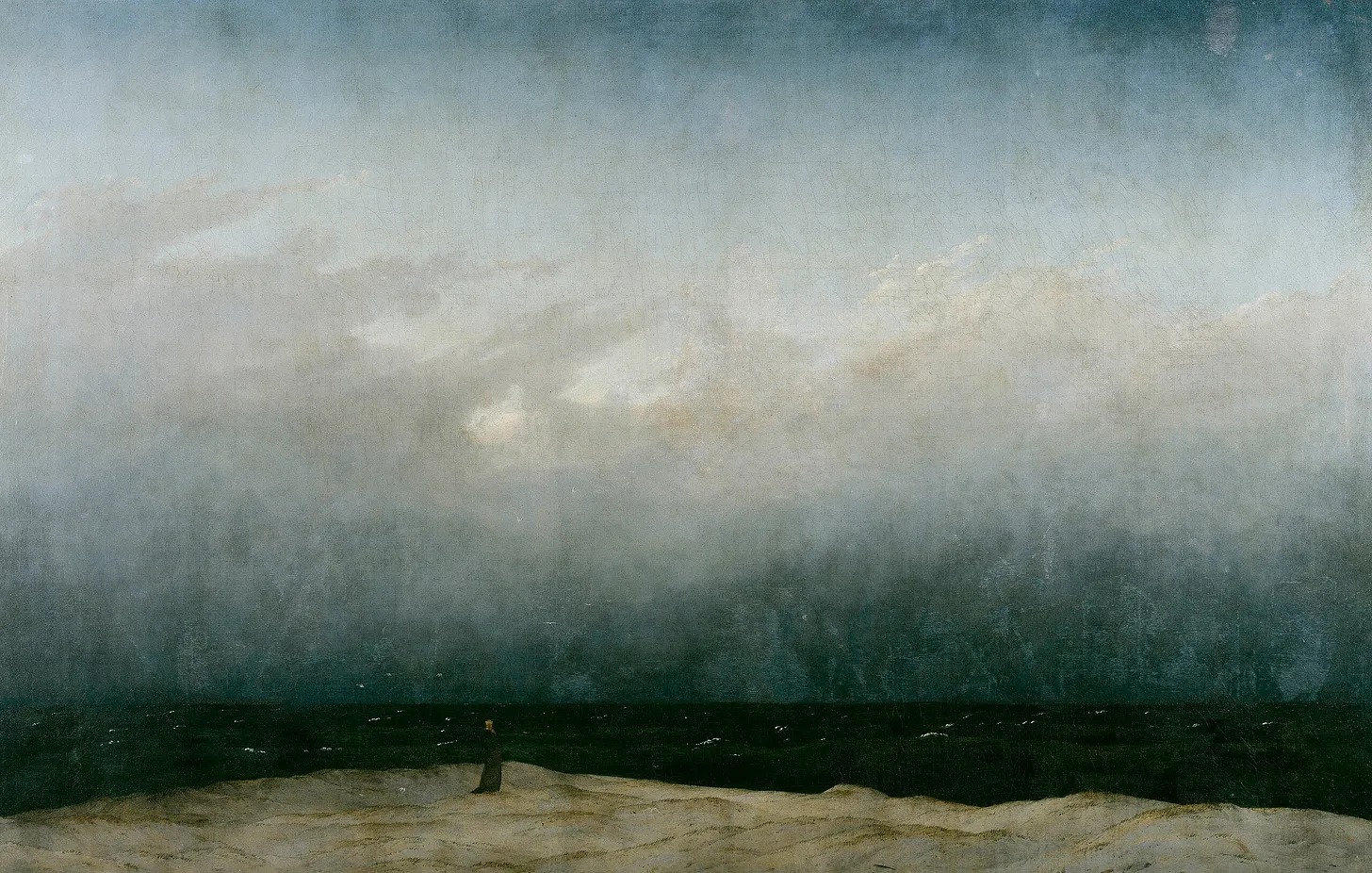
The Monk by the Sea - Casper David Friedrich - Painted sometime between 1808/1810 - Image Source, Wikimedia Commons
My claims upfront: We are born into an extraordinary mystery, with too few clues to realistically hope to solve it in this lifetime. We have been given a compass (moral compass, and intuition), so we do have something to guide us through this mystery, but we don’t know who gave us this compass, and we cannot prove in material terms its existence or reliability.
All the most important things cannot be proven by us here and now, and appear to belong to an ethereal realm that is intertwined with the material realm; the knowledge that life is meaningful has been given to us, and our only option is to either dismiss this knowledge that we access through subjective processes, or make a leap of faith by trusting it (which is what I mean in the title by ‘mysticism,’ and for my purposes here I could just as well have called it ‘spiritualism,’ or ‘romanticism’). Agnosticism is not an option in response to this unknown because life compels us to act, and our actions reveal our beliefs.
In an attempt to have certainty some people put on knowing more than they do, by claiming they know the moral compass to have material origins in behavior selected by natural selection through survival of the fittest. In addition to false certainty, this belief leads to nihilism because matter alone is soulless. There’s no sense in wasting time on any road known to lead to nihilism, since those roads are known dead ends.
The choice to believe in what we already seem to know through subjective processes does not lead to a lack of concern for objective truth because we must be objective about the information we submit to the judgment of subjective processes, if we want the subjective processes to point us in the right direction.
The realist does not bury their head in the sand and reject a whole realm of knowledge (subjective knowledge) just because it is mysterious, and appears to be (and may very well be) ethereal rather than material in origin. The realist accepts the mystery and then uses what little they do know to navigate the unknown as best they can.
Those are my claims up front, now I’m going to proceed to not prove an ounce of it. I’ll just show you that you already know I’m right.
There is a narrative arc, in my life, that mirrors a centuries spanning narrative arc of our civilization.
This being the journey that starts from solid foundations in Christian faith, then proceeds to initial doubts, and then to wandering out beyond the Church. This is a story that plays out at both an individual and civilizational scale. I know this story then at a personal level.
Like our civilization I grew up Christian (analogous to how the whole West was enveloped in Christianity for some centuries, and in places, well over a millennia), I had a solid foundation for my belief system: the word of God, bound between two covers, nice and neat. A divinely inspired instruction manual for life – perfect. Likewise the West, when it all came under Christendom, was confident it had the truth.
Then the West began to question its previously held beliefs in Christianity and the Bible. Doctrinal disputes here and there and what not, were the first pebbles of the eventual avalanche.
Christianity is still a significant force, of course, and its mark on the West, for both better and worse, remains visible everywhere. But The Church and the Bible have been dethroned. Most people do not accept an appeal to the Bible or church doctrine as valid argument.
Furthermore, the Church specifically has been singled out for exclusion from the halls of power, with the secular doctrine of the separation of Church and state, all the while, other belief systems are embedded within the state, such as scientism, Zionism, and up till recently, and perhaps soon again, Woke (which is a type of living dead, Christian/Un-Christian, zombie Christianity, that is based on the social gospel and the Beatitudes, all while vilifying its very own foundations by being anti-Christian. But Woke/zombie-Christianity, wasn’t seen as ‘The Church’ so it was allowed into the halls of power).
As with the West questioning Christianity after being immersed in it, I too had questions about the authority of the Bible and the legitimacy of Christian doctrine. Tugging at those questions ultimately unraveled the beliefs that I had at first thought would serve as the foundation for my world view. This set me adrift. I went from a believer who had the answers, to a wanderer seeking them.
At a societal level we haven’t handled this uncertainty very well at all. In fact we’ve generally refused to accept uncertainty, and have opted instead to end our wanderings at the first available opportunity by clamping down prematurely on conclusions. We’ve decided we must have certainty, and we must have it reducible to hard proof that can be physically measured by our instruments. This petulant response to uncertainty, has led us to insist that what lies beyond the capacity of our scientific instruments to measure, does not exist at all.
Our most fundamental experiences such as consciousnesses, and the exercise of our will, cannot be measured by our scientific instruments, and so the “scientific” view insists that they aren’t real at all – that they are mere illusions.
This insistence on only measurable matter being real is philosophical materialism, or in popular parlance atheism, which leads to excluding such ethereal concepts as a spiritual realm and the soul.
Most people profess some religious or spiritual belief but based on how I see people in our society act and argue I think that philosophical materialism has been the most prestigious belief system for well over a century, because arguments based on The Science (generally understood to limit itself to materialist explanations) are the most socially acceptable.
Matter alone is not meaningful, and so nihilism flows logically from philosophical materialism. You can see this in anything that philosophical materialism touches – it becomes dead and meaningless, or at least the modernist, whose unstated default position is philosophical materialism, tries to flatten whole fields of endeavor and reduce them to matter alone, and thereby deadens the field to the degree that they gain influence over it. Take art for example. Art, music, and poetry, are means of tapping into ethereal realms. They are to the ethereal, as the sciences are to the material.
Modernity Meets Art, Makes Surprising Discovery That Paintings Are Actually Just Paint Stuck to a Flat Surface.

No. 2, 1950 mixed media – Jackson Pollock
Recent centuries have seen a flowering of great art (thanks to romantic streaks that have survived “progress”), that serves as a medium channeling the ethereal and mysterious elements that flow through landscapes, and nature, and the human form. But this is something you detect by feeling it, and letting it speak to you on another level, not measuring it with a scientific instrument, and so of course from the materialist view, what the art channels doesn’t exist at all.
So what does a modernist mindset, where philosophical materialism is the prestigious viewpoint, look for in a painting? The measurable things, the physical paint itself, the flat surface, etc.
Read carefully the following excerpts from modernist art critics, and immerse yourself in their mindset:
– On the Materiality of Painting By Sam Powers 2019
“The painter no longer approached his easel with an image in his mind; he went up to it with material in his hand to do something to that other piece of material in front of him. The image would be the result of this encounter.”
“The big moment came when it was decided to paint…just to PAINT. The gesture on the canvas was a gesture of liberation, from Value—political, aesthetic, moral.”
The American Action Painters Harold Rosenberg – 1952
With modernist painting we get a nice encapsulation of what happens when you reduce things to physical matter only – painting became liberated from value, or we could say value free, valueless, pointless, nihilistic: flattened in more ways then one. The same happens at the macrocosmic level; when your world view is reduced to only believing in what is measurable with scientific instruments, then the world becomes to you about as shallow and surface level as Jackson Pollock’s No. 2.
(The supportive critics, and painters, of this kind of art may or may not be philosophical materialists themselves, but their approach, in which the physical matter itself becomes their focus, and they exhibit deafness and dumbness to the ethereal, is consistent with the physical materialism infused modernist outlook, and would be a very dense, dim, way of looking at art for someone who believes in an ethereal realm. That’s why I see philosophical materialism as the dominant belief of people who talk like these art critics do, even if they profess some spiritual beliefs)
Painting just for the sake of painting is meaningless. But the physical materials that make up a painting become meaningful when they are used as a medium that channels something else. Paint and panel that serve as portal, threshold, or liminal space. Matter that thins the veil. Likewise the whole material world becomes mysterious, and at least potentially deeply meaningful, if the physical world is not just itself, but is serving as the medium for the soul and the ethereal world.

The Abbey in the Oakwood – Caspar David Friedrick – painted 1808/1810, image source, Wikipedia
Our civilization’s flip from Christianity to nihilism is somehow built in as a sort of mutually assured destruction between Christianity and the West. At an individual level I have known many Christians to defend their belief in the inerrancy of the Bible by insisting that life would become meaningless to them if the Bible is not really the word of God; that if they don’t have the Bible as the bedrock of their faith, they have no reason for faith in anything. The Bible or nothing.
What I think this is, is a type of persuasion where you try to make someone (including yourself) believe something by making the alternatives seem unbearably awful.
Happens all the time:
Don’t believe in Covid? Well then you are going to die! Or…well…your grandma is going to die and it will be your fault!
Don’t believe in the Bible? Well then you are going to burn in hell for all eternity, muahahaHAHA!
Don’t think you need to convert your friends and family? What then, do you want them to burn in hell?
All the Abrahamic religions present themselves to their target audience as the only way. Lamentably even the poetic gospel of John puts forth such an argument:
“I am the way and the truth and the life. No one comes to the Father except through me.”
John 14:6
Let us hope that this was just some unscrupulous scribe, trying to bully people into belief, who put that passage in, and not the venerable Jesus of Nazareth saying such things.
We can see then that Christianity, like other belief systems, has tried to browbeat people into believing it, by making them think that it is the only option. Salvation through Christianity, damnation outside of it. The Bible is worthy of one’s faith or nothing is.
To respond to the crumbling of one’s Christian faith by going straight to nihilistic beliefs such as philosophical materialism/atheism is to succumb to the emotional blackmail that clever Christian activists and apologists began putting into place the better part of two thousand years ago.
Our society did succumb to that trap, or at least that’s part of my theory for our societal level rejection of post Christian wandering in favor of flipping right over into materialism.
What We Really Believe

Magdalene Before Mirror – Georges de La Tour – Painted around 1635-40 – Image source, Wikipedia
We do not have definitive material proof that life is meaningful, or that truth and goodness exist, in any meaningful way.
We also don’t have definitive material proof that they don’t exist; we have no compelling reason that would justify ruling them out. Life might be deeply meaningful. Truth and goodness may both exist in a meaningful sense, and we might have the means of accessing them, and knowing what they are or at least getting closer to them.
Agnosticism, simply not knowing, and not pretending to know, is then the most intellectually defensible position to be in, in regard to these big questions. But agnosticism won’t do. We don’t have the luxury of being agnostics. You can be an agnostic only so long as you don’t take action. Once you start doing things you reveal what you really believe.
I’m going to paraphrase William James now. I can’t find the book I read this in, and can’t find the quote online by searching for fragments of what I think the passage read, but anyways, I’m pretty sure I read this or something like it, in some collection or another of William James’ essays. Here it is:
“Suppose that a man in a room proclaims himself an agnostic on the question of whether or not the room is too cold, too warm, or just right. He simply doesn’t know, he insists.
But then this man, of his own volition, gets up, closes the windows, puts on a coat, and starts a fire in the fire place. By his actions he has revealed that he believed the room was too cold. He was not an agnostic after all.”
Henderson paraphrasing what he thinks is from William James.
The man’s actions above do not prove that the room is too cold, only that he believes the room is too cold.
So let’s now apply this concept that taking action reveals what your beliefs really are.
We intuit that we are capable of knowing goodness and truth or at least getting closer to them by consulting what we call the conscience, the moral compass, or the little voice in our head. In other words, we believe that we can hone in on goodness and truth like a dowsing rod equipped water witcher hones in on water.
We also believe that other people have this moral compass, and that theirs too will point them towards truth, goodness, and right action. However, we think that these moral compasses work to some extent like a key in a field guide. Let me explain:
If you have, say, a mushroom field guide, it will have a key that you ‘feed’ information into. The key will ask things like:
“Does the fruiting body (of the mushroom in question) have gills on the underside radiating out from a stalk? If yes, go to page X. If no, go to page Y.”
Then let’s say you go to page X, because the mushroom meets that criteria. Page X will ask you another question like:
“Is the mushroom growing out of dead wood?” and if yes, it will send you to another page, and if no, there will be other questions that will send you to different pages.
And in this way the key, will use all the information you feed into it (by answering its questions), to point you in the right direction, that is, it will identify what type of mushroom you are looking at with the major caveat that you must give the key accurate information, and you must have enough information. If you feed inaccurate information into the key it will give you a wrong answer. If you don’t have enough information – say you don’t know what color the mushrooms spores are, you may need to go out and collect more information (such as taking a spore print, or digging up the mushroom to inspect the base to look for other defining features), before the key can give you a reliable answer.
Moral compasses have a similar aspect. They will point you in the right direction if you give them accurate information to work with, or at least that’s what we all believe.
Now you may think me very arrogant for believing that I know that other people believe these things too. But I do. By their actions they are showing what they believe.
If we thought other people didn’t have moral compasses, we wouldn’t waste time arguing over what is the right thing to do. But we do frequently argue as if we believe that there really is a right and a wrong in the moral sense, and that we have a means of knowing this, and that the other person has a means of knowing this too.
Furthermore, we think that the reason the other person’s moral compass isn’t pointing them in the right direction is either because they aren’t listening to their moral compass (in which case we try to get them to do so with exhortations such as: imagine if it were the other way ‘round, listen to your heart/don’t be heartless), or we see that they are listening to their moral compass (trying to do the right thing, their heart’s in the right place), yet their moral compass is still pointing in a different direction from ours.
In the latter case, we don’t shrug our shoulders and go, “guess our moral compasses just point in different directions.” No, we still think that both our moral compasses are designed to point towards truth, goodness, and right action. We assume that at least one of us has fed inaccurate information into their compass/field-guide-key, and because of that the key/compass is pointing them in the wrong direction. We think that this can be remedied by finding and correcting the inaccurate information, or providing critical missing information. That’s why we inspect their argument looking for where they went wrong in constructing their premise, or went wrong in building on their premise, then we challenge them on the errors we identified in the hope of getting them to correct faulty premises, which will then lead their moral compass to re-calibrate and point them in the right direction.
A vast amount of discussion, argument, and introspection, from personal quibbles, to society wide debates, is consistent with people either trying to get people to listen to their moral compasses to begin with, or getting people to re-calibrate their moral compasses by correcting false information/premises that they fed into the compass’s ‘key.’
In this way (by observing our choices) it is as clear that we believe these things, as it is that the man who chooses to close the windows, put on a coat, and start a fire, believes the room is chilly.
Let’s keep going in this vein, looking at things we all, or many of us, believe, but won’t admit we believe, but give away that we believe them, by acting in accordance with these beliefs.
We intuit that the ethereal sensation of consciousness and free will are real. Our anguish and pain and guilt at times are all consistent with our believing that we really are at least partly responsible, that we really do have real choices in how we conduct our life, and that decisions we made, we could, at least some of the time, have made differently.
We intuit that our physical, material, body is the medium of an ethereal soul.
This belief in the body being the medium of an ethereal soul isn’t just visible in obvious ways, like beliefs in ghosts, an afterlife, or reincarnation; this belief permeates our language so much that we’re unfazed by people talking as if they consist of not just their physical body but something else too. Very common expressions show this belief:
“He conducted himself well”
As if ‘he’ consists of not just his physical body, but also another self, different from his physical body, that is leading his physical body, as if this non-physical self were a conductor, and his physical self, an orchestra.
“She’s driving herself too hard, she’s gonna get burnt out, driving herself like that”
As if ‘she’ is something other than her physical body, and that she is driving her body (‘herself’) like a man driving an ox, and in this case she’s driving ‘herself’ too hard, potentially leading to ‘herself’ (her body) balking at her demands, and getting too tired to carry them out. And so on and so forth, with sentences like these, which indicate that we believe ourselves to be made up of our physical body bound with something else, with something other than our physical body, but that is also us:
“I forced myself to do it”
“I tricked myself into doing it”
“You need to listen to what your body is telling you”
My own working hypothesis for what’s going on here is that our body is governed largely by laws of matter and Darwinian instinct, but that our ethereal soul can hone in on truth and goodness by means of a moral compass accessible to the soul. The moral compass sometimes points in a different direction from where our body’s instincts might want to lead us, leading to internal conflict. I cannot prove this of course, but I do think it is a good working model with a lot of explanatory power. More on that in a moment.
Then, whether we admit it or not, we believe that: there is goodness and truth. That we have a moral compass that can point us to goodness and truth. That other people have such compasses too. That these compasses are a bit like keys in field guides, and need accurate information to give good answers. That our volition is real. That we have real choices. And, that our self is not just our physical body, but some other self of ours that is not the physical body, but is bound up with the physical body, together making up our self.
We go on believing these things, and professing our belief in them through our actions, but we won’t profess our belief in them through our words. Why not?
Well for one we overreacted. We’re still throwing our civilization-spanning tantrum, where we threw out not just The Church, but the entire ethereal realm with it. We only want to admit to believing in what we can prove and measure with our scientific instruments. Admitting to believing the things we can’t prove is a low class, backwards bible thumper way of doing things. We, modern man, the control freak, will only admit to believing the things we can prove through science.
‘Dumb’ people admit to believing things that they can’t prove, ‘smart’ people believe those very same things and also can’t prove them, but the smart people won’t admit they believe them, because they’re, you know, smart, and rational – guided by science and reason.
What if these things we believe, we don’t just believe: what if we outright know them? How humbling would it be if arrogant man were to be granted the ability to prove things only within certain limits like the material world, but the most important knowledge we have we were simply granted from the get go, and we don’t even get to know who gave us that knowledge or how we’re accessing it? Well, that appears to be the case.
Darwinian Just So Stories

Painting by Carl Jutz, 1882 – Image Source, Wikimedia Commons
Our most basic experiences and beliefs point beyond mere matter. This poses a problem for materialists. So they (materialists) need a means of explaining away the presence of these experiences (i. e. that consciousness is an illusion, that just sorta happens once you get a big enough computer/brain going), or flattening these beliefs into matter only.
If you read materialists such as New Atheists and evolutionary psychologists, you will find that when they come up against something they don’t know and can’t prove, they often won’t just say “It’s mysterious: who knows what lies behind this?” Because they would find themselves leaving doors open right and left, and even opening doors that had before been thought sealed shut – doors that might lead to ethereal, non-material explanations, ugh, and they need the doors to the otherworldly shut tight, so that they can feel secure and confident in their materialist outlook.
At best they’ll acknowledge it’s an unknown, but that they know already that if the answer is ever found the answer will be a material explanation for the phenomena. This much they know, cuz . . . yeah, it’s scientific you see.
Often they’ll go further though and spin a Just So story, of how matter alone leads to something that appears otherworldly (as in, influenced by something beyond just the material world). These Just So stories are unfalsifiable. You can’t prove them right, you can’t prove them wrong, they might be true, they might not be.
The materialist favors their Just So story though, because often their Just So story is the best explanation from a materialist standpoint, and since they believe that materialist explanations are the only valid explanations, they see their Just So story as the most likely explanation, which it is, if you have first dogmatically ruled out the ethereal world, leaving only material explanations.
For example, Darwin felt the gloriously long train of feathers possessed by the male peacock was so extravagant as to be a handicap, a hindrance. That bothered him (Darwin that is, not the peacock; the peacock is very pleased with his over the top feathers. He thinks himself quite handsome with them, and the ladies agree). Why hadn’t natural selection favored a fitter peacock with a more modest feather train?
Well, the popular explanation among evolutionary biologists these days is that the more encumbered by an extravagant feather train the male is, the fitter he really has to be, to survive with something so unfit, so the extravagant feather train signals to the peahens that the male must be very fit, because of all that unfitness he’s burdened with, but surviving anyway.
You can read the long version of the tale about peacock tails and evolution here.
Now what the evolutionary biologists have done there is give themselves a story where evolution selects for both the fittest traits, but also unfit traits, to signal to females that a male with unfit traits must be extra fit to survive with the unfitness. Survival of the most unfit, that’s still fit enough to survive. What is going on here? Just So stories are being spun, that do nothing to truly advance our understanding; they just give a false sense that something mysterious has been explained through a Darwinian framework.
Something similar is done with our moral compass. Evolutionary psychologists create two opposite categories, and any evidence that contradicts one category they put into the other, making their theories unfalsifiable Just So stories. Stories that make it seem as though another unknown has been accounted for in Darwinian terms.
Moral imperatives are explained by evolutionary psychology to be a set of behavioral instincts, selected by natural selection, because those instincts led to the highest fitness at either the individual or the group level.
What about individuals sacrificing their own interests to do what they feel is right, such as monks, and nuns dedicating themselves to charity and piety, and sacrificing their own reproductive interests by doing so: how is that fit from an evolutionary standpoint? Well, they would say, it is evolution working at the group scale. Sacrificing for the good of the group makes the group fitter, and is a behavioral trait that natural selection would select for at the group level.
What about selfish behavior that benefits the individual but is detrimental to the group? Well, of course they would say that is evolution working at the individual level.
What about selfless behavior against one’s own group? Such as a whistle blower jeopardizing the success of their own side, and putting themselves in danger of retribution, because they feel their own side has acted wrongly? Well you know evolution is blind: sometimes you get runaway selection; it must be some trait that in other circumstances would have benefited the survival of the individual or the group, and here it just went awry.
Any data that contradicts one part of the story is just put in another, opposite category. Selfless behavior contradicts self interest so it just gets categorized at the group fitness level; selfish behavior that harms the group is moved to the individual self interest level. And if the behavior cannot be explained still, it is assumed that it must at one time have served at either the group or individual fitness level, and evolution being blind couldn’t foresee how it would be applied in a different circumstance, so it went awry.
Now let’s say that this were true, that moral imperatives really do just boil down to behavioral traits that ultimately just serve to enhance the fitness of the individual or the group. That would mean that right and wrong, good and evil, don’t really exist, in any sense other then being synonyms for fit and unfit. There would only be fit and unfit.
The little voice, the conscience, the heart’s whisper, would actually just be the voice of the survival of the fittest, of evolutionary instinct. The inner voice telling us something is good would really just be instinct pointing us towards behavior that is fit. The conscience warning us that some behavior is wrong, is really just instinct trying to prevent unfit behavior.
Now that we know this we should be able to replace all our of language about good and bad, and right and wrong, by just saying, that’s fit, or that’s unfit. In fact right and wrong couldn’t help but collapsing into just fit and unfit.
Let’s say country A, a more powerful country overruns country B, and exterminates the genetically different inhabitants of country B. You can’t possibly say that’s wrong, you could only say whether it’s fit or unfit, and it looks pretty fit actually (from an evolutionary standpoint), and if fit is the basis of morally right, then we would even have to say it was the morally right thing to do.
Or take a fertility doctor substituting his own sperm for artificial insemination without his patient’s consent: is that wrong? Well if right and wrong ultimately have their basis in fitness and unfitness, we’re going to have to say what he did was right. Take this guy, 94 kids at least, that makes him fitter than almost anyone else alive (from an evolutionary standpoint), doesn’t matter what happens to him now, he has been extremely fit, he fulfilled the purpose that morals are apparently serving too. I’m afraid we’re going to have to consider him one of the most morally good men for his deception. He excelled at the thing that evolution selects a sense of morals for to begin with – evolutionary fitness.
How about the biblical story where Moses orders the Israelites to slaughter all the Midianite men, boys, and married women, but keep for themselves the virgins (whose mothers, brothers, and fathers, they had just massacred): was that wrong?
“They fought against Midian, as the Lord commanded Moses, and killed every man. Among their victims were Evi, Rekem, Zur, Hur and Reba—the five kings of Midian. They also killed Balaam son of Beor with the sword.
The Israelites captured the Midianite women and children and took all the Midianite herds, flocks and goods as plunder. They burned all the towns where the Midianites had settled, as well as all their camps. They took all the plunder and spoils, including the people and animals, and brought the captives, spoils and plunder to Moses and Eleazar the priest and the Israelite assembly at their camp on the plains of Moab, by the Jordan across from Jericho.
Moses, Eleazar the priest and all the leaders of the community went to meet them outside the camp. Moses was angry with the officers of the army—the commanders of thousands and commanders of hundreds—who returned from the battle.
“Have you allowed all the women to live?” he asked them. “They were the ones who followed Balaam’s advice and enticed the Israelites to be unfaithful to the Lord in the Peor incident, so that a plague struck the Lord’s people. Now kill all the boys. And kill every woman who has slept with a man, but save for yourselves every girl who has never slept with a man.”
Well clearly we would have to say it was the most morally right thing they could have done, that it was good, nothing wicked or evil about it, because it was fit, it was very fit.
The reason we don’t say these awful behaviors that I listed above are good, and morally right, is because we know very well that the basis of good, and right, is not fitness. Darwinian morality is an oxymoron.
The moral compass is above and beyond evolutionary instinct, not a product of it, as we can see from the way the moral compass is just as likely to condemn as condone our instincts.
Our moral compass will take two behaviors, both of which are evolutionary advantageous, and tell us that one of of them is good, and the other bad. We will affirm an instinctive behavior that is fit, such as a mother’s love for her child, and our compass reading will tell us that yes, that is very good. But another equally fit, evolutionarily advantageous behavior, such as the Israelites’ treatment of the Midianites (above) our moral compass will point us away from; we recoil at it. If we’re listening to our heart then, we don’t want that done, not even if the one’s doing it were genetically our twins.
Even the Israelites’ who carried out the Midianite massacre, had to either ignore their moral compasses (behave heartlessly), or corrupt the reading of their moral compasses by feeding their compasses’ ‘keys’ wrong information; that God made them do it, and that the Midianites deserved it, because they had been very bad, worshiping the wrong gods, and other, you know, just somehow bad things that justified their being treated this way.
Remember my working hypothesis that I introduced earlier in this essay:
“My own working hypothesis for what’s going on here is that our body is governed largely by laws of matter and Darwinian instinct, but that our ethereal soul can hone in on truth and goodness by means of a moral compass accessible to the soul. The moral compass sometimes points in a different direction from where our body’s instincts might want to lead us, leading to internal conflict. I cannot prove that of course, but I do think it is a good working model with a lot of explanatory power.”
See how nicely my model can account for our moral compass condemning one behavior, and condoning another, even when both behaviors are fit and evolutionarily advantageous?
Of course my working hypothesis is as unprovable, at least for now, as the materialists’ Just So story, but at least I don’t have to engage in verbal acrobatics and mental contortions, saying things like,
“Well you see my dear, Watson, it’s elementary; the feeling of right and wrong is an evolutionary adaptation, which also frequently condemns evolutionarily advantageous behavior.”
I can avoid the mental contortions on the matter of the peacock’s feathers too. Instead of saying that, “Well clearly the burdensome unfitness of the extravagant and cumbersome feather train displays the male’s fitness. The more unfitness the male is burdened by the more fit he really is, and so survival of the fittest has selected for these unfit traits.”
Instead of that, I can propose a much cleaner more straightforward hypothesis. I can take the appearance of two principals at work, and think, well you know what? Maybe it looks like two principals are at work because there are two principals at work.
The female is selecting for beauty, and her sense of beauty is informed by something more than just fitness – some other principal. The male must then display this beauty to fulfill the females’ demand for it, but natural selection through survival of the fittest still comes into play, as only the fittest males can pull off the unfit display of beauty and still make it. The peacock is then a compromise, or maybe even a dance, between fitness and beauty, with beauty being a different principal from fitness.
The human I also see, I could put it this way, as a compromise, or a struggle, and maybe even, when we’re conducting ourselves especially well, a dance, between the Darwinian instinct driven material body, and the morally attuned ethereal soul, with the Darwinian instincts of the body, and the ethereal morals of the soul being separate principals.
Crossroads: Known Dead Ends Versus Destinations Unknown

Destination Unknown – Maynard Dixon – Painted in perhaps 1938? – Image Source, PaintingMania
We can choose materialism or other similar roads that ultimately lead to nihilism. These roads are dead ends, in that even if they were to turn out to be true they still wouldn’t lead us to anything worthwhile.
The only reason to choose the dead ends would be if the weight of the evidence came down so strongly in favor of materialism that we were compelled to see materialism, or some other path that leads to nihilism, as true if we wanted to remain honest with ourselves.
We don’t have to choose those roads though; we are not intellectually compelled in the slightest to take those paths, because the weight of the evidence is not in their favor. The best the materialists have done is make the world safe for atheism by creating a defensible intellectual framework around the dogma that only matter is real.
Defensible is not the same as likely though, and their perspective is no likelier then competing perspectives. The illusion that they have an edge is formed by making up Just So stories, which make it seem as though their perspective accounts for just about everything. But again, providing an account doesn’t mean your account is true, or likely to be true, in many cases it just means you spun a story, and in the case of Darwinian Just So stories, opposite effects (fitness/unfitness, selfishness/selflessness) are attributed to the same materialist principle, meaning no evidence can count against the story: it’s unfalsifiable, and unprovable. You could probably put a Biblical Just So story to the test more easily than a Darwinian one.
Now, the roads that lead off into mystery, that hold the promise of meaning, and goodness, we can’t prove those roads more probable to be true either, so why take them?
Well, if you were at a crossroads, and you knew that one set of roads were dead ends that led to meaninglessness, and another set of roads led off into the unknown, why wouldn’t you take the roads into the unknown? You have nothing to lose by taking them, and there you may find truth, goodness, meaning, and light. Whereas the known dead ends offer nothing.
This is why I think the materialists put on knowing more than they do, using Just So stories to paper over doors into the unknown, because unless the evidence were to be overwhelmingly in their favor, there’s simply no reason to waste time on the known dead ends. How much better, more exciting, and more promising to head down the unknown roads off into the mystery.
Now you might argue there’s a thousand unknown paths, how could we ever take the right one? The odds are against us, but no, to get going we’re not facing a thousand choices, we’re just facing one. Either, the means that we have been given to hone in on truth and goodness can lead us to the truth and the good or they can’t.
It’s something like the story in The Princess and the Goblin. The Princess Irene is given, by her great, great, grandmother, a ring, with a thin thread, woven from spider’s webs, attached to the ring, and to home. When she gets lost in the labyrinth of the goblin’s caves, she follows the faint feeling of the thin spider’s thread back to home.

Image Source MFLibra
We similarly are in some mysterious place; we don’t know where we are, how we got here, and don’t know the way forward, and to just pick a course of action at random sounds unwise, but we have a ring with a thin thread (the moral compass, our intuition, our conviction that life is indeed meaningful, and that there is good that we can hone in on, and so forth). Unlike Irene we don’t know who gave us the ring and the thread, but someone or something appears to be looking out for us.
My point here is that leaning into our beliefs (that we believe whether we admit to it or not, as revealed by our actions, as I went over earlier in the essay), is not to respond to uncertainty by just rolling the dice and picking a random course of action, it is to respond to uncertainty by leaning into the most promising things that we have been given, even if we don’t know how we got them or where they lead.
Options:
- Pointless course of action – to pick a road that is a known dead end, such as philosophical materialism which leads to nihilism.
- Careless course of action – to roll the dice and pick a random direction.
- Intuitive course of action – to place our faith in the tools we have been given to guide us, such as our moral compass, and use them to hone in on truth and goodness like a water witcher uses a dowsing rod, and hope for the best.
The third option of course is the only reasonable course of action, and so reason and romanticism re-converge, and intertwine, as they always should have.

The Ascension – Painting by Steve Henderson
Jordan Henderson lives in the Northwest of the United States. He works in oil paints, and charcoals. A portfolio of his works can be viewed at either of his websites: Original Paintings – Fine Art Prints.
Thanks for reading...
You can help us keep doing what we do. Every little helps and is hugely appreciated.



For other ways to donate, including direct-transfer bank details click HERE.
 wpDiscuz