Forget About ‘Healthy Life’
Sinéad Murphy
It has been reported that ‘healthy life expectancy’ in the UK has fallen during the past decade.
Disparity between the ‘healthy life expectancy’ of those in different regions of the UK has been described. A 20-year gap between the ‘healthy life expectancy’ of those in Richmond and the ‘healthy life expectancy’ of those in Blackpool has been alleged.
The concept of ‘healthy life expectancy’ has been bandied as if we have used it always. Its precursor, ‘healthy lifestyle,’ is already ubiquitous. Its successor, surely to be ‘healthy lifespan.’
But the concept of ‘healthy life-anything’ should be unusable. It should say nothing. Like ‘unmarried bachelor.’ Or ‘free gift.’ Or ‘organic food.’
What is health but life? The uninterrupted progression of life. Immersion in the projects of life. Involvement with life. Obliviousness to anything but life.
There is no ‘healthy life.’ There is only life.
We say that we fall ill. But if illness is a fall it is only because health is getting-on-with-life, folded into our purposeful expenditures of energy and attention, taken for granted.
Only illness is salient. Only illness is a thing.
Now that health is a thing – the biggest thing of all – it is like illness.
We submit samples to ‘Our NHS’ or download lists of ‘Keto’ foods or exchange cigarettes for ‘vapes’ or sign up to a marathon training programme – the details do not matter at all. What matters is that the obliviousness to health that is essential to health is gone.
There is now no real difference between health and illness. There is only the spectacle of difference between them and the veneer of sentiment with which it plays out.
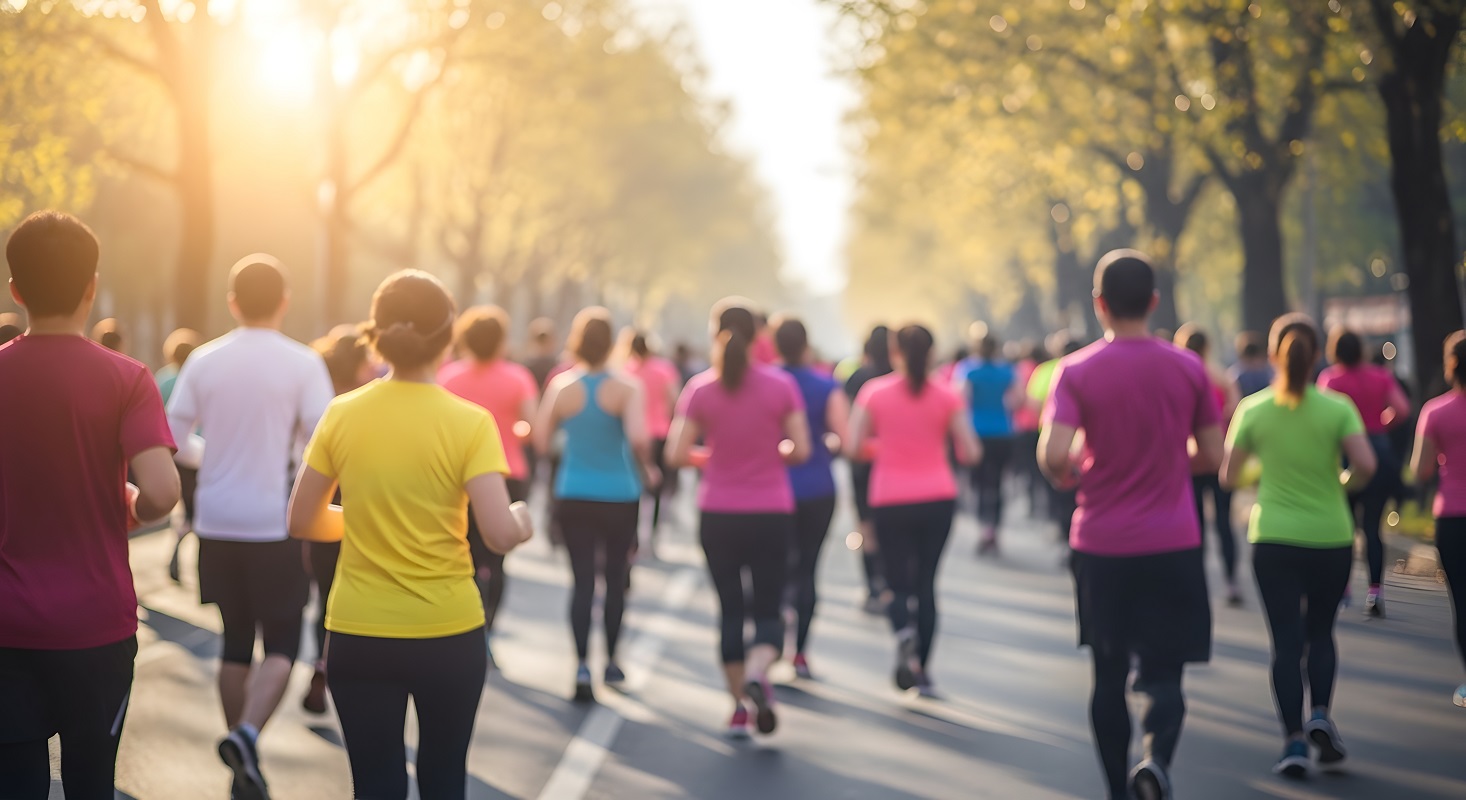
The ‘healthy’ hordes at Park Run are all but indistinguishable from the ‘ill’ pile-up in nearby cancer wards: misshapen bodies strapped to measurement devices of one kind or another, ailing from one punishing regime or another, according to one strand of expertise or another. Those ‘battling illness’ jostle alongside those in ‘full health,’ raising awareness or raising funds. Even the meds are shared; Park Run is sponsored by a pain-relief gel.
Health and illness comprise now the same interactions, the same losses, the same wins, the same monitorings by the same devices and the same institutions.
Through these same routines are refracted the mechanisms of our control: the rations and rewards, the data collections, the consumer opportunities, the recalibrations of diet, exercise, sleep. Ever-refreshed solutions to problems manufactured by discourse and by drugs.
Health and illness are no longer alternatives. They are not even two ends of a spectrum. They are only flavours of the same submission: to unmitigated surveillance, to inhuman engineering, to corporate concepts and products, to displaced experiences that we record and replay so as to have them and that pass for us as life.
*
Foucault detailed the execution in 1757 of Damiens the regicide. Public, bloody in the sublime, it exemplifies a brand of rule over people that was essentially spectacular, inscribed with excess on the few so as to produce subjection in the many.
Death was the currency of this brand of rule – imposed with artistry and eclat, or suspended theatrically at the final hour. As for life, it could go on as it would beneath the shock and awe.
Now there is a different arrangement of spectacle and power.
The might of the king inhered in the great show of his might; to rule, he must appear more than human, with infinite reach and absolute will. Our subjection relies on a great show of everything but might.
Nothing that is shown to us is what is done to us. Nothing that is done to us is what is shown to us. Display is, for us, without gesture. Gesture, for us, without display.
The spectacle of our times – the tremendous spectacle of ‘health’ – does not amplify the power that operates on us but distracts us from it. It does not make us see more force than is humanly possible but blocks us from seeing any force at all.
Ours is a modest tyranny. It does not rely on limelight but unfolds in the shadows, monitoring our every pulse and diagnosing and treating so as to steady us or steer us or make us stop.
Life is the currency of our brand of tyranny. Life – not as sacred gift of nature or of God, but as ever more detailed sets of data and their averages. This data is gathered and crunched behind our backs, a quiet nothing, addressing life at its most unobjectionable – its most neutral, its most bare.
But bare-life is not neutral. It is a manufactured phenomenon, an overlay of biopolitical modelling that recasts human life as livestock, to be farmed and not so humanely.
What makes us submit?
‘Healthy life,’ that is what. The great theatre of ‘healthy life.’ Which not only distracts us from our reframing as bare-livestock, but nudges us to apparatuses that at once constitute bare-life and decimate ways of life too wild to be farmed.
All aspects of erstwhile ways of life are hauled before us now as health issues, as ‘healthy life’: relationships, leisure, knowledge, ambition, sleeping, eating, making love. War, and work in the grocery industry: matters of ‘mental health.’
Life is made literally to pass before our eyes – as ‘health,’ which is to say, as illness. Reduced to a set of problems awaiting solutions only experts can tell.
‘Healthy life’ and bare-life: the pull and push of our subjection. The one: spectacular; total abstraction. The other: modest; total extraction. Bolstered by a interface of digital applications that amplify ‘healthy life’ and service bare-life.
We click through these applications in our headlong pursuit of one latest solution or another. A low-carb recipe, a best treatment for knee inflammation, a life partner. Consenting absently to the mechanisms of bare-life so as to reboot the spectacle of ‘healthy life.’ And the obliviousness that would make us ungovernable is eroded.
Mired in an unrelenting illness into which we did not and cannot fall, an illness that we call ‘health’ and mistake for life, we manage everything as if it is a symptom. Insofar as we apply their strategies, their devices, their products and their concepts to manage, we are managed.
Bits of life are delivered to us through approved channels – hashtag concepts, latest tech, ‘shared’ experiences, ‘made’ memories. Like vaccines, attenuated doses so we resist the thing itself (Tiqqun).
When life comes, in a rattle of fits and starts, it gains no purchase on us. We’ve already seen it. We already have it. We are immune.
And all the while, the inhuman data that substitutes for human vitality is mined without mercy.
*
How am I to live? The question that follows from all of this. The question defining of our times.
How am I to live?
As impossible to answer as, How am I to be healthy? Because it is the same question. And because to answer it is to render explicit that which is, by its nature, implicit.
This is the desperation unique to our age. We cannot find what we look for – health, life – because looking for it hides it from us. Like trust, it shrinks from our anxious gaze.
How am I to live?
The question is a trap. Much better to ask ourselves another: How am I to die?
For, as it is, we no longer die. The management regime that has turned health into illness and illness into a permanent state without fall, can only itself be managed. It can only be terminated.
Bare-life must be killed. Death too becomes a spectacle.
The rash of new laws admitting assisted suicide are only a show. As if being killed by the state is a marginal possibility, when it is now the default end to human lives.
Forget about health. Forget about life. By looking for them, we destroy them.
Better to turn our eyes to what does not disappear before them. Illness. Death.
Illness is made to be seen. Death, made for ritualised appearance. By looking for them, we do not destroy them.
Let us train our eyes on illness. Determine that when it comes it is a fall.
Let us train our eyes on death. Determine that when it comes it is not a crime.

Sinéad Murphy is author of Effective History (2010), The Art Kettle (2012), and Zombie University (2017), and co-editor of Pandemic Response and the Cost of Lockdowns (2022).
Thanks for reading...
You can help us keep doing what we do. Every little helps and is hugely appreciated.

For other ways to donate, including direct-transfer bank details click HERE.
 wpDiscuz