The Eclipse of the Soul
Todd Hayen

Humanity is unravelling. In the span of just a few generations—scarcely a century—we have witnessed a precipitous decline in the quality of our shared life. What was once a world of craft, connection, and quiet moral coherence has given way to machine-made uniformity, moral drift, environmental squalor, widespread addiction, and a pervasive spiritual emptiness.
The symptoms are everywhere: drugs flooding communities, garbage choking landscapes, ethics treated as quaint relics, families dissolving, and relationships reduced to transactions. Many sense the rot but struggle to name its root. The cause, at bottom, is simple yet profound: we have ceased to value what is real. We have traded conscious relationship with soul for mere stuff.
This is not merely nostalgia for a romanticized past. For most of human history, daily life was saturated with human presence and intention. A child’s hobby horse was not ordered from a warehouse but carved by hand—perhaps by a parent or village craftsman. Houses rose under the skilled hands of bricklayers, carpenters, and masons who brought years of embodied knowledge and personal care to their work.
These creations carried something especially potent: the energy of focused attention, love of craft, and a sense of participation in a larger story. Even primitive shelters—the thatched huts of early communities—were built in the context of kinship, mutual reliance, and a felt connection to the living world. Soul flowed visibly through the making.
In truth, all material objects in God’s universe possess soul—they are part of one unified, living matrix. Yet humans more readily access and recognize this soul through direct connection with nature—especially other living beings, but also in the broader natural world of plants, sunsets, rivers, and even ancient rocks. Within our human realm, objects crafted by hand from these natural materials carry a particularly potent resonance of soul.
These handcrafted objects act as bridges, carrying the imprint of both divine creation and human soul.
Technology has accelerated a process underway for over a hundred years. Machines now dominate production. Efficiency and scale have triumphed, delivering abundance and uniformity. While these objects are not devoid of soul, they often lack the intimate human touch that makes the divine presence more immediately accessible to us. Most people no longer notice the difference, yet something vital has diminished.
A mass-produced chair may function identically to a handcrafted rocking chair, but it carries less of the concentrated human heart and artistry that helps us feel the deeper energy. We sit in it without the subtle, unconscious nourishment that comes from knowing another soul consciously poured itself into the making. Our non-material heart—our deeper self—goes partially hungry.
This materialist shift reflects a deeper philosophical error. We have embraced a worldview that sees the universe as an arbitrary product of blind cause and effect. Without belief in an intentional creation—whether framed as God, a meaningful cosmos, or a purposeful intelligence—life collapses into mere biology: bodies consuming resources, competing, and reproducing until they expire. Meaning, purpose, and transcendence become illusions or evolutionary byproducts at best. In such a cosmos, the tangible and measurable naturally take precedence. Money, possessions, status, and pleasure become the measures of a successful life. The invisible dimensions—love, fidelity, compassion, beauty, moral courage—lose their claim on us.
The consequences cascade outward. If life is fundamentally material, then family and relationship lose their sacred weight. They become optional arrangements valued only insofar as they deliver convenience or pleasure. Yet these bonds are precisely where soul most notably dwells: in the unseen realities of commitment, regard, receptivity, and shared suffering.
When we prioritize the physical over the relational, we erode the very ground of meaning. A life oriented toward being good, caring for others, and mitigating suffering feels pointless when the highest good is material acquisition. Without belief in something bigger than the physical world (like God, a meaningful universe, or a higher purpose), people stop feeling a deep reason to be ethical or moral. Why sacrifice for the neighbour, the stranger, or future generations if nothing ultimately matters beyond the physical self and its appetites?
The further we drift from conscious relationship with soul-infused creation and connection, the more fragmented we become. Community dissolves into materialist narcissism. Work loses its dignity as vocation and becomes mere labour. Art, architecture, and everyday objects grow uglier and more disposable. We surround ourselves with artifacts that make the soul harder to feel and wonder why we feel empty.
The soul, undernourished, begins to express its neglect through shadow: addiction, despair, cruelty, and nihilism. As Jungian thought reminds us, what is unconscious does not disappear—it erupts.
At its core, this diagnosis aligns with a profound spiritual principle, often rendered as: Nothing real can be threatened. Nothing unreal exists. This is a core teaching from A Course in Miracles (ACIM), a spiritual text published in 1976. It was dictated to psychologist Helen Schucman, who claimed it came as an inner voice from Jesus. The line summarizes the Course’s central idea: only what is of God/love/spirit is truly real and eternal; everything else (fear, ego, the material world) is illusion.
The materialist project, for all its glittering achievements, is built on the unreal—the illusion that meaning is secondary, that soul is superstition, and that love and purpose are mere byproducts of matter. These unreal foundations cannot sustain a flourishing culture. They are threatened by their own hollowness, and they threaten us in turn.
Reversing this eclipse does not require rejecting technology or returning to pre-modern hardship. It demands a revaluation of values. We must consciously restore our awareness of the soul present in all things, while giving special attention to those avenues—nature and human craft—through which we most readily feel God’s living presence.
This begins in small acts: choosing the handmade when possible, spending time in nature, investing deeply in family and community, orienting our purpose toward service and soul-making, and reclaiming a sense of the sacred in the created world. It continues through cultural renewal: supporting artists, artisans, and builders who infuse their work with presence; educating toward wisdom rather than mere utility; and cultivating the inner life through reflection, dream, relationship, and ethical practice.
Humanity does not fall apart from external forces alone. It disintegrates when we forget who we are—embodied souls navigating a meaningful cosmos, not mere consumers in a machine-made void. The mass-produced chair may rock the same, but the handcrafted one more readily carries the living imprint of another heart and, through it, the divine.
Only one feeds what truly endures. The choice before us remains: Will we value the real, or continue building our world from the unreal? The soul of mankind hangs in the balance.
*
Todd’s newest book The View of the Shrew: Unmasking the Truth in a Confused World 2025, has just launched on Amazon.
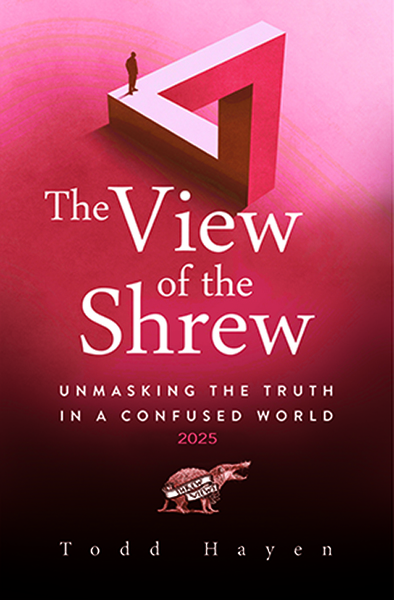
You can claim a FREE advanced reader e-copy in exchange for leaving an honest review! Click HERE to sign-up. Offer open until August 6th.

Todd Hayen PhD is a registered psychotherapist practicing in Toronto, Ontario, Canada. He holds a PhD in depth psychotherapy and an MA in Consciousness Studies. He specializes in Jungian, archetypal, psychology. Todd also writes for his own substack, which you can read here
Thanks for reading...
You can help us keep doing what we do. Every little helps and is hugely appreciated.




For other ways to donate, including direct-transfer bank details click HERE.
 wpDiscuz