Chronicling the Global Agri-Cartel’s Assault on Rural India
Colin Todhunter
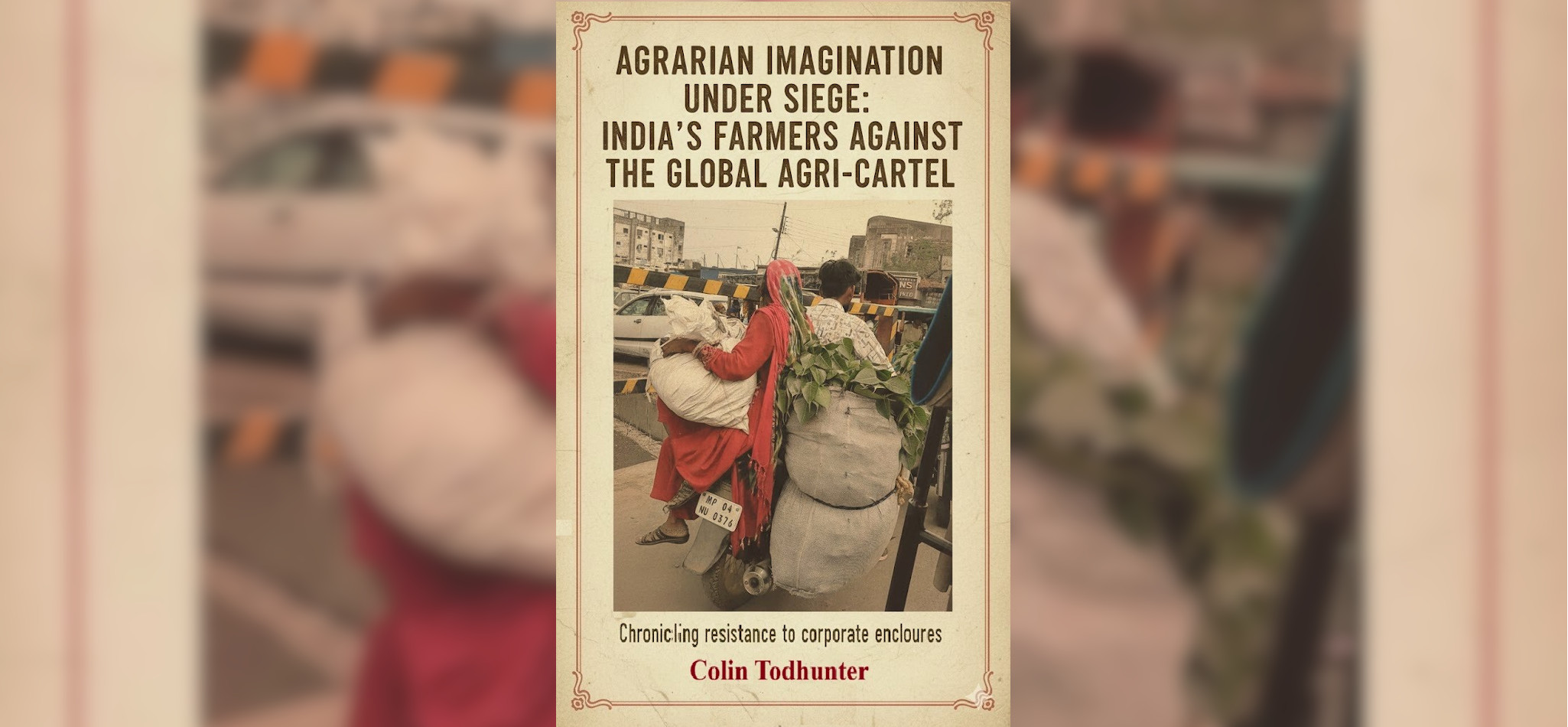
Agrarian Imagination Under Siege: India’s Farmers Against the Global Agri-Cartel (2006) is now available to download for free at Zenodo.
The global news cycle is notoriously fleeting, often treating systemic shifts as fleeting moments of spectacle. When the historic farmers’ protests in India during 2020–21 reached their zenith, images of tractor convoys and mass encampments on the outskirts of Delhi dominated international headlines.
However, while the cameras have long since moved on to other crises, the struggle has not ended. The agrarian crisis has deepened and shifted into new, more complex territories, making the stakes for the future of food and rural life more urgent than they have ever been.
A new collection of 19 essays, written between 2015 and early 2026, offers an archive of this ongoing battle. Far from being a mere historical record of past grievances, this volume serves as a single, consolidated access point for understanding the systemic forces currently attempting to dismantle the foundations of rural India.
It conveniently brings together a selection of writing previously scattered across several books, print publications and digital platforms. By bringing together these essays, the collection provides a resource for those who are working to navigate the complexities of modern food systems or who are just interests in where there food comes from, how it is cultivated and who controls it.
However, this collection is far more than a chronicle of economic policy and resistance. It is a documentation of a war on life itself. It captures an existential struggle against the attempt to strip the soul from Indian agriculture and replace it with a mechanical, profit-driven logic.
Behind the technical language of memoranda of understanding and the implementation of digital control grids lies a move to alienate people from their own heritage. The book explores the corporate capture of food systems and the erosion of rural livelihoods, revealing how the sacred bond between the farmer and the land is being redesigned into a series of digital extraction points. It documents the refusal of millions to be reduced to mere data points, highlighting a massive, grassroots insistence on human dignity.
While the heart of this book is firmly rooted in the realities of India, the questions it raises transcend national boundaries and speak to a universal condition. Readers residing in any corner of the globe will recognise the same logics of commodification and control currently transforming landscapes from the Americas to Europe and beyond.
Whether it is the loss of local autonomy or the encroachment of high-tech surveillance on traditional farming practices, the forces reshaping India’s countryside are global in scope. This collection serves as a mirror for any society facing the encroachment of corporate power over the basic right to food, land and self-determination.
As we move through 2026, the situation in India remains the frontline of a global debate about what it means to be human in an age of total digital and corporate capture. This book is a sobering reminder that while the international headlines may have faded into the background, the resistance continues with renewed intensity. The struggle for the countryside—whether in India or elsewhere—is a struggle for the future of humanity’s connection to nature.

Colin Todhunter specialises in food, agriculture and development and is a research associate of the Centre for Research on Globalization in Montreal. His open access books on the global food system can be accessed via Figshare (no sign in or sign up required).
SUPPORT OFFGUARDIAN
If you enjoy OffG's content, please help us make our monthly fund-raising goal and keep the site alive.




For other ways to donate, including direct-transfer bank details click HERE.



“Bureaucracy is Procedure; without procedure, no bureaucracy” … (anon) …
Big tech Palantir put automated procedure (algorithm) to lethal effect in The
Killing Fields of Gaza…
“Down with the Dictatorship of Procedure !
Down with the Dictatorship of Algoritgms !” … (anon) …
Whatever happened to Gaza. The youknowwhats are still killing Palestinians hand over fist. This, I hate to tell you, is wrong. And they should be stopped. With extreme
Good article, I know Indian’s love their cattle, but the West doesn’t – the cow fating myth is just another angle to control the amount of meat we eat – meat contains a plethora of minerals the body needs – I suppose they want you a veggie, so that you become weaker and rely on more medication.
“This is part two of a two part discussion with Christof Plothe DO on the issue of Bovaer. Bovaer is a drug marketed as a methane-reducing feed additive for cattle, with claims of reducing methane emissions by 30% in dairy cows and 45% in beef cattle. Its mechanism of action is rooted in disrupting natural biological processes. The long-term effects remain entirely unknown, raising serious concerns about the safety and ethics of deploying this unproven chemical experiment on a global scale.”
The Dangers of Bovaer and Its Implications for Public Health – Science, Public Health Policy and the Law
Been a vegan for fifteen years.
No ailments, no drugs, no problems.
Which is the opposite of almost all the omnivores I know.
I’ll never see 70 again.
Do some research.
The minerals and vitamins obtained through meat is derived vicariously. Minerals and vitamins come from plants grown in soil and exposed to sunshine. The only vitamin we humans can generate ourselves is vitamin D when exposed to the sun.
Crocs, cats, some birds and a few other animals are obligate carnivores, humans are not.
In fact, Dan Buttner studied longevity in human cultures across the world and wrote some books about the “blue zones” where people lived the longest and found that in those regions people ate mostly vegetarian foods, if not vegan. Check it out – here an article:
Blue Zones: Lessons From the World’s Longest Lived
Dan Buettner, BA, and Sam Skemp, BA
Typo in the year? s.b.2026
Money doesn’t grow on trees.
Unless _ _ _ _ _