The Haunted Village: The Local Has Become a Ghost in Its Own Home
Colin Todhunter
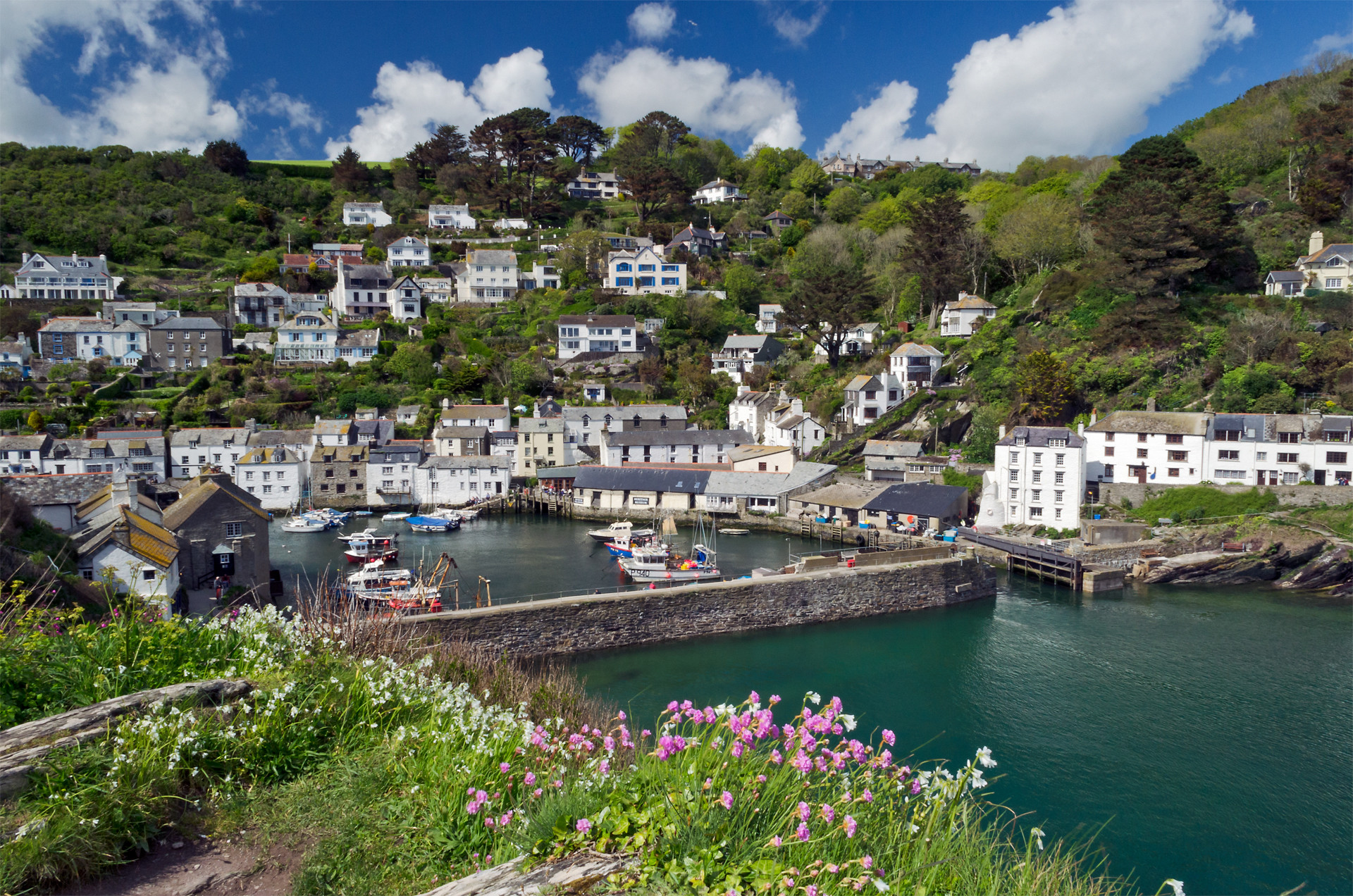
An edited excerpt from The Great Flattening: How Everything Is Being Taken, a forthcoming book by Colin Todhunter on enclosure, place and autonomy.
In the Cornish coastal village of Polperro during the first half of the 20th century, the smell of the harbour was inescapable. It carried fish in various states of decay and preparation.
The smell moved through alleys, up stone steps and into doorways. It mixed with rope, wet timber and the residue of labour embedded in the quay’s very surfaces.
As photogenic as the harbour might have been at the time, it was a gritty point of contact between sea and settlement. Here, catching, gutting, mending and selling occurred in a place that was visible to everyone. Life was hard and the risks were immediate. A shift in the wind or a poor catch had consequences that could not be deferred.
Today, if you visit the village (and others like it), the walls, the slips and the narrow streets remain, but the activities and sensory range have narrowed. What remains is carefully managed for mass tourism.
Aside from the usual trappings associated with the tourist economy, we can see this in belief systems. In Polperro, the transition from a genuine belief in piskies (pixies) to their current status as shiny souvenirs and fridge magnets follows the village’s shift from a self-contained working society to a place reshaped for outsiders.
In the 1700s and 1800s, piskies were a practical reality. Local people didn’t see them as magical icons. They were earthy, weathered beings that explained why a boat might fail or why a path home became suddenly confusing in the dark. They represented the danger and randomness of a life lived on the edge of the sea.
To a fisherman in 1850, a piskie was a way to personify the uncertain forces that could ruin a life’s work in a single night. This fear was functional because it kept the community tied to the rhythm of daily life and the harsh reality of the coast.
Gradually, however, the piskie was stripped of its teeth. As artists and travellers arrived in the late 19th century, they turned a serious local truth into a curious bit of folklore for entertainment. Once the daily pressure of working the harbour vanished, the original purpose of the piskie went with it. The figure was rebuilt as a smiling plastic item sold to people who have no connection to the village’s difficult past.
This transformation follows a sequence we see across the globe. First comes the outside attention: painters, actors, writers and travellers arrive and recast the notion of the village in terms of its ‘character’ and continuity or ‘tradition’. The village begins to be understood by how it appears to those arriving from outside, rather than how it functions for those within.
Eventually, the economy turns outwards entirely. Income becomes tied to external demand, which fluctuates according to fashion rather than local production. This is a form of enclosure without physical barriers. Exclusion is shaped through affordability (expensive restaurants and hotels) and systems of allocation (fewer locals and more holiday lets).
As housing shifts into intermittent occupation or short-term rentals, the village is no longer structured around the people who maintained its daily continuity. Streets that were once lived-in year-round become partially empty outside peak seasons. The village persists as a form, but its internal logic is now produced elsewhere.
This is not a uniquely Cornish phenomenon. From the Scottish Highlands to the Welsh coast and the Yorkshire moors, we are witnessing a ‘flattening’. Different villages, shaped by vastly different histories of work, are beginning to converge. Agricultural, industrial and coastal histories become secondary to a shared requirement of what it means to be a ‘village’ in a globalised world where the ‘local’ has been displaced.
Enclosure operates through replacement of function, and ‘flattening’ (homogenisation) operates through repetition of what remains visible after that replacement. The gentrified village remains open (if you can afford to stay), but its use is determined by the needs of private capital located elsewhere and the digital platforms that manage a transient population.
Polperro’s streets still follow their ancient lines. The visual form remains strong. But the connection between these forms and the activities that shaped them has weakened. It is now possible to stay in the village without ever touching the systems that sustained it.
The quay is relatively quiet and the environment is curated. The ‘local’ has become a ghost in its own home.

Colin Todhunter specialises in food, agriculture and development and is a research associate of the Centre for Research on Globalization in Montreal. His open access books on the global food system can be accessed via Figshare (no sign in or sign up required).
Thanks for reading...
You can help us keep doing what we do. Every little helps and is hugely appreciated.




For other ways to donate, including direct-transfer bank details click HERE.



10/10
Exact same story in Ireland’s west and other coastal villages. The populations were much greater in number 200 years ago than today and nobody is left who could say how the people lived there
Nothing of the original culture remains it has all been replaced by government department store fronts, medical, educational, welfare or tourism for the most part is all that happens there now.
The past 200 years was thick with rembrances
200 from now should there be, will have nothing to share but the certainty of the enforced ideology.
Air B&B has ruined many a beautiful place – in Scotland tourism is welcome but it can in some instances be overwhelming to an area.
Also in the Scottish colony over one million English people have moved to Scotland – mainly older English folk looking for more bang for their buck North of the border – their presence changes old villages from the inside out – young folk can’t get a social house – or there’s very few if any available properties to buy.
“Wherever you go, there you are.” – Buckaroo Banzai. Except for those unique places which will be purged of regular folks for the exclusive enjoyment of a few, self-chosen, wealthy, Which is scary because, as anyone who has spent any time around them will know “rich people have no taste” (from a gallery owner I knew who would curate, for a stiff fee, the homes of the wealthy).
Yeah man.Where has it all gone.Do we only have it for a decade ? Is that what a decade is ? Shite x
the same thing has been happening to our villages in greece. mass tourism has been invading relentlessly. our own village, where we live year round and have til now avoided being directly contaminated by tourism, has still been eroding in recent years from the corrosive flood of fakeness that ever year seems to be lapping a bit higher up the mountainside and is now splashing our toes. there still isnt an ‘airbnb’ in our village but the next village down the mountain has been inundated with them, as the old timers die their heirs dont move back from the city, but turn the house into yet another cookie cutter tourist accomodation. in our own village we’re still second or third cousins with almost everyone we see day to day, but you can see it pulling apart. the younger generation has already lost most of the foothold by moving away for jobs etc, and even half the folks who live here still, work in town or down the mountain in some tourism related venue and have gotten hooked on that flow of money.
of course the government etc dont help at all- theyve decided that they dont want any other way of life _except_ tourism and actively make it almost impossible to live from the land like we used to.
Love of money is the root of all evil. Will the tourists stay home when Greece is totally tokenized, probably not.