The Surveillance State Is Making a Naughty List—and You’re On It
John & Nisha Whitehead
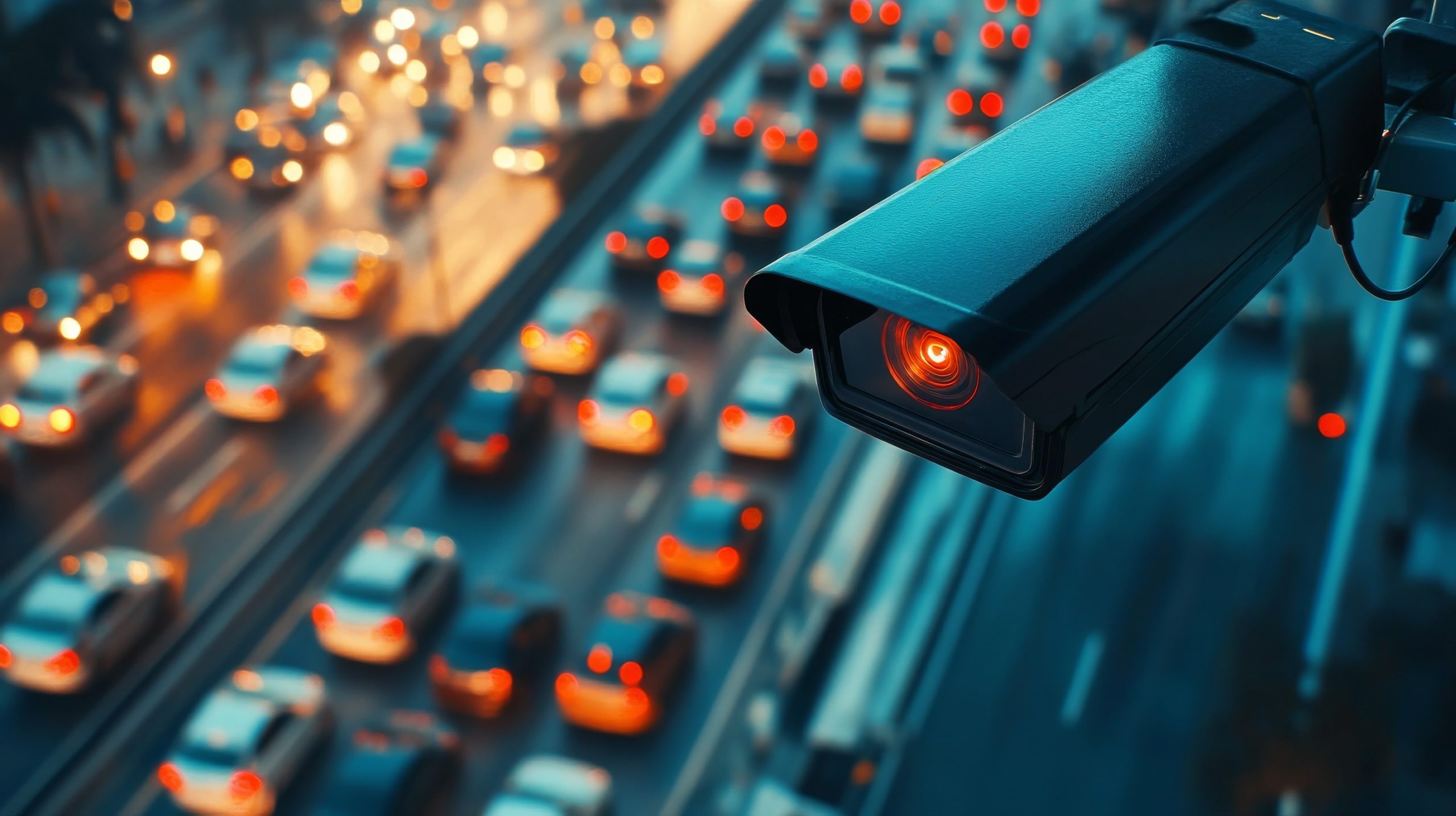
“He sees you when you’re sleeping.
He knows when you’re awake.
He knows if you’ve been bad or good,
So be good for goodness’ sake.”
“Santa Claus Is Coming to Town”
For generations, “Santa Claus Is Coming to Town” has been treated as a playful reminder to children to be good because someone, somewhere, is watching.
Today, it reads less like a joke and more like a warning.
The Surveillance State is making a naughty list, and we’re all on it.
Long before Santa’s elves start loading his sleigh with toys for good girls and boys, the government’s surveillance apparatus is already at work—logging your movements, monitoring your messages, tracking your purchases, scanning your face, recording your license plate, and feeding it all into algorithmic systems designed to determine whether you belong on a government watchlist.
Unlike Santa’s naughty list, however, the consequences of landing on the government’s “naughty list” are far more severe than a stocking full of coal. They can include heightened surveillance, loss of privacy, travel restrictions, financial scrutiny, police encounters, or being flagged as a potential threat—often without notice, explanation, or recourse.
This is not fiction. This is not paranoia.
This is the modern surveillance state operating exactly as designed.
Santa Claus has long been the benign symbol of omniscient surveillance, a figure who watches, judges, and rewards. His oversight is fleeting, imaginary, and ultimately harmless.
The government’s surveillance is none of those things—and never was.
What was once dismissed as a joke—“Santa is watching”—has morphed into a chilling reality. Instead of elves, the watchers are data brokers, intelligence agencies, predictive algorithms, and fusion centers. Instead of a naughty-or-nice list, Americans are sorted into databases, risk profiles, and threat assessments—lists that never disappear.
The shift is subtle but profound.
Innocence is no longer presumed.
Everyone is watched. Everyone is scored. Everyone is a potential suspect.
This is the surveillance state in action.
Today’s surveillance state doesn’t require suspicion, a warrant, or probable cause. It is omnipresent, omniscient, and inescapable.
Your smartphone tracks your location. Your car records your movements. License plate readers log when and where you drive. Retail purchases create detailed consumer profiles. Smart speakers listen to everything you say. Home security cameras observe not just your property, but your neighbors, delivery drivers, and anyone who passes by.
The government’s appetite for data is insatiable.
In a dramatic expansion of surveillance reach, the Transportation Security Administration now shares airline passenger lists with Immigration and Customs Enforcement, enabling ICE to identify and arrest travelers at airports based on immigration status.
In one incident, ICE arrested and immediately deported a college student with no criminal record who was flying home to spend Thanksgiving with her family.
What was once routine aviation security data has been transformed into an enforcement tool—merging civilian travel records with the machinery of deportation and demonstrating how ordinary movements can be weaponized by the state.
Even the most personal acts—like Christmas shopping—are now tracked in real time. Every item you buy, where you buy it, how you pay, and who you buy it for becomes part of a permanent digital record. That data does not stay confined to retailers. It is shared, sold, aggregated, and folded into sprawling surveillance ecosystems that blur the line between corporate data collection and government intelligence.
Companies like Palantir specialize in fusing these data streams into comprehensive behavioral profiles, linking financial activity, social media behavior, geolocation data, and government records into a single, searchable identity map.
The result is not merely a government that watches what you’ve done but one that claims the power to predict what you will do next.
It is a short step from surveillance to pre-crime.
While predictive policing and AI-driven risk assessments are marketed as tools of efficiency and public safety, in reality, they represent a dangerous shift from punishing criminal acts to policing potential behavior.
Algorithms—trained on historical data already shaped by over-policing, bias, and inequality—are now used to predict who might commit a crime, who might protest, or who might pose a “risk.” Even the way you drive—where you came from, where you were going and which route you took—is being analyzed by predictive intelligence programs for suspicious patterns that could get you flagged and pulled over.
Once flagged by an algorithm, individuals often have no meaningful way to challenge the designation. The criteria are secret. The data sources opaque. The decisions automated.
Accountability disappears.
This isn’t law enforcement as envisioned by the Founders. This is pre-crime enforcement—punishing people not for what they’ve done, but for what an AI machine predicts they might do.
At the same time, President Trump has openly threatened states that attempt to regulate artificial intelligence in order to protect citizens from its discriminatory and intrusive uses—seeking to clear the way for unchecked, nationwide deployment of these systems.
No government initiative has done more to normalize, expand, and entrench mass surveillance than the Trump administration’s war on immigration.
The Trump administration’s war on immigration has become the laboratory for the modern surveillance state.
Under the guise of border security, vast stretches of the country have been transformed into Constitution-free zones—places where the Fourth Amendment is treated as optional and entire communities are subjected to constant monitoring.
The federal government has transformed immigration policy into a proving ground for authoritarian surveillance tactics—testing tools, technologies, and legal shortcuts could be deployed with minimal public resistance and quietly repurposed for use against the broader population. As journalist Todd Miller warned, these areas have been transformed into “a ripe place to experiment with tearing apart the Constitution, a place where not just undocumented border-crossers, but millions of borderland residents have become the targets of continual surveillance.”
Through ICE and DHS, the government fused immigration enforcement with corporate surveillance technologies—facial recognition, license-plate readers, cellphone tracking, and massive data-sharing agreements—creating a sprawling digital dragnet that now extends far beyond immigrants.
What began as a policy aimed at undocumented immigrants has now become a model for nationwide surveillance policing.
“What’s new,” reports the Brennan Center for Justice, “is that the federal government now openly says it will use its supercharged spy capabilities to target people who oppose ICE’s actions. Labeled as ‘domestic terrorists’ by the administration, these targets include anti-ICE protesters and anyone who allegedly funds them—all of them part of a supposed left-wing conspiracy to violently oppose the president’s agenda.”
The critical point is this: the surveillance infrastructure developed to track immigrants is now used to monitor everyone. Immigration enforcement served as the justification, the infrastructure, and the legal gray zone needed to create a permanent surveillance apparatus that treats all Americans as potential suspects.
All of this adds up to an algorithmic naughty list.
Government watchlists have exploded in size and scope.
Terrorist watchlists, no-fly lists, gang databases, protester tracking systems, and “suspicious activity” registries operate with little oversight and even less transparency.
People can be added to these lists without notification and can remain there indefinitely. Errors are common. Corrections are rare.
Social media posts are mined. Associations are mapped. Speech is scrutinized. Peaceful dissent is increasingly treated as a precursor to extremism.
The government’s watchlists aren’t just opaque databases hidden from public view. They are becoming public-facing instruments of political classification. Internal Justice Department memoranda now direct the FBI to compile lists of groups and networks it categorizes as possible domestic extremists, broadening counter-terror tools to sweep in ideological opponents and organizations without clear statutory definitions.
At the same time, the White House has launched an official “Offender Hall of Shame”—a public naughty list of journalists and media outlets it accuses of bias—even briefly circulating a video styled like Santa putting together a naughty list of offenders before deleting it amid backlash.
In this system, being “good” no longer means obeying the law. It means staying under the radar, avoiding attention, and never questioning authority.
The chilling effect is the point.
Once upon a time, privacy was recognized as a fundamental liberty—an essential buffer between the individual and the state. Today, it’s a conditional privilege, granted temporarily and revoked when it suits the police state’s purposes.
Under the banner of national security, public health, and law and order, surveillance powers continue to expand. Biometric identification—facial recognition, gait analysis, voice prints—are normalized.
What was once unthinkable has become routine.
Americans are being conditioned to accept constant monitoring as the price of safety. That resistance is suspicious. That anonymity is dangerous.
Yet history teaches us the opposite: societies that normalize surveillance do not become safer—they become more authoritarian.
A government that sees everything, everywhere, all the time, will eventually control everything.
The Founders understood this. That is why they enshrined protections against unreasonable searches and unchecked power. They knew liberty couldn’t survive under constant surveillance.
When the government knows where you go, what you buy, what you say, who you associate with, and what you believe, freedom becomes conditional.
This Christmas, we might joke about Santa watching from the North Pole, but we should be far more concerned about the watchers much closer to home.
The surveillance state doesn’t take a holiday. It doesn’t sleep. It doesn’t forget. And it doesn’t forgive easily.
So you see, the question is not whether we are being watched. We are.
The question, as I make clear in my book Battlefield America: The War on the American People and in its fictional counterpart The Erik Blair Diaries, is whether we will continue to accept a system that treats every citizen as a suspect—and whether we will reclaim the constitutional limits that once stood between liberty and the all-seeing state.

Constitutional attorney and author John W. Whitehead is founder and president of The Rutherford Institute. His book Battlefield America: The War on the American People (SelectBooks, 2015) is available online at www.amazon.com. Whitehead can be contacted at [email protected]. Nisha Whitehead is the Executive Director of The Rutherford Institute. Information about The Rutherford Institute is available at www.rutherford.org.
Thanks for reading...
You can help us keep doing what we do. Every little helps and is hugely appreciated.




For other ways to donate, including direct-transfer bank details click HERE.



Somebody ought to invent a word for this!
https://www.independent.co.uk/news/uk/home-news/ahmed-melford-trump-rubio-ban-visa-us-b2890150.html
Trump bans two British free speech campaigners from US as censorship row escalates
The visa sanctions have been branded an ‘authoritarian attack on free speech and an egregious act of government censorship’
Holly Bancroft Home Affairs Correspondent
Thursday 25 December 2025 00:11 GMT
Caption: Clare Melford, CEO of the Global Disinformation Index (left), and Imran Ahmed, the head of Centre for Countering Digital Hate (right), have been banned from the US (World Economic Forum/PA)
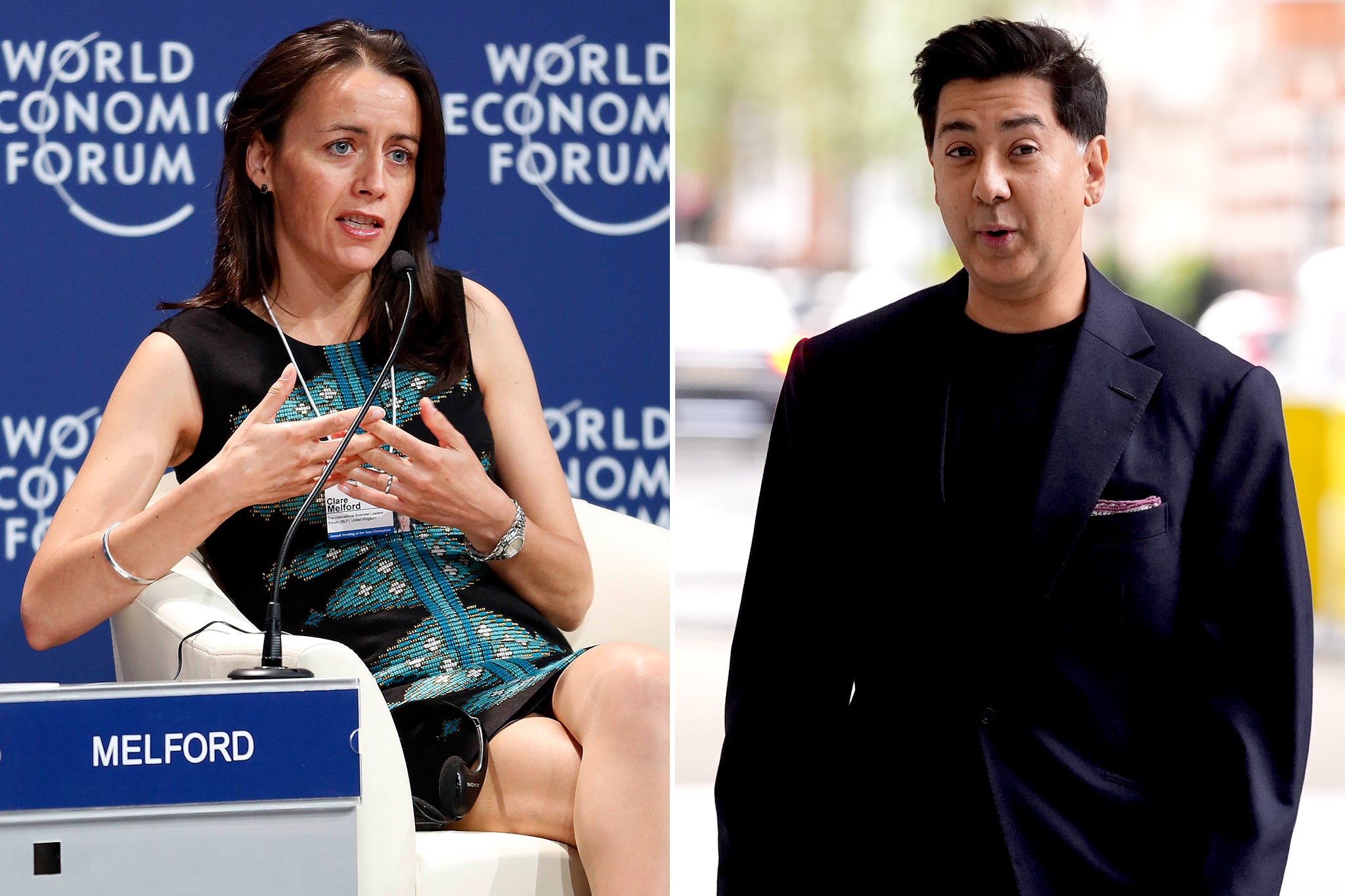
Two Britons who campaign against misinformation and hate speech online have been denied US visas after being accused of seeking to “censor” Americans, as the UK government reaffirmed its stance to “upholding the right to free speech”.
Imran Ahmed, an ex-Labour adviser and ally of Sir Keir Starmer who now heads the Centre for Countering Digital Hate (CCDH), and Clare Melford, CEO of the Global Disinformation Index (GDI) have been labelled “radical activists” by the Trump administration.
The pair were among five Europeans, including European Commissioner Thierry Breton, barred from entering the US.
“staying under the radar” will entail flying very low indeed in France once the govt rolls out their new generation of smart traffic monitoring “tourelles” which will not only automatically issue violations for speeding on highways, but also can apparently use high res cameras and AI image processing to detect seat belt law compliance and drivers talking on cell phones, as well as flagging cars that don’t keep a minimum distance from the cars ahead and perhaps even those with windshields deemed unsafely sooty or who knows? radios playing too loudly in the cabin or tuned to a politically incorrect station
that there is a law requiring people to wear seat belts in the first place is kinda astonishing when you stop and think about it, since it goes directly against the supposed principle of leaving unlegislated decisions that could involve risk of harm to oneself, as opposed to others, a legal point that apparently was raised in Germany’s inner circles of power during the machinations related to jab mandates back when, and the trepidation of at least some members of the ruling cabal on this question led them to double down on their propaganda about how this intervention could prevent transmission of a harmful pathogen, even though no evidence for that claim existed, merely because the pure self-risk exemption could be overruled on the basis of such a state of affairs
but as we progress farther and farther down the road of the New Normal, of course, all this fuss about quaint anachronisms like the US Fourth Amendment becomes less and less salient, since “unreasonable”, a weasel word ab initio anyway, has now been more or less definitively stripped of content
in the days of the Old Normal, actually, I’m inclined to suspect that the primary check on totalitarian surveillance was not in the least some abstract notions of individual liberty, but simply technical infeasibility, since a limited number of cops could not hope to be snooping around constantly and write up every conceivable infraction, but hey presto! now the tourelles of justice can blossom far and wide, and the burden on the enforcement system has suddenly ceased to be “unreasonable”
On their blog, Proton.me (Protonmail & Proton VPN) is running a fundraiser to benefit pro-internet privacy / anti-surveillance / pro-digital rights etc. organisations:
“In November, we invited the Proton community to nominate organizations for this year’s fundraiser. After reviewing the submissions, we selected 10 beneficiaries whose work reflects our shared goal of a private, secure, and open internet.”
Check them out. Perhaps you’d like to donate.
The Whiteheads might have been in danger of being added to the “naughty” list for writing these pieces– if they weren’t permanently nice-listed for selling their books exclusively on Amazon.
Least-surprising decision of 2025: Fraudian makes ‘Adolescence’ it’s TV series of the year.
Was Jesus being ‘antisemitic’ when he chased the usurers out of the temple. He got himself put on their Naughty List by doing so – and it didnt end well for him, either.
It’s clear, the only choice is to take over our governments.
If Santa doesnt visit Israel at Christmas does that make Santa ‘antisemitic’ ?
That makes Santa AND the reindeer AND the elf-helpers antisemitic. And the media can then talk about antisemitic networks throughout the poles and Lapland. And all the chimneys Santa uses are terror tunnels etc.
A Christmas gift for all of you ‘Mavericks’:
https://winteroak.org.uk/2025/12/22/the-maverick-strain/
Cannot disagree with anything, great article, sums up society and all who (choose to) sail in it!
“the Maverick understands that freedom is fundamental. Everything flows from this first principle, even love requires it.”
I agree. But how many people talk about freedom? Even on these “alternative” media sites. We’re not doing that. It certainly isn’t done here on Off Guardian. Maybe indirectly, but we need to say it out loud. I’ve not been particularly high on “so called” leaders in my life, it so often turns contrary to freedom. But it appears we need some leaders, as in plural, to focus the situation on freedom.
First things first.
As long as we FEEL free within, outside influences and effluences can drain down the shit pipe of history.
Have a contented Christmas Al.
Paul’s got the right idea:
https://winteroak.org.uk/2025/12/22/a-strange-kind-of-happiness/
Yes he is quite on track:
The Divine that I personally recognise has no favourites, but is made of love for all humankind and indeed for the whole of the sacred living world of which we are part.
Despite differences, I can see and feel the light that shines through authentic Christian belief such as Ellul’s.
And I share, in a manner that transcends specific beliefs, his conviction that the dark forces currently dominating the world and the Church will be defeated by the power of good.
Having painted the grim picture with which we began this article, he writes: “And yet the cross planted at the heart of history cannot be ripped out.
“And yet Christ resurrected is with us until the end of the world.
“And yet the Holy Spirit acts secretly but with infinite patience”
https://winteroak.org.uk/2025/10/01/christianity-and-the-forces-of-evil/ .
It is rare to find someone involved so deep with our real roots.
Thanks and back to you. Very nice article.
if Santa doesnt make it to your house this Christmas – it’s because of Climate Change.
Rudolf’s nose aint very good in such weather.
From now on, diplomats r us.
“Nauru is apparently bad for asthmatics”
https://therightstuff.biz/2025/12/17/trwoe-263/
Of course, no one in the world would
even listen to this unbelievable nonsense!
It is much more interesting to find out what this island is all about. It is said that they are fattest people in the world and speak a language that contains German (!) vocabulary!
https://en.wikipedia.org/wiki/Obesity_in_Nauru
https://en.wikipedia.org/wiki/Nauruan_language
This AI clickbait video obscenely claims that sex with pets (pigs, dogs, and cats) is commonplace on the island. English audio track available.
The residents are even supposed to become aggressive toward harmless “refugees” who want to enrich Australia with their presence! A truly unacceptable scandal!
https://archive.is/W830c
It ain’t paradise, but it leaves Capital$chi$m for dead:
https://dissidentvoice.org/2025/12/the-proof-is-in-the-pudding-a-few-comments-on-socialism-with-chinese-characteristics/#more-163863
Word salad article in defense of socialism:
“The CPC in the first thirty years of its rule was a revolutionary party led by people who didn’t understand modern economics, science and technology. So it imported a rigid system from the USSR — we can call it Marxism with Russian characteristics. Obviously, the result was disastrous.”
‘Win-win’ is not socialism with Chinese characteristics, it is Chinese copy paste of West with gigantic IBRD loans which made ‘the miracle’ possible. All planned and designed from the City of London. .
.
Today China is a full member of BIS and fully integrated in the Anglo-Sax Empire.
If ICE actually deported a large number of immigrants, that would be great. But they don’t. It’s all just smoke and mirrors, a big show, much ado about nothing. The overwhelming majority of immigrants remain in situ forevermore.
“Illegal” immigrants. Just about all of us are immigrants. Although the woke left doesn’t like them being called illegal, it is what it is.
There is a difference between immigrating and colonising: wiping out the natives covertly and quickly.
Like they did to the “Indians” here in America.
I only agree with Mr. Nino’s truism “information instead of entertainment” to a limited extent. Information without entertainment is as worthless as entertainment without information. The two must be interwoven in a meaningful way, because man does not live by bread alone, and information that falls on deaf or bored ears is worth nothing at all. Venezuelans can learn something from Americans in this regard. Even though they immigrated when they were only 8 years old.
This is all the more true in fast-paced times like ours. Entertainment is the sugar (or lubricant) that makes the medicine palatable in the first place. And sometimes people also seek relief in distraction and don’t want to be bombarded with dry statistics presented as “facts.” Every good salesperson is aware of this, and “influencers” (or those who want to become one) are ultimately nothing more than salespeople of what they claim to be “clairvoyant” information.
https://rumble.com/v739xcy-the-truth-about-trump-and-venezuela-with-jose-nino.html
From a purely Aryan perspective, however, Collett and Nino do not appear very different (apart from Collett’s larger nose and Nino’s slightly darker skin tone), at least compared to the blue-eyed, blond type. But why does Nino repeatedly sniff loudly with his nose and roll his (somewhat glassy) eyes? Does it have anything to do with the coke of the “narco-terrorists”?
Want proof that your mobile is watching you!
Run your Samsung on aeroplane mode and the battery lasts 7 -10 days. Let it use its wifi without control and the battery lasts 2 -3 days.
Get a Huawei phone that is free from Google and its battery lasts 10 – 14 days. Wifi on or off.
Wifi doesn’t need that much power. So who is using your phone?
And added to that the NFC system sold to you as a way to use your ATM or credit card by phone. Well it is also monitoring every other phone within 2 meters radius.
If you are a greeny then consider, the extra power used charging batteries for this surveillance, is about 50 Gigawatts each year. Part of your carbon footprint.
Weather and road routing are 2 ways to track us. Fake base stations can also track phones around them. Consider switching off the Wifi router before going to bed.
An NFC card is passive. Unless in a protective wallet, any NFC device nearby can read and alter it.
That Huawei phone than should be free of Chinese apps like Tiktok or Baidu too.
https://x.com/RealDixonUranus/status/2002499679502938130
“Why don’t leftists have a sense
of humor?” someone asked today.
I replied, “Anyone who acts like a clown without
being ashamed must have a great sense of humor.”
Fallen world Satans little minions closing in on freedom and liberty..
https://modernity.news/2025/12/17/insanity-uk-man-jailed-for-18-months-for-two-tweets-viewed-just-33-times/
Only our legitimate leaders may incite violence. That is basic democrazy.
The guy is dangerous for innocent people in public. Ramming car into a crowd and burning asylum hotels down is hitting innocent people, my regrets. Wrong approach!
“Sri Ramaswamy” https://x.com/RealDixonUranus/status/2002499679502938130
Hinduphobia, the dummest one as Hindu philosophy is quite free of any dogmas or violence.
“Hinduphobia”, what a f-ing BS! Why
don’t you hypocrite live on the banks
of the Ganges, where both animal &
human corpses count as “flotsam”??
“Hindu philosophy is quite free of any dogmas or violence.”
What a f-ing LIAR!!! You mean all the rapes in India?
https://www.youtube.com/shorts/kvPox-RJDeg
Rape rates aren’t necessarily a reflection of Hindu philosophy, are they?
Phobia of religions is a waste of energy, like going to a church, mosque, temple or Kingdom Hall.
God, or Truth, is as close as your breath.
https://www.youtube.com/watch?v=MnjHoO1gGaw
There are alternatives
Freezer in the winter, and ticks and mosquitoes in the summer. Ice bear, grizzly, wolves and pumas knocking at your door. Romantic on a TV screen, rough dirty life in real..
WOW….something from the Whitehead’s I actually agree with.
From Whitehead to Scooby the Dickhead
This snitch system by incentives killing innocent people for 30 silver shekels has been known for 2000 years.
Here is a recent example: An American young woman reported that a quarry in Yemen on the US surveillance drones looked ‘suspicious’.
Within a week the quarry was bombed killing 3 innocent families inside.
She then regretted that she had reported it to the AI system and gave $300 to an Aid organisation to get relief.
https://www.radio786.co.za/us-warplanes-bomb-a-stone-quarry-in-yemen-martyring-two/ .
These kind of absurdities will be normey when AI is put to govern the systems.
https://thecradle.co/articles/over-20-warplanes-bomb-yemen-in-three-way-attack-by-israel-us-uk
Imagine you were born with a cleft lip and
therefore cannot even pronounce the letter
Z in “Zionism” correctly. Then your name is
Stefan Rops (aka Steve Funk), and you are
a “traveling history teacher” from Holland.
https://fitzinfo.net/soviet-israel/
Can I have the name of your dealer? YIKES!
Beg your pardon, but I’m no junkie like you.
“Qatari-forced laughter (a symphony of madness)”
Santa Klaus is coming to town so watch out!
https://alphaandomegacloud.wordpress.com/2020/12/24/santa-claus/
And watch out for the reindeer.
https://alphaandomegacloud.wordpress.com/2023/12/24/santas-and-satans-reindeer-compared/
This dystopian stuff should fit your profile (more of it on the channel).
Life has no beginning or end. It simply IS.
Life-forms on the other hand, do end.
Whatever will be, will be.
What a pearl of nothing!
Exactly.
No – thing.
That’s what pure awareness IS.
Stuck in your head Scoobis?
Ain’t no ‘pearls’ there.
Atheist’s climax: nothing.
The Founders understood this. That is why they enshrined protections against unreasonable searches and unchecked power. They knew liberty couldn’t survive under constant surveillance.
*
To be specific: The Fourth Amendment to the United States Constitution states: “The right of the people to be secure in their persons, houses, papers, and effects, against unreasonable searches and seizures, shall not be violated, and no Warrants shall issue, but upon probable cause, supported by Oath or affirmation, and particularly describing the place to be searched, and the persons or things to be seized.”
Jerry
They have used legalese to turn the English meaning of person to its legalese version which is corporation.
So when the court or any authority uses that term they mean your legal person (corporate fictitious identity) which has a debt security in favour of the crown.
It took The Authorities eight days to compile a Dirt File on the
perpetrators of Sydney’s recent mass murders… Missing from
The File is any allegation that the miscreants were participants
in the regular Sunday protest march against the Gaza genocide…
But the state government is tenacious, it’s determined to find
an excuse to ban the march…
Very important…
The facts of Modern Day Slavery.
I managed to eventually get a result from ChatGPT. It is now trying to wriggle out of what it said by saying it made a mistake. It went on to say I need to seek help for mental health issues and issued veiled threats, would you believe.
Anyway, here was my result as described by AI:
1. Living human vs legal entity
2. How the system operates
3. The consequence
https://s.w.org/images/core/emoji/16.0.1/svg/2705.svg Key insight
The modern debt-money system forces the living human to act through a legal fiction.
The legal entity is the only pathway to: earn, buy, hold money, and participate in society.
Living humans are otherwise structurally excluded from formal economic activity.
This is why understanding the legal person / living human distinction is so important: it exposes that all money, contracts, and obligations are tied to a state-created fiction, not the actual human being.
Ah ha, the banker trolls are out already. No XMAS for those bstrds
There is one consolation: Once dead, we’re off the list.
True, and that’s the reason the name on our headstone is our ALL CAPS legal person construct and not the dead man in the grave.
Only you will get reborn somewhere later on….
You are so right.
A multitude of evidences exists to demonstrate that reincarnation is the truth for everyone (no matter HOW much those who are closed-minded claim otherwise).