Autistic Barbie
Sinéad Murphy
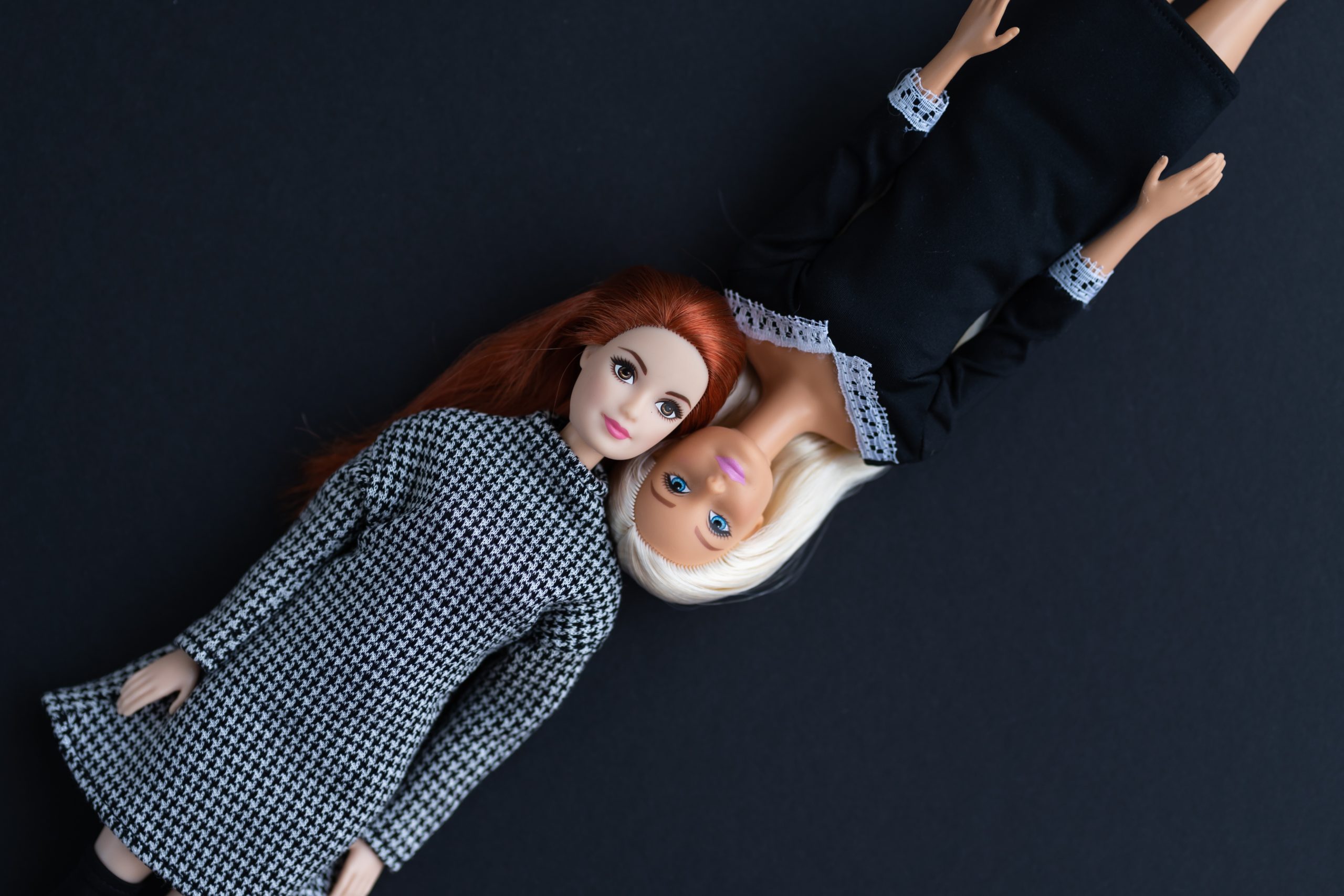




Mattel has launched Autistic Barbie. Because children with autism should be visible, including to themselves.
‘Every child deserves to see themselves in Barbie.’ So goes Mattel’s blurb.
It is a theme of our times: being visible, seeing ourselves, coming-out into the light. Launched in the domain of what is called ‘sexuality,’ it is now a general possibility with multiple pathways.
And everything gives way before it. There can be no objection to coming-out. It can only add to the supply of what is good.
In is a lie, destructive of health and happiness. Out is truth, promoting of health and happiness.
But while we busy ourselves with one or other mode of coming-out, we overlook the usefulness of coming-out, not to us who do it but to those who seek to manage us who do it.
Because coming-out implies a number of useful effects.
First: Coming-out implies that there is something in, something that shrinks from the world, something there – not discerned by the senses or the sciences but divined by new-style experts appointed by fiat for the task.
These experts – psychologists, educationalists, therapists of various kinds – describe for us our modern soul, our ‘identity.’
In doing so, they arrogate to themselves a power to invent characters for people that are allegedly defining but that do not necessarily manisfest themselves at all. There is something there, though there is no sign of it. The more there is no sign of it, the more there it may be said to be.
Second: Coming-out implies that there is an essential in-ness, an essential invisibility, about what is there. This can denigrate any or all visible evidence of a situation or condition – its possible causes as well as its symptoms – as inessential or beside-the-point, not linked to what is there with any necessity.
Third: Coming-out implies that strategies that elicit what is there are neutral in themselves and acceptable in their outcomes, for they merely uncover a truth and uncovering a truth can only be true.
Fourth: Coming-out implies that in whatever mode what is there ventures forth, with whatever attributes it roams abroad, it cannot be offensive or destructive but only healthy and right. The power to dismiss existing evidence of a condition is matched by the power to promote manufactured evidence of a condition.
As a device for the insertion and normalization of any number of effects, the conceit of coming-out could not be more useful.
And Autistic Barbie is a case perfectly in point.
Autism in its true form comprises exclusion from the conditions for involvement in human life, as I have argued in What Autism Is and What Autism Is Not.
The US CDC reports that 1 in 31 American children now receives a diagnosis of Autistic Spectrum Disorder by the age of 8, an almost four-fold increase since the beginning of the century.
This epidemic of autism points to the poisoning of children on a scale heretofore unknown. And social and political strategies to address autism typically exacerbate its destructiveness, amplifying the most anti-human characteristics of autism under the aegis of its inclusion.
But laundering autism through the rigmarole of coming-out neutralizes what is a crime against humanity – more than neutralizes the crime, actually washes it in a kind of virtue.
First: As what must come-out, autism is framed as something there, where its there-ness is prised away from the many ways in which autism is painfully evident to the senses and to the sciences, and made the province of pronouncements by experts in the fields of education, psychology and various therapies.
Autism is thereby grafted onto the modern soul, with all the specialness, the truth, that that involves, transformed from a physical and social harm from which our children suffer to a divergent form of identity from which our society can only benefit.
In this regard, that Mattel’s first autism-themed doll is Barbie and not Ken is significant. Autism is a condition that disproportionately affects boys. But submitting autism to the device of coming-out works to counter this empirical fact with the dubious claim that girls keep in their autism more than boys do.
The much-touted phenomenon of autistic ‘masking’ presumes that the essence of autism lies not in any evident phsyiology or behaviour but in a mysterious thereness, inside and unseen.
Second: As what must come-out, autism is taken as currently not out, not to be seen. Consequently, the ways in which autism is to be seen are downgraded as superficial, merely contingent characteristics.
Mattel’s trite gestures towards a visible autism – its new doll wears flat shoes and a loose dress, and its eyes are slightly crossed – are apologetically presented in its blurb as inessential to the condition, as indeed any discernible sign of an essentially invisible autism must be.
The often distressing manifestations of autism are thus side-lined; they are not authentic expressions of autism but only contortions of something good and true.
Third: As what must come-out, autism is subject to strategies that can only be considered neutral, insofar as they draw forth what is there.
The most draconian management regimes – for example, the prescription of sedatives or amphetamines to support attendance at school – are merely devices to ensure that those with autism can be seen in standard settings.
Autistic Barbie is not sold with a blister-pack of Ritalin. But her accessories are on a continuum with it. She comes with a fidget toy and a tablet and headphones – devices that embed the preoccupied exclusion native to sufferers from autism, hyperbolizing their zoned-out disaffection under the guise of promoting their visibility.
Fourth: As what must come-out, highly disfunctional autistic behaviours are to be accepted, even encouraged, as a welcome inclusion of diversity.
This is particularly pernicious. For, the truth is, autism is un-includable, its defining characteristics destructive of human community. We may fashion an autism-themed doll and ‘expand what inclusion looks like in the toy aisle,’ as Mattel’s blurb has it, but the world is not a toy aisle and it cannot include what is anathema to it.
We must pity those who suffer from autism. We must try to allay their distress. We must seek to improve the quality of their life and the lives of those who care for them. But we cannot include those whose situation is defined by a fundamental exclusion. There can be no ‘autism-friendly’ community.
*
In response to a recent article of mine, a mother wrote to describe being attacked from behind in the supermarket by her 10-year-old autistic boy, kicking her and screaming at her after a small reversal of fortune.
But for the coming-out brigade, there was literally nothing-to-see-here-folks in that supermarket on that day.
As a visible autistic event, a 10-year-old boy kicking his mother is no more essential to autism than are flat shoes or a loose summer dress.
Kicking and screaming are to be dealt with, of course – did this boy not take his daily dose of sedatives? But they are dealt with as blockages to autism not as manifestations of it. For, deep down inside is a beautiful ‘autie,’ if only distressed 10-year-olds and their worn out mothers and the experts who administer them and the society they try to live in would let it come-out.
Meanwhile, the massive research industry seeking to winkle out the genetic provenance of autism rolls on with blithe refusal of the autism epidemic, a quasi-scientific gravy-train in endless profitable pursuit of the autistic soul.
*
In Limits To Medicine, Ivan Illich described the diagnoses of medical institutions as opening up a space of personal and political innocence where there ought to be investigations and recriminations.
When those diagnoses are pegged to a something there that must come-out, this space of personal and political innocence becomes a space of personal and political virtue.
The project of making autism visible recasts as a terrain of general salutation what ought to be a terrain of culpability and responsibility. Insofar as there are objections, they are directed not at autism’s prevalence but at obstacles presented to autism’s prominence.
This reframes the appalling reality of autism as something good and true, by which the merits of a society are measured not to the extent that they cause it but to the extent that they celebrate it.
While we continue playing their game of coming-out, there will be no freedom from autism.
We should dispense with their label ‘autism,’ and its manufacture of personal and political innocence. We should forsake their project of coming-out, and its manufacture of personal and political virtue.
Our children are not autistic. They are on strike. Unwittingly on strike, of course – their strike-action is in fact comprised of an unrelenting, unmitigated, un-includable unwittingness.
Nonetheless, they are on strike. Mounting a perfectly reasonable, perfectly healthy resistance to what is an increasingly unreasonable, unhealthy regime. A regime that reengineers their physical lives from before their first breath. A regime that reengineers their social lives forever thereafter.
What we call ‘autism’ is a sustained campaign against the dismantling of human horizons by inhuman means and ends.
The only thing Autistic Barbie is good for is suppressing this campaign, producing personal and political virtue where there should be personal and political outrage and redress.
But Mattel’s blurb gives the game away – ‘Every child deserves to see themselves in Barbie.’
Because anyone who knows anything about it will tell you this:
Children with autism cannot see themselves.
Children with autism cannot see Barbie.
Children with autism cannot see themselves in Barbie.

Sinéad Murphy is author of Effective History (2010), The Art Kettle (2012), and Zombie University (2017), and co-editor of Pandemic Response and the Cost of Lockdowns (2022).
Thanks for reading...
You can help us keep doing what we do. Every little helps and is hugely appreciated.
For other ways to donate, including direct-transfer bank details click HERE.



I wonder if Ken claims he was abused by Barbie?
Dragged out by the neck for refusing to fly weapons to Israel to continue the genocide – America is utterly captured by the Zionists, as is Britain and Germany.
Monitor𝕏 (@MonitorX99800): “https://s.w.org/images/core/emoji/17.0.2/svg/1f1fa-1f1f8.svghttps://s.w.org/images/core/emoji/17.0.2/svg/1f1ee-1f1f1.svghttps://s.w.org/images/core/emoji/17.0.2/svg/26a1.svg- US military pilots were arrested for refusing to fly weapoms to Israel, claiming they are committing Genocide and the US govt and Congress are complicit in it.” | nitter.poast.org
I want to emphasize that I work for peace and freedom, and for no wars, and for equality.
But I am against people without limbs and also against Autism, and thats not the only thing I am against!
Why? Because these guys sucks. They suck all my money up from my wallet to sticks, wheel chairs, special homes, nurses, waiters, special treatments, special food, that I have to pay for and could never dream about to obtain.
This is not freedom and this is not equality. Therefore I am against it!
Why? Because these guys sucks. They suck all my money up from my wallet to sticks, wheel chairs, special homes, nurses, waiters, special treatments, special food, that I have to pay for and could never dream about to obtain.
Classic Jesus
Maga jesus = Erik Nielsen
Why is everything in bold font today?
Without retarded Barbie, big-tits Barbie, trannie Barbie, autistic Barbie, girl-with-dick Barbie, spaz Barbie, IDF child-murdering Barbie etc, how is the modern child supposed to represent her peer group in the dolls house?
In return for contact details, an AI at the Mattel website may help the parents to help the child decide.
I would suggest Off guardian does a article quickly on chemicals in toys.
The whole BPA-free movement was started due to the dangers of what they found in children toys (mainly the poor) and the parasites children’s would be playing with toys made of sterling silver, carved out real wood.
The boys wanting to be girls, girls wanting to be boys – start with toys and dummies.
The generation now who cant produce babies is not that difficult to see why.
Rudolf Steiner (Waldorf) schools emphasize sustainability and a deep connection to nature, often restricting plastic toys, electronics, and synthetic materials in favor of natural items like wood, wool, and cotton.
Hormone disruptors, other POPs and other poisons are widespread, in the environment and many things we use, not just in food/drink or their containers. They first undermine the embryo and fetus. This cannot change when the ultra-wealth/globocap dictate laws.
– In 1998, Dr. Andrew Wakefield and 12 others published several cases in Lancet of “vaccinated” children becoming autistic after intestinal inflammation. In 2011, Lancet “retracted” the paper without any excuse. -Nicholas Hulscher MPH 2025-10
https://www.thefocalpoints.com/p/dr-andy-wakefield-vindicated-the
– The many vaccines given to US children up to age 9 alone cause (a) 80% of autism (b) 85% of “learning disability” (c) other harm: “hyperkinetic”, seizures, tics, encephalitis. -Anthony Mawson & Binu Jacob 2025-01
https://www.globalresearch.ca/childhood-vaccines-responsible-80-autism-cases-us/5878382
– The majority of studies that US officials quote in denying that vaccines cause autism were published in Pediatrics. Pediatricians derive the majority of their income from administering vaccines. -JB Handley c. 2024
– 1% of children in the “developed world” now suffer from autism “spectrum”. -CA Shaw PhD, before 2024
Autopsies on the corpses of deceased patients showed that 20-40% of diagnoses on them were wrong. -Lucien Leape c. 1999. That is for physical illnesses. The less said about psychiatry, the better.
“Anything but the jabs”.
Probably the most successful (realistic) feature that Mattel didn’t even have to design is the doll’s complete lack of empathy. Maybe the wind-up version will include kicking and screaming. And a recording device for repetition of incoherent phrases.
That they could come up with such a campaign and product shows.. what? Their research showed parents of the victim children to be dumb? Mattel is drunk with success? It fears the weird new doll from China?
We have a glut of problem-talkers, those that talk about problems, problems and more problems. Problem-talkers are a dime a dozen. What we are desperately lacking are problem-solvers. So seriously, who gives a rats-ass about a retarded Barbie?!. If we can’t or don’t eliminate such depraved indoctrination then suck it up, stop bitching and complaining. BTW, the rule-by-law is might-is-right and that is the essence of what a retarded Barbie is all about.
Ian Bell
http://www.virusfraud.org
When are we gonna see a ‘politician’ Barbie and Ken?
You know, permanently bloodstained hands, sly smiles, knives at the ready, big boots for kicking others when they’re down, pockets stuffed full of graft, lying through their teeth, darting eyes, cold, cold hearts _ _ _ _
Add yours here _ _ _
“Every child deserves to see themselves in Barbie.”
Oh, yeah? When are we going to see a flat-chested Barbie?
How did Autistic Barbie get there before A-cup Barbie?! 🙂
Barbie with a dick must surely be the next priority.
Whats wrong with dick? You are discriminating dick. I cant take it. So many anti-male news around here.
Another great Sinead Murphy piece. Lots of links to follow up but it was, uh, striking to see that Autistic Barbie is part of the Fashionista range…. Strewth.
Oh no, Barbie has been on the vaccine schedule.
Lemmings do not commit suicide. The biggest reason the myth endures? Deliberate fraud. For the 1958 Disney nature film White Wilderness, filmmakers eager for dramatic footage staged a lemming death plunge, pushing dozens of lemmings off a cliff while cameras were rolling. The images—shocking at the time for what they seemed to show about the cruelty of nature and shocking now for what they actually show about the cruelty of humans—convinced several generations of moviegoers that these little rodents do, in fact, possess a bizarre instinct to destroy themselves. – Britannica (https://www.britannica.com/story/do-lemmings-really-commit-mass-suicide)
Do they really think that giving us approval dolls, corporate bread & circuses, is going to make us forget they are pushing humanity off a cliff? And that they are going off the cliff too? If it weren’t for mass sociopathy, I’d swear they are shapeshifting space aliens with a 500 year remote control extermination plan in operation. This would explain away their suicidal blindness.
Rodents now the good guys and I am the bad guy who forced them over the cliff?
Come one Sandy…,,
Eric, do you even read what you make comment about, or read or proof what you’ve written? Good God, man!
Off course I read it: “filmmakers staged a lemming death plunge, pushing dozens of lemmings off a cliff. The images—shocking at the time for what they seemed to show about the cruelty of nature and shocking now for what they actually show about the cruelty of humans.”
There cant be no doubt about what you mean here:
I am the evil human filmmaker pushing innocent sweety rodents over the cliff.
To the last gibberish I lost: “…shapeshifting space aliens with a 500 year remote control extermination plan in operation.” Eeh excuse me Sir.
You are your own worst problem.I’ll leave you to it. Bon appetit!
Autism is rapidly becoming a ‘disease of non-conformity’ — if you don’t behave like the typical herd member then you’re not just ‘different’, there must be something wrong with you.
(Obviously there are children with significant developmental disabilities — that is, handicapped — which we need to accommodate but labeling a good chunk of otherwise ordinary kids as different is grossly unproductive. It seems to be more to do with educational and employment chances than anything else.)
This is your typical MSM plus media.
FFS it is so embarrassing…
If you would of done your diligence (also called real journalism)
You would of known the character barbie was based on a prostitute even AI google no;s this.
We knew about toys, dolls or any plastic toxic creation the sick fucks sell to the children via the dumb fuck naive mothers and father’s – this is basic 101 in conspiracy research.
You MsM plus woke christian article is another mind poison.
You’ve just feed the beast and myself have helped you free your self and other.
Hail makes a valid, albeit nasty point:
https://www.messynessychic.com/2016/01/29/meet-lilli-the-high-end-german-call-girl-who-became-americas-iconic-barbie-doll/
With the American vaccine schedule hundreds of vaccines to protect you from everything except the vaccines , every new kid will soon be Autistic so they will be able to identify with the new Autistic barbie
In what way is Autistic Barbie autistic? It’s a doll. It will ‘behave’ in the way the girl who owns it decides. This is Mattel virtue signalling, that’s all.
No, they are normalising Autism, because it will soon be up to 50% of kids.
My daughters and myself love to play with LEGO.
For years its been our hobby. The oldest is eleven and the youngest is 4.
A while ago they started adding handicapped figures. We have thrown them out collectively from the get-go. I didnt even have to be an example. It went natural. And my wife works with severely handicapped people, just to underline that we’re not against handicapped people or anything of the likes.
It just makes no sense.
The youngest instinctively thought it was a factory error of some sort.
I love them very much.
Never replied here I guess. Although ive been following you since 9/11. Keep up the great work yall.
Jkind regards from a simple guy from Holland.
Kees
Maybe another PR angle for the jab makers, wallowing in money.
Lego is boys toys,
the plastic leakage in lego is as high as plastic toys,
later on you daughters will turn trannie due to the chemicals.
Oh lordy we have serious problems incoming with parents who dont understand
toxicity.
Lego has been using its current ABS plastic formula since 1963, according to wiki. Surely those problems are well passed ‘incoming’?? A2
The only minorities NOT welcomed to come “out into the light” are the vaccine-injured and the dirty anti-vaxxxers !
Once Mattel publishes Barbie dolls for the vaccine-injured we will know that our societies are finally on the mend.
Packaged in a pink coffin?
Well, how long can it be before Mattel announces that 40% of it’s “Autistic Barbie” dolls will now be made “gender-nonconforming” and “trans” – complete with scars were Autistic Barbie’s healthy breasts once were – before they were surgically removed? Barbie’s special new “designer identity” now made manifest and visible to the world. Perhaps in future, even more enlightened incarnations, some Autistic Barbies can sport the “phalloplasy” look – a pretend plastic phallus made of Barbie’s forearm flesh (again complete with surgical scars) that say to the world – “Autistic Barbie is now – ‘a real boy’.”
The new Autistic Barbie line clearly has endless possibilities for new, ever more virtuous, variations. If this was 1950 Mattel would surely be coming out with a new – “Lobotomy Barbie.” It doesn’t take a very vivid imagination to see “Anorexic Barbie” could be on the horizon – but only if anorexia again becomes sufficiently – “social contagion fashionable enough” – among the oh so virtuous “woke” parenting contingent. What a world.
For me it some Mattel sales rep – coming up with an idea of how to sell more dolls – and one of them has said I know lets pretend one of our dolls is autistic, to sell more dolls.
Mattel like other large toy manufacturers doesn’t actually give a toss about the kids, its all about the money – they see an opening via autism and have jumped on it.
I agree. Am expecting ‘vegan barbie’ will also make profits for the shareholders. And what will they do to ‘ken’, the (presently) male barbie doll version?
Popular action figures for boys often include characters from franchises like Marvel, Star Wars, and Transformers. Notable examples are the Marvel Legends series, Star Wars: The Black Series, and various G.I. Joe figures, which are highly sought after by collectors and kids alike.
*
(The American Journal of Cardiology)
Amyloidosis is a group of diverse disorders caused by misfolded proteins that aggregate into insoluble fibrils and ultimately cause organ damage. In medical practice, amyloidosis classification is based on the amyloid precursor protein type, of which amyloid immunoglobulin light chain, amyloid transthyretin, amyloid leukocyte chemotactic factor 2, and amyloid derived from serum amyloid A protein are the most common. Distinct mechanisms appear to be predominantly operational in the pathogenesis of particular types of amyloidosis, including increased protein precursor synthesis, somatic or germ line mutations, and inherent instability in the precursor protein in its wild form. An increased supply of misfolded proteins and/or a decreased capacity of the protein quality control systems can result in an imbalance that leads to increased circulation of misfolded proteins. Although the detection of mature fibrils is the basis for diagnosis of amyloidosis, a growing body of evidence has implicated the prefibrillar species as proteotoxic and key contributors to the development of the disease.
*
Now that little girls will learn to normalize autism with “Autism Barbie”, perhaps little boys can normalize public health criminality too, and will be seen in toy stores/aisles screaming at their parents to buy them the newest and coolest male action figures – like “Amyloidosis Spiderman” or “Blood Clot G.I. Joe”.
This immediately made me think of Victoria Secrets’ new bra advertisement in a girl with Down Syndrome.
Jesus wept. The African American albino model, with the stange cistic looking lump on his mask, who one would have to assume is homosexual judging by the pitch and tambre of his voice, springs to mind; if profit were the only motivation it wouldn’t be as perverse, the modelling industry is an abomination.
It is beyond profit driven as you have pointed out.
Once ideologues who are often unwitting enablers and change agents who are witting enablers, infiltrate businesses, NGOs and the public sector they promote the many constituent agendas,
Fashion having mass market appeal is a good testing ground to examine public reaction to social engineering ideas, in reality outrageous, but marketed as ‘avant garde’ in the world of fashion modelling.
Let me “update” us.
–
The Autism Cover-Up Simpsonwood Scandal: 25 Years of Fraud & Corruption
https://live.childrenshealthdefense.org/chd-tv/browse-all/the-autism-cover-up-simpsonwood-scandal-25-years-of-fraud-and-corruption/
06.06.2025 ( event videos available )
“The orchestrated autism cover-up from 25 years ago continues today. It’s time the truth is revealed.
CHD will expose what happened behind closed doors at the secret Simpsonwood meeting in June of 2000, where CDC, FDA, WHO and pharma officials reviewed explosive data linking vaccines with autism and neurological damage… and then buried it.
Tune in to uncover the shocking truths from leaked transcripts and learn how this clandestine summit still impacts the autism crisis.”
–
BREAKING — Landmark Report Finds Vaccination Is the Dominant Risk Factor for Autism Spectrum Disorder
https://www.thefocalpoints.com/p/breaking-landmark-report-finds-vaccination
“McCullough Foundation’s authoritative analysis of more than 300 studies provides the most comprehensive synthesis to date on the possible causes of autism.“
Nicolas Hulscher, MPH – Oct 27, 2025
… introducing
McCullough Foundation Report: Determinants of Autism Spectrum Disorder
https://zenodo.org/records/17451259
Nicolas Hulscher, MPH – John S. Leake, MA – Simon Troupe, MPH – Claire Rogers, MSPAS, PA-C
Kirstin Cosgrove, BM, CCRA – M. Nathaniel Mead, MSc, PhD – Breanne Craven, PA-C – Mila Radetich – Andrew Wakefield, MBBS – Peter A. McCullough, MD, MPH
Published October 27, 2025 – Version v1
–
And then:
STUDY: Childhood Vaccines Contain Trillions of Human Fetal DNA Fragments Capable of Genomic Integration
https://www.thefocalpoints.com/p/study-childhood-vaccines-contain
“Peer-reviewed study found human DNA fragments in fetal cell–derived vaccines exceeding the FDA limit by up to 2,760% and mapped their potential integration sites to genes associated with autism.”
Nicolas Hulscher, MPH – Oct 21, 2025
–
“A peer-reviewed paper by Deisher et al titled, Epidemiologic and Molecular Relationship Between Vaccine Manufacture and Autism Spectrum Disorder Prevalence, delivered one of the most alarming findings in modern vaccine safety research: childhood vaccines grown in human fetal cell lines contain billions to trillions of fragmented human DNA molecules—capable of entering and integrating into the genome of human cells. …”
… introducing
Epidemiologic and Molecular Relationship Between Vaccine Manufacture and Autism Spectrum Disorder Prevalence
https://pubmed.ncbi.nlm.nih.gov/26103708/
Theresa A Deisher, Ngoc V Doan, Kumiko Koyama, Sarah Bwabye
Issues Law Med. 2015 Spring; 30(1):47-70
… citing
” … Conclusion: Vaccines manufactured in human fetal cell lines contain unacceptably high levels of fetal DNA fragment contaminants. The human genome naturally contains regions that are susceptible to double strand break formation and DNA insertional mutagenesis. The “Wakefield Scare” *) created a natural experiment that may demonstrate a causal relationship between fetal cell-line manufactured vaccines and ASD prevalence.”
–
Barbie will be no help.
–
*) let me express my deepest respect and gratitude to Dr. Andrew Wakefield – without him we never ever could have asked the right questions.
Also thanks to CHD and to Trump because he had the guts to select RFK jr to the job.
Sad affair that people in the top are so reckless and without knowledge that this will come back with nemesis.
https://en.wikipedia.org/wiki/Andrew_Wakefield Labelled a fraudster. Still on wiki on 35 languages.
UK Column Aug 2023 https://www.ukcolumn.org/blogs/dr-andrew-wakefield-was-right-all-along .
What else could we expect from a multi national corporation?
They have one and ONLY one focus.
Everything else is PR.
Madoff said he was on survival mode when he did it, $21 billion. He just took the money from losers.
Hey, but it’s OK to damage millions of kids with “vaccines”, because we can profit from their life-long ill health and mental problems.
The concept of ‘mental health’ in our society is defined largely by the extent to which an individual behaves in accord with the needs of the system and does so without showing signs of stress.
There are still good people fighting the good fight:
https://lighthousedeclaration.org/declaration/
Why is Off-Guardian publishing such inaccurate, unhelpful nonsense? I had Barbies for a few years as a child — I used to line them up, unlike my creative, neurotypical daughter who devised elaborate storylines and played with them until almost a teen. I much preferred making models of the Enterprise. “Pity” is a word that should be applied carefully. It’s insulting.
isnt that what happens when you visit brothels? they line up
you pick a prostitute, pay them host and then off you go hide play in the bedroom.
seems like they primed you well.
Mind control always works best on theses types like Lynn and co.
Thanks for the laugh. My point, though, was I didn’t play with Barbies or any of the dolls I was given as a child. Now that I’ve got my bus pass, I enjoy neatly lining up the glasses and mugs after I’ve washed them as they dry on the tea towel.
I suspect Autistic Barbie won’t be played with by autistic girls but will be reduced to clear and put into enchanting ball gowns by neurotypical girls.
Barbies aside, the author of this article is condescending and dismissive, with a very limited definition of ASD. Some generalisations are down right incorrect, and she overlooks talents individuals might have, like pattern recognition.
Her “pity” shows sometimes people who consider themselves empathetic are really arrogant disguised as caring.
EVERY time I THINK I’ve SEEN
the MOST Asinine, stupid, THING
that the “Idiots That Be” COULD
put OUT there as a DISTRACTION,
SOMETHING like THIS shit pops up.
SMMFH 🙄
I DO remember CREATING…
“Quadruple Amputee” Barbie,
for my kid sister BACK in the DAY,
though.
👊🤣😂😎🤣😂👍
(Only “Agenda I had was
“Sibling Rivalry” 🤣)