Crude Harvest: Food Security Beyond Oil and Nano-Tech Quick Fixes
Colin Todhunter
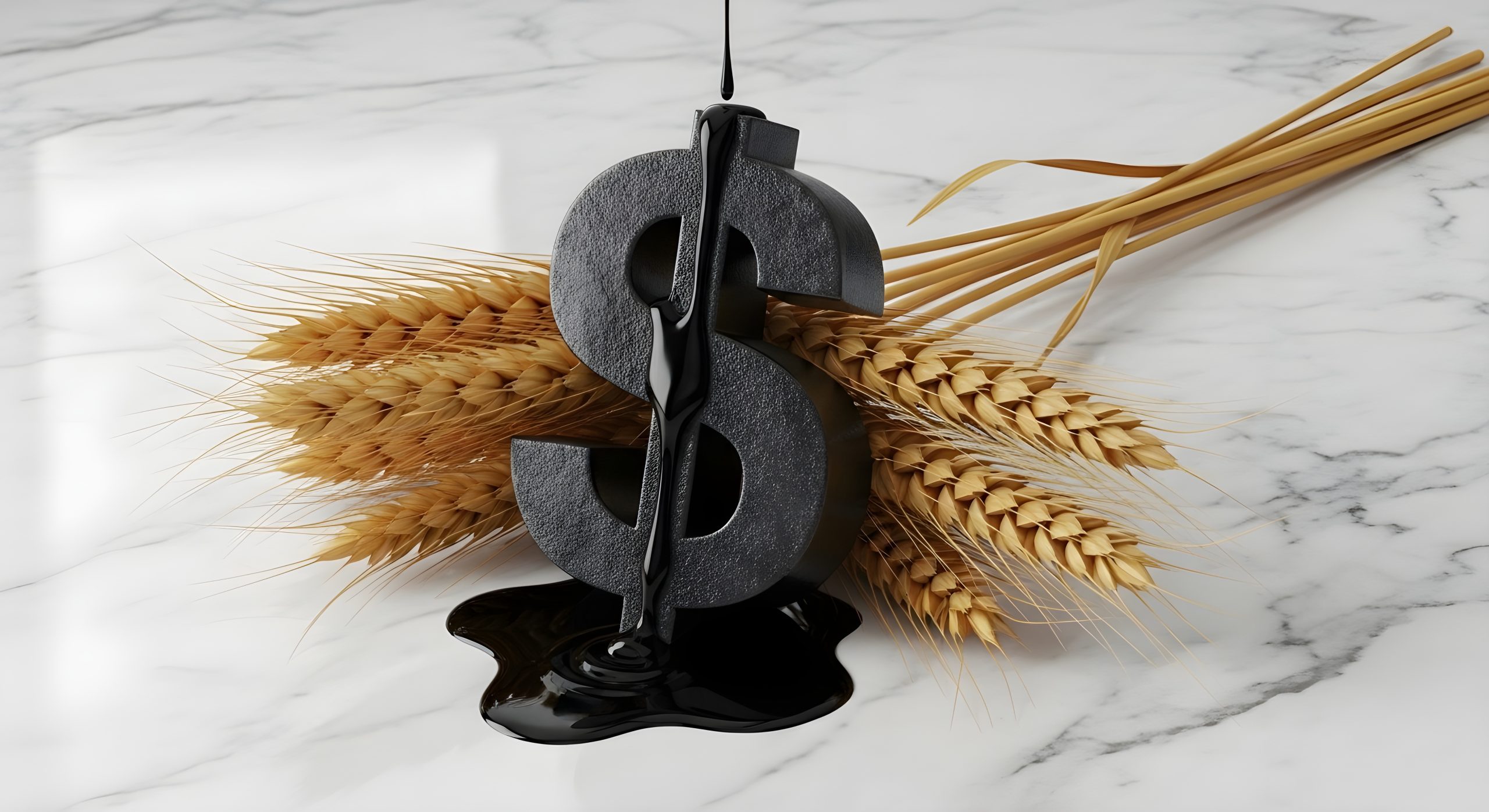
Petroleum industry impact, agriculture market, crude oil spill, currency symbol, wheat harvest, resource dependency




The myth of the ‘Green Revolution’ is finally evaporating in the heat of the Persian Gulf. The near-total closure of the Strait of Hormuz in March 2026 has impacted the Indian agrarian landscape.
As 16 million barrels of oil and massive LNG shipments stall daily, India’s domestic urea production has plummeted. It is now clearer than ever that industrial agriculture is a sub-branch of the petroleum industry.
Having spent decades forcing farmers into dependency on West Asian gas for synthetic nitrogen, the state now watches as global urea prices spike by 20% in a week. This validates what Norman J Church warned in 2005: that vast amounts of oil and gas are the hidden raw materials of every stage of food production—from planting and irrigation to the very construction of the trucks and roads that facilitate the industry.
The industrial food supply is basically a system of fossil-fuel conversion.
With the just-in-time supply chain for granular urea broken by war, the Indian government has accelerated the push for Nano Urea. Developed by IFFCO (Indian Farmers Fertiliser Cooperative) as a central pillar of Aatmanirbhar Bharat (Self-Reliant India), this liquid fertiliser, sold in 500 ml bottles containing nitrogen at the nanoscale (20–50 nanometres), is marketed as a miracle of self-reliance.
The claim that a single 500 ml bottle replaces a 45 kg bag of urea is the ultimate ‘technological fix’. But this ‘fix’ is an optical illusion. A bag of granular urea builds a nutritional reservoir in the soil, but the 500ml Nano Urea is a foliar spray that merely stimulates the plant’s leaves (like a caffeine shot). This forces crops to mine the soil’s remaining internal reserves to stay green while the earth beneath them is hollowed out.
Soil-based fertility (like compost or legumes) is a permanent asset. A foliar spray is a just-in-time commodity that must be purchased every season. Nano Urea represents a transition from a commodity-based dependency to a proprietary one. Unlike soil and compost, Nano Urea is a controlled, patented substance. It is the Trojan horse of the current crisis, used to maintain chemical dependency while rebranding it as high-tech efficiency.
The February launch of Bharat-VISTAAR—the AI-powered ‘voice of authority’ personified as the chatbot ‘Bharati’—aims to provide real-time, multilingual advisory to 140 million farmers. By integrating with the AgriStack ID system, the state is creating a digital panopticon for farmers.
Farmers, cut off from traditional urea supplies by the war, are now being nudged by Bharati towards proprietary specialty chemicals and Nano Urea. To access these ‘benefits’, the farmer must first become visible via AgriStack, surrendering their data and autonomy to an algorithm whose training data remains a corporate secret.
Meanwhile the response from farmers organisations has been firm. The March 2026 Charter of Demands issued by the SKM and the AIKS calls for digital non-cooperation and a refusal to sign up for AgriStack.
The SKM (Samyukta Kisan Morcha) is the umbrella coalition of over 40 Indian farmers’ unions. It gained global prominence for leading the 2020–2021 protests against the three farm laws. The AIKS (All India Kisan Sabha) is one of the oldest and largest peasant organisations in India.
Farmers are effectively rejecting digital enclosure. Their demand for a legal audit of Bharat-VISTAAR’s training data challenges the technological neutrality of the state and insists that AI, if it is to be used, must promote agroecology rather than corporate dependency.
In the article ‘And you thought Greece had a problem’ (2015), Norman Pagett says that the age of oil has been a “short flash of light” that briefly lifted us out of the mire. We are now discovering that modern civilisation is a fragile construct of cheap energy. The Gulf states sell oil for food; the UK imports 40% of its diet; India is pushing a 500ml bottle to replace a 45kg bag.
Cheap energy has been used to replace labour in the fields and allows the distance between producer and consumer to be extended. But Pagett notes that the trappings of civilisation have not altered the one rule of existence: if you don’t produce food from the earth on a personal basis, your life depends on someone converting sunlight into food on your behalf.
We must acknowledge that an end of the oil age would, in reality, signal the end of the industrial food age. For genuine food security, we must return to the democratic control of soil, water and seeds. We must replace the ‘black box’ of Bharat-VISTAAR with the open-source wisdom of agroecology and localisation.
Here, a ‘black box’ is a system whereby farmers receive recommendations (use Nano Urea, apply this chemical etc), but they don’t know how AI makes decisions, how it was trained and any inherent corporate, political and economic biases. So, the concern is: farmers are being guided by an authority they cannot question or understand.
Moreover, to understand why Nano Urea is a strategic dead-end, we must look at the energy return on investment (EROI). In the conventional Green Revolution model, it takes approximately 10 to 15 calories of fossil fuel energy to produce just 1 calorie of food delivered to the plate. This is a significant energy deficit (see this).
Proponents claim Nano Urea is efficient because it uses less bulk material. However, the EROI tells a different story. The energy required to manufacture nanoparticles is immense (see this) When you add the energy cost of the Bharat-VISTAAR digital infrastructure (server farms, satellite linkups and AI processing), the energy input per unit of nutrition actually increases.
This is all being branded as part of ‘precision agriculture’, the alliance of Big Tech and Big Ag that espouses the notion of environmentalism and climate-friendly farming while creating farmer dependency and power-hungry digital infrastructure (see this).
In contrast, a decentralised agroecological system, as championed by the March 2026 Charter, strives for a positive EROI. By using nitrogen-fixing cover crops, farmyard manure and solar-powered local distribution, the energy input is minimal while the biological output is sustained by the sun.
It is the only model that survives when the flash of light of cheap oil fades.

Colin Todhunter specialises in food, agriculture and development and is a research associate of the Centre for Research on Globalization in Montreal. His open access books on the global food system can be accessed via Figshare (no sign in or sign up required).
Thanks for reading...
You can help us keep doing what we do. Every little helps and is hugely appreciated.
For other ways to donate, including direct-transfer bank details click HERE.



Israeli’s on Telegram last night talking about hitting a significant target in Texas – one of America’s largest refinery’s in Texas at Port Arthur (Valero oil refinery) was ablaze the last time I looked – the refinery has a capacity for 380,000 barrels – the cause of the incident is under investigation.
Reminds me of the Israeli’s dancing in the street when the towers came down – no doubt this current event will be blamed on Iranian sleeper cells.
A wee ditty to sing along with:
https://m.youtube.com/watch?v=ey5NthOLOpU
A ‘tribute’ to Pete Hegseth.
tRump’s Hitman.
🎼The Dumbest of the Goys🎶
A classic, surely.
Robert F. Kennedy Jr
United States Secretary of Health and Human Services is sorting out the food problem in USA.
The Gulf states sell oil for food
Most nations sell their unprocessed or low-tech resources for (a) essentials including food (b) fake defence and armaments against cooked-up enemies. World Bank works to undermine food security and indebt nations.
‘The United Christian Patriotic Front for Salvation’ !??
Don’t believe me?
https://united-christian-patriotic-front.blogspot.com/2026/03/government-program-of-united-christian.html
There’s a lot of big names in there.
Mmm.
Ignore that. Just someone’s fantasy.
‘Dissident Voice’ offline (Account suspended). Anyone know why?
Was also wondering.
Australia’s ‘fuel crisis’ is being called a ‘Covid level crisis’. Is the government going to impose a nation-wide lockdown “to save the petrol” ?
No need for quick fixes if the preparation is thorough:
https://www.garydbarnett.com/chaos-war-and-murder-continue-in-the-face-of-a-failed-u-s-empire/
Not on Facebook, but I was looking for something there, and they now have a QR code to enter the site. WTF!
Why does this author always reduces global problems like now the 3rd Gulf war to only an Indian issue?
Unhealthy obsession, Western Soros NGO style. Political.
•India is the biggest ‘democracy’ on Earth.
•India is Colin’s field of expertise.
•India is a nuclear state.
•India feeds more than one billion people quite successfully.
•India is one of Gates’s test beds.
It is a tempting target for experimentation. Local capitalists join hands with foreigners. The extremist government hopes to benefit. All the activism up to the Supreme Court has not gone far, as the author wrote earlier.
Australia’s Anti-Islam party, One Nation, outpolled one of Australia’s Uniparty wings, the Liberal Party, in a South Australian state election on Saturday. One Nation’s leader claims ‘There’s just too many of them in Australia, and they’re causing all sorts of problems.’
So far the Islamists havent been accused of, as were the 10 pound Poms that came to Australia after WW2, “They dont wash !”
One Nation are anti refugee, social and economic.
Chinese, Vietnamese, Sub Continent, African, South American, etc etc.
You name it, they grab the hate and fear baton and run with it.
Hanson is an opportunistic Bimbo.
I live in a fertile farming area. They don’t use commercial urea. They use sewage. So they’ll be fine.
There’s urea in hoomin urine. So that it doesnt burn plants it has to be diluted
with water before being applied. Sharing a house with a coupla guys a few
years back i wanted to start a vegie garden out back, but one of the guys had
claimed the garden area (he was quite territorial). At its center he’d planted a
single strawberry plant. He used to water it everyday. Whenever i returned at
night from my local i always gave his strawberry plant a Golden Shower. The
poor lonely little thing soon wilted, then died. When he wondered “Why ?” i
offered “Maybe it was overwatered ?”
😂
Seriously though, you should be punished for 🍓 murder. It’s the selfish hoomin you should have pissed on!
Diluted 10:1 it might have been useful.
Citrus trees can take it straight.
Undiluted, it can be used for Urine Therapy.
You first.
Many practising traditional farming know this. The dung of farmed animals, after processing, makes a rural village largely independent of external human parasites and even the monetary eonomy. It is hard to survive there as a skiver or conman.
You will hurt the feelings of those hawking proprietary products.
Talking about Nitrogen fertiliser – the Netherlands and Sri Lanka have already banned its use – according to this guy.
matrixbot (@thematrixb0t): “Greenpeace Co-Founder, Dr. Patrick Moore: “Net Zero Would Kill at Least 50% of the Population”” | nitter.poast.org
Depopulation. Eugenics is still fancy among the “Green” Elite behind the curtains.
Anyway thanks to Toadhunter for a positiv article from India. So the peasants in India still have guts to give Modi a rightful middle finger. I agree in all Colin’s articles.
Sri Lanka revoked the ban toutes suites.
I’m not overly familiar with the finer points, but it’s clear that the system as it is has become perverse – extracting value from the farmers by paying them less, boosting profits for big corps, while ‘efficiencies’ are introduced in an attempt to both compensate for the resulting rural hardship and exert more control. A lose-lose for people and environment.
More power to the farmers and farmers organisations; for increased Minimum Support Price, and in their fight to retain essential agroecological practices. What is effected there ultimately has impacts here.
Probably the most existential Old World versus New World battle there is.
I’d say the overall goal of the PTB – is to decrease the population size of India – by controlling who can/how, and when crops can be grown, and the pretendy nano urea system is a big step to achieving that control of the farmers.
The current and coming oil crises, will open the door big time to AI via energy controlled companies around the globe, once they control the system of agricultural growth – they’ll control the amount of foods that reach the market place, and inturn that will deeply affect humans.
If you look up nano urea the AI Co-pilot app can’t say enough good things about it, that tells me a lot about it.
There’s a lot of bad to be said about ‘AI’, but the good part is that if you ask it the right way, you can get a more realistic, accurate summary of just about anything – Some bots are more accurate than others:
Unproven scientific claims: The Indian Farmers Fertiliser Cooperative Limited (IFFCO) assertions (80% nitrogen use efficiency, one 500ml bottle replacing a 45kg bag of granular urea, 8% yield increase, major environmental benefits) lack robust independent evidence. The product is poorly characterised, with studies often missing proper controls and data.
• Yield reduction: Punjab Agricultural University (PAU) trials (2020-2024) showed 13% lower rice yields and 21.6% lower wheat yields when nano urea was used to substitute part of conventional urea. Yield drops worsened over years due to soil nitrogen depletion.
• Lower grain quality: Protein content declined sharply — up to 35% in rice and 24% in wheat – reducing nutritional value of India’s staple crops.
• Insufficient nitrogen supply: Foliar nano urea cannot meet the full nitrogen demand of major crops. It works only as a partial supplement, not a full replacement for granular urea.
• Higher real costs: A 500ml bottle seems cheap but requires multiple labour-intensive sprays (mixing with large volumes of water, special equipment), raising overall input costs without yield gains. Many farmers find it more expensive than traditional methods.
• Forced bundling and coercion: Farmers across Haryana, Punjab, Gujarat, Tamil Nadu, Kashmir, and others report being forced to buy nano urea bottles to access subsidised granular urea bags (e.g., 1 bottle per 4-5 bags). This has sparked protests and resentment.
• Practical application problems: Requires precise timing, favourable weather, and skilled spraying. No quick visible effects (unlike granular urea’s rapid greening), leading to farmer disappointment and distrust.
• Low adoption and resistance: Despite aggressive government and IFFCO promotion, many farmers reject it after trials, citing no benefits or losses. Sales have fluctuated (sharp drops reported in some years), with ongoing scepticism among small and medium farmers.
• Risk to farmers and food security: Over-reliance on unproven technology risks widespread yield losses, higher costs, and income reduction for millions of smallholders, potentially undermining India’s food production and farmer livelihoods.
On the face of it, you are right: control, profit, less nutrition for all. An agenda of nefarious intent.
It seems some leading AI chatbots are unanimous on where the progress in AI and humanoid robots is going: no jobs (livelihood) for us. Luckily, our masters are sorting out assisted death, on demand or on a whim.
That’s why you should not see Chatbots as helpful, they are the enemy of the global majority.
The struggle of farmers (with regulations, expenses and weather threats), and the little urgency shown by governments in improving the domestic food supply, epitomises the insanity of globalism (importing food) and government corruption. Compared to farmers, urban people engaged make-work and professional fraud are thriving.
Thank you, Colin. Excellent.
Colin’s work is consistently excellent.
Brilliant graphic as well.
aUStralia’s most significant export; Permaculture. Is part of the solution.
Biggest question is whether villages can become self-sustaining, not needing to engage with corrupt politicians. If a million villages can do that, politicians will become surplus to requirements.