The Great VIRAL Debate: Dr Rancourt’s Opening Statement
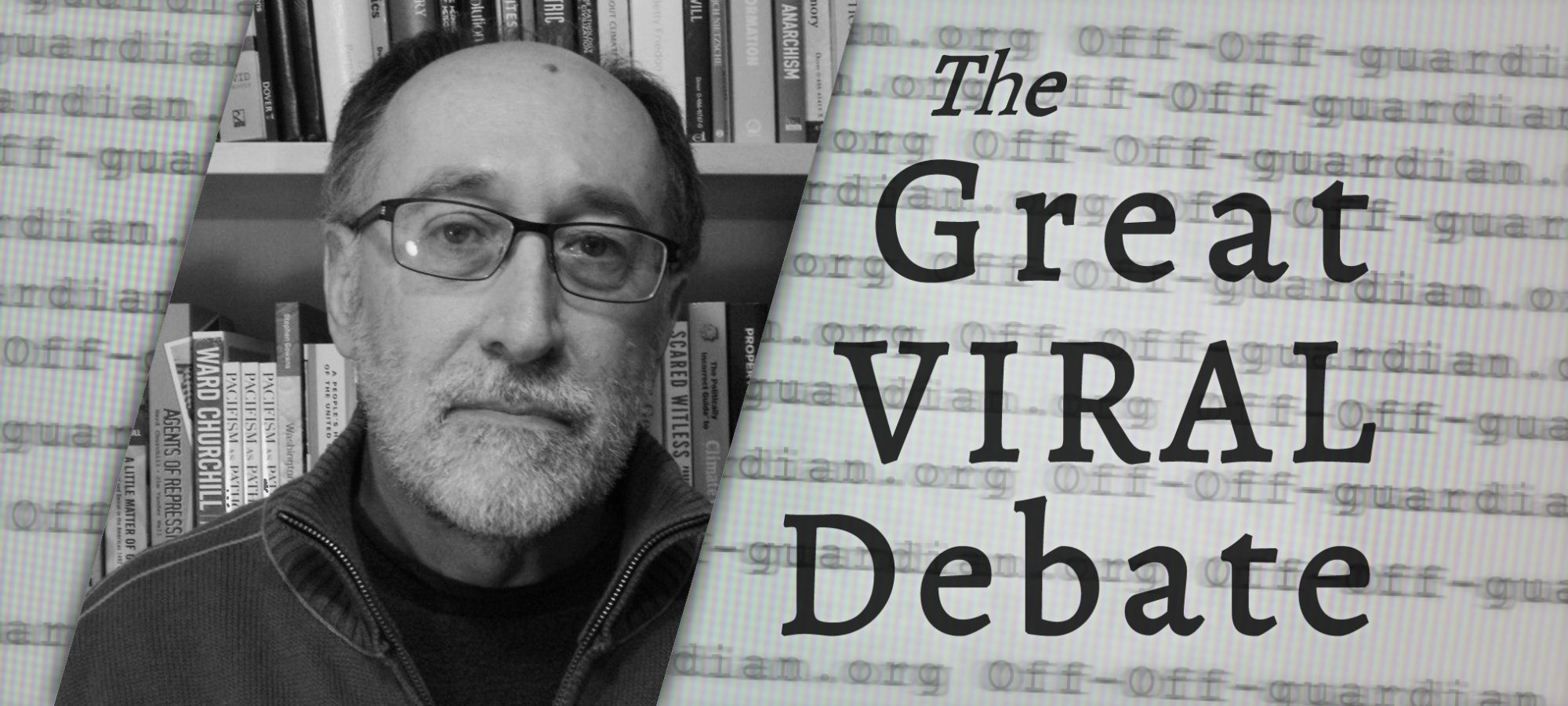
Dr Piers Robinson is our Chair. Off-Guardian is your host. The proposition to be debated is:
SARS-COV-2 merits suppression measures in order to combat the virus rather than the herd/community immunity approach
Dr Rancourt delivers his opening statement, arguing against the proposition:
The events of COVID-19 can be analysed by unembedded critical commentators following different stances, or using different filters. Examples of useful analytical stances include:
- COVID-19 is caused by a particularly virulent and transmissive viral respiratory disease pathogen. The death rate in a given population will depend on the effectiveness of government-coordinated mitigation interventions and treatment practices. Therefore, the hospitalization and death rates are a measure of intervention effectiveness in a given State jurisdiction.
- Irrespective of anything else, the questions of virulence (infection fatality rate) and transmissivity (contagiousness) can be answered by unbiased scientific enquiry, assuming virulence and transmissivity to be properties of the pathogen, for a given societal structure.
- The presence of a massive and coordinated information and recommendation (propaganda?) campaign, integrating government departments and health institutions, can be objectively ascertained, and it is both real and unprecedented in magnitude. In-effect this campaign serves to justify: harsh mitigation measures, censorship and surveillance, severe travel and trade restrictions, a large slowdown of the global economy, and a massive and accelerated effort to develop a vaccine. Are there geopolitical drivers, and what might they be? Or is the campaign simply a rational and apolitical response to a palpable public-health threat, in the other extreme?
- Large numbers of excess all-cause deaths have occurred in many State and local jurisdictions (and have not occurred in many other infected jurisdictions). Can it be established by scientific enquiry whether these deaths are primarily due to a new pathogen (SARS-CoV-2) or primarily due to the imposed mitigation measures, in the given societal structures? Can the quality of government be evaluated in terms of the lethality of the mitigation measures themselves?
Now, Professor Anderson and I want to debate whether SARS-CoV-2 merits special suppression measures versus business as usual, as, I will venture, would probably have occurred if no pandemic was declared.
One reason that we can even have this debate is that SARS-CoV-2 is not particularly virulent, nor is it more contagious than influenza, which is highly contagious. Folks are not dropping in the streets from SARS-CoV-2, not even in the USA. I do not know anyone who knows anyone who has died of this thing, and virtually all of my social contacts report the same. If SARS-CoV-2 were evidently deadly, in real observable terms for most people, then the debate would be over. There would be an obvious need to do more than the usual. Likewise, with an exceptionally virulent and contagious pathogen, the effectiveness of various mitigation measures would easily be ascertained. With SARS-CoV-2, the weakness of the pathogen allows for endless debate, spin, and policy uncertainty.
In that sense, the nature of the instant debate itself puts a limit on the presumed dangerousness of SARS-CoV-2. Unlike imperialism, war, global exploitation, and so on, in terms of human misery, this is largely an academic exercise, if it is confined to the virulence of SARS-CoV-2.
In my own on-going research, I have examined COVID-19 through the lens of each of the four stances outlined above. My main research articles have been:
- Evaluation of the virulence of SARS-CoV-2 in France, from all-cause mortality 1946-2020 (20 August 2020) (with Marine Baudin and Jérémie Mercier)
- All-cause mortality during COVID-19: No plague and a likely signature of mass homicide by government response (2 June 2020)
- Masks Don’t Work: a Review of Science Relevant to Covid-19 Social Policy (11 April 2020)
- Face masks, lies, damn lies, and public health officials: “A growing body of evidence” (3 August 2020)
I also authored a Report for the Ontario Civil Liberties Association (ocla.ca), entitled “Criticism of Government Response to COVID-19 in Canada” (18 April 2020); and co-authored an OCLA letter to the WHO, entitled “WHO advising the use of masks in the general population to prevent COVID-19 transmission” (21 June 2020).
Regarding virulence, the infection fatality rate (IFR) is a scientific question, which cannot be answered merely by using socio-political inferences. The IFR is the number of deaths attributed to the pathogen (SARS-CoV-2), occurring within a relevant time period, per proven infection in the corresponding relevant time period, in a given population [1].
The IFR must be discerned from the case fatality ratio (CFR), which is the number of deaths, within a relevant time period, per number of diagnosed medical “cases”, which are confirmed and actual illnesses, in a given population. CFR is a measure of clinical severity. Here, I should stress that a “case” is not a “PCR positive”, as misused in the media, and that the evaluation must be based on a population, without selecting only the most ill individuals presenting themselves to hospitals. At the start of the COVID-19 saga, a large uncorrected CFR, estimated from hospital cases in Wuhan, caused the initial panic.
An authoritative and detailed recent study of the IFR for COVID-19 is provided by Professor John Ioannidis [2]. Professor Joseph Audie reviewed the Ioannidis study, in relation to a demonstrably faulty evaluation of IFR revised and concocted by the CDC (dated 10 July 2020) [3]. The CDC published re-revised estimates on 10 September 2020 [4].
Both Ioannidis and Audie conclude that SARS-CoV-2 is not more virulent than a “bad”-season influenza. Ioannidis puts it in these terms, in its socio-political context:
Based on the IFR estimates obtained here, COVID-19 may have infected as of July 12 approximately 300 million people (or more), far more than the ~13 million PCR-documented cases. The global COVID-19 death toll is still evolving, but it is still not much dissimilar to a typical death toll from seasonal influenza (290,000-650,000), while “bad” influenza years (e.g. 1957-9 and 1968-70) have been associated with 1-4 million deaths. […] COVID-19 seems to affect predominantly the frail, the disadvantaged, and the marginalized – as shown by high rates of infectious burden in nursing homes, homeless shelters, prisons, meat processing plants, and the strong racial/ethnic inequalities against minorities in terms of the cumulative death risk.
The revised (10 September 2020) CDC best-estimates of the IFR [0.003%, 0-19 years; 0.02%, 20-49 years; 0.5%, 50-69 years; 5.4% 70+ years] are comparable to and smaller than the values for the mild 2009 (H1N1) influenza pandemic [0.00066%, 3-19 years … 0.22% (0.05%—4%), 60+ years] [5].
Therefore, by now, the numbers are in: SARS-CoV-2 is not an extraordinarily deadly respiratory disease pathogen.
This is to say nothing about the unsolved problem of inflationary bias in attributing medical deaths to COVID-19, which is the numerator in the IFR ratio. The latter bias is documented to be particularly severe with deaths of elderly persons having multiple comorbidities. It also says little about the problem of the questionable premise of virology that mortality is primarily due to the genetics of one guilty viral strain, rather than being primarily due to vulnerability of the host population (subjected to an ecology of pathogens), including vulnerability to violent government interventions.
Find out more about our two eminent debaters here
Read Dr Anderson’s opposing opening statement here
Footnotes:
1. https://www.medrxiv.org…
2. Ibid.
3. https://www.researchgate.net…
4. https://www.cdc.gov/…
5. https://www.ncbi.nlm.nih.gov/pmc…
Thanks for reading...
You can help us keep doing what we do. Every little helps and is hugely appreciated.




For other ways to donate, including direct-transfer bank details click HERE.
 wpDiscuz