What we can learn from the “Russian GPS interference” story.
Kit Knightly




On Monday morning it was widely reported that a private jet ferrying Ursula Von Der Leyen to Plovdiv in Bulgaria was subject to “GPS interference”, and had to navigate using paper charts for the final part its journey.
This was quickly blamed on Russia, a supposed attempt to assassinate, or at least intimidate the EU chief, and the reactions kicked into high-gear almost instantly.
The Financial Times lead the pack, headlining [emphasis added]:
Ursula von der Leyen’s plane hit by suspected Russian GPS interference
ABC news went with [more emphasis added]:
EU head Ursula von der Leyen’s plane hit by suspected Russian GPS interference
The BBC mixed it up a little [even more emphasis added]:
EU chief von der Leyen’s plane hit by SUSPECTED Russian GPS jamming
Are you seeing a pattern?
Elsewhere, the AP claims to have got all the information you need, adding that it’s so completely definitely true that there isn’t even any point in investigating it:
Bulgaria will not investigate suspected Russian electronic interference with a top European official’s plane, officials said Monday — because this kind of GPS jamming is now so common.
Having established it definitely happened, Sky News turned to analysis:
Russia responds to GPS jamming accusations – but such instances are expected to escalate
Euro News is at full blown panic stations:
What can Europe do to better defend against GPS interference from Russia?
The good news is that NATO are going to save us, according to the Independent:
NATO says it is working to counter Russia’s GPS jamming after EU leader’s plane incident
The Conversation is asking the big question, hinting at the grander agenda behind the story:
Russia’s GPS interference: do I need to worry when flying?
Got that everyone? Flying is scary. Putin might kill you. Probably safer to just stay at home.
The counterpoint, appearing in comments sections all across social media, was that the alleged attack was likely a false flag, carried out by Ukraine or NATO.
However, somewhat lost in the tug-of-war assigning blame was this simple fact: There was no evidence any “GPS inteference” had ever happened.
The website FlightRadar24 monitors air traffic GPS and telemetry data for flights all over the world, and within a few minutes responded to this assertion with the following tweet:
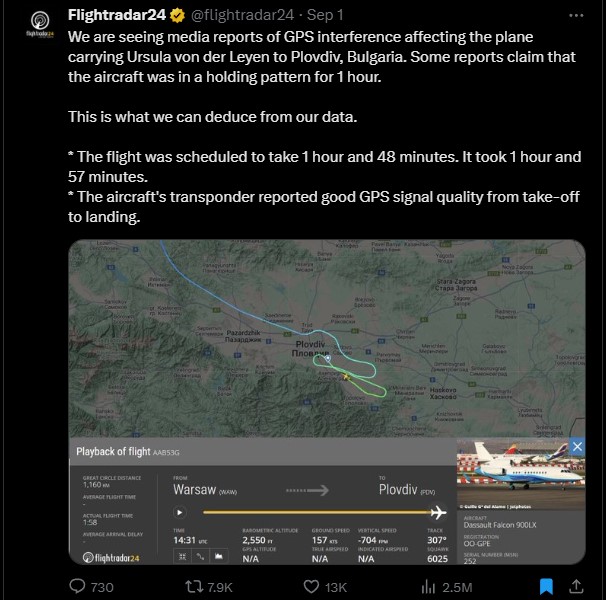
According to their data, far from being an hour late (as some stories reported), the flight was delayed by only nine minutes, which is pretty standard in terms of air travel. And the data shows it maintained transponder signal throughout its journey.
In short, there’s nothing in the data to say the flight was anything but completely ordinary.
The media are clearly aware of this apparent contradiction, accounting for its “peculiarity” in their version of the narrative. In their follow up article, earlier today, the Financial Times notes:
unusually, the transponder onboard von der Leyen’s plane appears to have been able to establish the plane’s position and broadcast it throughout the incident.
The aircraft’s location was reported accurately and continuously on flight tracking websites because its so-called Automatic Dependent Surveillance–Broadcast (ADS-B) system appeared to be unaffected.
Which is essentially an admission that the data makes it appear the “GPS interference” never actually happened.
In fact, we have no confirmation anything happened at all. It’s just a story, and people on both sides ran with the underlying assumption before it was properly established.
What can we learn from this story? Always. Question. Everything.
An old lesson that always bears repeating.
Thanks for reading...
You can help us keep doing what we do. Every little helps and is hugely appreciated.
For other ways to donate, including direct-transfer bank details click HERE.



The ADS-B signal just transmits the data it collects from the GPS system. Therefore the fact that it was “unaffected” tells us that the GPS was unaffected, i.e. there was no interference, at least nothing of any significance.
(6)
https://vazrazhdane.bg/костадин-костадинов-поздравих-влади/
21.03.2024
Kostadin Kostadinov: I congratulated Vladimir Putin on his election victory, I hope to congratulate Donald Trump soon
“Yesterday I read in at least a hundred places how elections in Russia should not be recognized because they were a manifestation of dictatorship… That is why yesterday I wrote and sent a congratulatory address on behalf of Vazrazhdane to Russian President Vladimir Putin. And I, like every normal Bulgarian, have an infallible political compass – if the native “Euro-Atlanticists” curse someone or something, then it is good and useful for Bulgaria. I hope that after the US elections in the autumn I will send a congratulatory address to the new US President Donald Trump.”
https://vazrazhdane.bg/bylgarskiat-lev/
17.07.2025
At the beginning of the week, a delegation of “Vazrazhdane”, consisting of Kliment Shopov, MP, and MEPs Stanislav Stoyanov and Rada Laykova returned from the United States. There they were invited by the Republican Party to its youth forum in Tampa, Florida. At a forum attended by the three representatives of “Vazrazhdane”, big names in the conservative sphere were present.
From journalists and activists, to entrepreneurs and politicians. Names such as Donald Trump Jr., Steve Bannon, Tucker Carlson, Charlie Kirk, Roger Stone, as well as US Secretary of Defense Pete Hegseth, and Secretary of the Interior Christy Noam. After the end of the event, our delegates held meetings in Washington, Boston and Baltimore. They also met with Prof. Steve Hanke – the creator of the currency board in Bulgaria and in a number of other countries around the world. The meeting took place in his office at Johns Hopkins University in Baltimore.
https://vazrazhdane.bg/възраждане-на-костадинов-се-срещна-с/
22.04.2024
Kostadinov’s “Vazrazhdane” met with part of Trump’s team in the United States
The nominee for MEP from “Vazrazhdane”, Rada Laykova met with congressmen and councilors from the Republican Party in the United States.
“I met with Congressman Paul Gosar and with national security advisers and legislative assistants to various congressmen on Trump’s team. We share common concerns regarding attempts to shift the Christian and moral foundations of modern society. We have reached complete unanimity regarding the emphasized importance of traditional family values, our skepticism about the EU’s attempts to become a federation and our common position against mandatory vaccinations for Covid 19.
..Various issues were also discussed, with a main focus on the legislative aspects of foreign affairs, with an emphasis on digital policies and the idea of abandoning the use of banknotes as a means of payment.
..We shared common concerns about globalist politics and united around the idea of preparing for future engagements that could benefit bilateral relations
https://vazrazhdane.bg/костадин-костадинов-публикува-в-соци/
19.01.2025
Kostadin Kostadinov published on the social network his invitation for the swearing-in of Donald Trump
“Good luck to Donald Trump in governing the United States! Millions of people are looking at him with the hope of normalizing international relations, and the world as a whole breathed a sigh of relief after his victory in the elections!”
We remind you that “Vazrazhdane” has been in communication with the Republican Party since November 2023. Then, in March 2024, the Youth Conference “We are the Youth of Europe” was held in Sofia, which was attended by representatives of the youth organizations of the partner parties of “Vazrazhdane” – “Alternative for Germany” (Germany), “Our Homeland” (Hungary), “Freedom and Direct Democracy” (Czech Republic), the Republican Party (USA). The Republican Party of the United States was represented by Jay Patel.
After that, Rada Laykova… visited the United States and in April 2024 met with Congressman Paul Gosar and with national security advisers and legislative assistants to various congressmen from Trump’s team.
Kostadinov has repeatedly expressed support for Trump’s positions and the invitation he received for the upcoming swearing-in is not surprising for Vazrazhdane.
https://vazrazhdane.bg/vazrajdane-trump-ewropa-25411/
01.03.2025
“Revival”: Full support for Trump in restoring peace in Europe
Millions of Russians for 12 years were victims of the Ukro-Nazi regime, whose icon after Bandera will obviously be Zelensky. Vazrazhdane expresses its full support for President Trump, who did not allow peace to be held hostage to the disrespectful behavior of a president who sacrificed his people to serve the interests of liberal elites in their war with Russia. We support US President Trump in his quest to restore world peace.
https://vazrazhdane.bg/trump-putin/
16.08.2025
Kostadinov on the Trump-Putin meeting: The EU has been reduced to a bystander, an economic appendage of the United States and a geographical appendix of Eurasia
..He stressed that the two presidents of great powers have shown how to defend national interests and how they stop at nothing to do so. According to him, the politics of power and fait accompli, formulated by Bismarck, has triumphantly returned to the big stage, making the era of hidden domination and soft power a thing of the past.
…Putin has proved, with a brilliant complex of military, economic and financial measures, that Russia’s place, as one of the five great powers on the planet, is unchangeable.
Trump has become a (unsuspected) master of diplomatic triumphs, who at the same time managed to wrest huge economic gains for his country from almost all of the United States’ trading partners.
“Real Politician” (the politics of power and fait accompli, formulated by Bismarck) returned triumphantly to the big stage, making the era of hidden domination and soft power a thing of the past. The unipolar world is already part of the past, humanity has returned to the era of the Great Concert – the complex and difficult cooperation/rivalry between the Great Powers.”
(8)
https://www.instagram.com/p/DMZILdoxOk0/
rada.laykova
Harvard University
I graduated from one of the most intensive and inspiring programs in the world: Leading in Artificial Intelligence: Exploring Technology and Policy at Harvard Kennedy School.
I spent a week in the heart of Harvard, surrounded by leaders from all over the world, from ministers and MPs to engineers, journalists, and innovators.
Bulgaria has something to say and something to defend in this transformation. I believe that our voice should sound loud and that in this new era of technology, the future will not wait. We will have to build it – alone, free, prepared.
https://www.linkedin.com/posts/rada-laykova-90313b2ab_ai-leadership-hks-activity-7351277564092387330-7vnc
Rada Laykova, Member of the European Parliament | ESN (Europe of Sovereign Nations)
I’m currently taking part in the Leading in Artificial Intelligence: Exploring Technology and Polic Executive Education programme at the Harvard Kennedy School.
This week has been a deep dive into AI governance, ethics, and innovation. I am grateful to learn alongside global leaders and thinkers and to bring sharper tools back to Brussels in defence of freedom, transparency and citizen rights.
I will continue defending democratic values in the age of digital transformation.
https://vazrazhdane.bg/laikova-29-07/
29.07.2025, Rada Laikova held a number of meetings in the US Congress on the topic of digital currencies and the future of financial freedom
https://www.instagram.com/rada.laykova/p/DMgMv70pE3z/
rada.laykova
United States Capitol
As a MEP from Vazrazhdane, I hold a number of meetings in the US Congress on the topic of digital currencies and the future of financial freedom.
In our conversations with Congressman Andy Oggles and Congressman Paul Gosar’s team, we discussed the risks of digital currencies issued by central banks such as the digital euro and how they are a tool for supervision and control by unelected bureaucrats.
We have common views on: The financial sovereignty of citizens; Resistance to programmed money, which can limit costs in time, place and purpose; A clear position against the digital dollar by the majority of Republicans in Congress; Protection of cash and the right to anonymous payments.
I presented the Bulgarian position on the protection of our national currency and our efforts against the digital euro and the supranational monetary control that the EU is planning.
It is time for the sovereign nations of Europe and the world to unite to defend financial independence and personal integrity!
https://www.instagram.com/rada.laykova/p/DMeTLQuxwyz/
Capitol Hill Club – where ideas about the future meet those with the power to shape it.
#Freedom #Sovereignty #VoiceFromEurope #GlobalDialogue #WashingtonDC
https://www.instagram.com/rada.laykova/p/DNkttBOtwLe/
rada.laykova 2 weeks ago
Europe is lagging behind in the battle for the future
The data for August 2025 is startling: USA: 68.9% of global computing power in AI China: 14.5% EU: 6.1% Europe, which gave the world the industrial revolution, is now reduced to the clerk who regulates artificial intelligence, cryptocurrencies and social networks, instead of creating their own giants.
How did it happen that a continent with so much history, resources and talents today behaves like the administrative department of Silicon Valley and Shenzhen?
The Brussels bureaucracy refuses Europe to strive for leadership! Bulgaria has no right to stand aside.
Vazrazhdane says clearly: We do not want to be a periphery that only consumes foreign technologies. Our people can and should develop their own innovations, their own specialists, their own breakthroughs. If we wait for “Brussels” to decide for us, we will remain forever in the queue.
https://www.youtube.com/watch?v=h70WNNjb_SM
I am honored to participate here together with leaders from all over the world – people who are shaping the future of digital governance. We talk openly about ethics, transparency, algorithms and who makes decisions in the new digital order.
https://www.instagram.com/rada.laykova/p/DM5FkBCtom_/
Sunday is a day for reflection. The future comes at algorithmic speed, and the question arises whether the human spirit will remain leading in the age of artificial intelligence. Artificial intelligence does not wait, does not ask and does not forgive mistakes in management. This transformation will not just be technological, but will change our lives.
I recommend: The Coming Wave AI, Power and our future, by Mustafa Syleyman, CEO of Microsoft AI
https://openlibrary.org/books/OL49766921M/The_Coming_Wave
Soon you will live surrounded by AIs. They will organise your life, operate your business, and run core government services. You will live in a world of DNA printers and quantum computers, engineered pathogens and autonomous weapons, robot assistants and abundant energy.
None of us are prepared.
As co-founder of the pioneering AI company DeepMind, part of Google, Mustafa Suleyman has been at the centre of this revolution. The coming decade, he argues, will be defined by this wave of powerful, fast-proliferating new technologies.
Can we forge a narrow path between catastrophe and dystopia?”
https://ia801201.us.archive.org/21/items/the-coming-wave-by-mustafa-suleyman-michael-bhaskar-pdfread.net/The%20Coming%20Wave%20By%20Mustafa%20SuleymanMichael%20Bhaskar-pdfread.net.pdf
…
“The Coming Wave is a fascinating, well-written, and important book. It explores the existential dangers that AI and biotechnology pose to humankind, and offers practical solutions for how we can contain the threat. The coming technological wave promises to provide humanity with godlike powers of creation, but if we fail to manage it wisely, it may destroy us.” — Yuval Noah Harari, New York Times bestselling author of Sapiens
…
https://booksthatslay.com/the-coming-wave-summary-analysis-and-themes/
…
The Interconnectedness Of AI And Synthetic Biology And The Emergence Of Converging Fields
In his discussion of AI and synthetic biology, Suleyman illuminates the extraordinary power of convergence. He emphasizes that these fields are not only advancing at breakneck speeds but are also beginning to intersect in ways that will amplify their individual impacts. The progress seen in AI—exemplified by the breakthroughs of DeepMind—echoes the transformative advancements in synthetic biology, where CRISPR and gene-editing technologies are revolutionizing medicine and industry.”
Bulgaria seems the most lost (if anyone) in the ‘tug-of-war’ model. Who the hell has heard of Bulgaria anyway?
Some nation on the map somewhere I believe, nevertheless maybe worth exploring…
“…the country’s burgeoning role as a hub for arms production. …an announcement by Germany’s defense company Rheinmetall that it would build two new factories in the Balkan nation, including expanding facilities at Sopot, to establish Bulgaria as Europe’s largest gunpowder manufacturer. ..Russia’s invasion of Ukraine has since breathed new life into Bulgaria’s defense industry, turning the country into a crucial supplier of Soviet-standard ammunition for Kyiv — and reviving once-idle plants and regions.”
Completely negligible.
…
Ursula (at the beginning, English): “One third of the weapons used in Ukraine come from Bulgaria.”
(Vagabard: “Who the hell has heard of Bulgaria anyway?”)
So I guess this means I have to cancel my GOOD RIDDANCE to Ursula Von Der Leyen party….
A search of GPS / GNSS jamming returns so many results gaslighting about threats from Russia and China, you would never know that the U.S. invented the technology decades ago and dominates low earth orbit real estate. One might be led to believe that GPS jamming was a technology beyond the reach of the West, or that the West would never engage such inscrutable tactics.
Even Israel is reported to have 12 military satellites (not necessarily GPS satellites, but satellites nonetheless).
I wonder how many satellites Hamas, Hezbollah, and the Houthis have…
What a crappy story, gps interference…..gaslighting for ignoramuses.
Air Traffic Control is the ultimate authority for airplanes. They have radars and know precise position of every airplane in the area. They navigate airplanes!
There is no need for gps when flying across the continent. Gps was given to airplanes after Korean airplane was shot down over Sakhalin.
!!!
“Russian babushka’s from “Putin’s Squads” burning dollars in support of American hapless workers.” – 2021
https://img-9gag-fun.9cache.com/photo/aV7vdpn_460sv.mp4
“Putin’s Babushka Squad Burn Ursula von der Leyen Effigy in Ritual Purge.. they declared the EU a source of harm and called for its dissolution” – March 2025
Moon of Alabama is now returning a 503 error message. Within 48 hours of B writing a damning assessment of Fond of Lying’s fairy stories.
Thoses puski red commi;s at it again.
The GPS is just one part of the navigation methods and it’s not always the most reliable. Using charts and the old good compass can take you where you want quite easily. All this frantic show is just to remind the people in Europe that there is somebody called vd Leyen, totally expendable
It’s usually a reliable rule of thumb that when the Russians are blamed for anything in the western media that it is in fact the US that is behind whatever has happened.
Have you been watching The Diplomat on Netflix??
Not just the Russians. Add to your list China, Iran, Venezuela, Cuba, Antifa, Proud Boys, violent or destructive subgroups of “protesters”, “lone gunmen”, “hackers”, “drug cartels” and “Muslim terrorists.”
James is a likeable American with background knowledge of communist “East Germany” (actually Central Germany). How he came to this is unknown, as is his surname. He describes himself as a “Germanophile”, which does not mean an interest in the Third Reich.
In the video, he also refers to another American with the (possibly Romanian) surname Zeihan, who predicts the economic (and, in the next 100 years, ethnic) downfall of Germany.
Well, that is not difficult to predict, unless the miracle happens that Germany frees itself from its American dependency, drastically changes its migration policy and realigns its energy policy with Russia, which is unlikely in all three areas.
Whether Zeihan is just one of the countless doom prophets of who are usually booming in times of crisis cannot be known by anyone who does not have the gift of clairvoyance into the future. https://en.wikipedia.org/wiki/Peter_Zeihan
Zeihan’s historical and geopolitical assessment.
as a 12500 hour pilot i can tell you any pilot that needs gps to land or navigate needs training wings. maybe the situation was an undetected problem in the cockpit?
AS a 12500 hour pilot I can tell you any pilot in need of gps to land or navigate an airplane needs training wings.. maybe the situation was an undetected problem in the cockpit .
Propaganda 101..
You, fuckheads, didn’t learn and don’t know anything!!! You also will never never know anything because you don’t learn something.
Far better to argue
was it a bat
was it a wet meat market
was it visiting Americans
was it accidental release from bio lab
was it deliberate leak from gain of function lab
was it the China or the USA
was it 5G
Was the story an invention with only the small boy noticing that it was a naked lie.
Likely none of the above. An AI psy-op par-extra-ordinaire? Then yes, possibly.
Did the Emperor have no clothes? Unlikely, since he managed to dupe the whole world into buying himself a new set of apparel at the same time. So a lie, but perhaps not naked?
Shithole UK is the most Russia phobic country on the entire planet ,Sadly it has an idiot population behind them
Says the famous smut journalist from Le Monde Mr. François du Plessis de Richelieu.
I’m not sure it’s worse than the USA, to be honest.
I wouldn’t say idiot population, more like cowardly, they don’t have the courage to change things, things they know need changing – using physical actions.
Possibly. Except that some of them have spent more time in Moscow than most Russians from the Siberian backwaters
I think Germany is a close rival… including the knee-jerk believers.
“I think Germany is a close rival… including the knee-jerk believers.”
Why not just say that around 95% of the Russian, German, US, British and everywhere else groups are gullible, guilty, self-centred, stupid a-holes.
Why, in particular, do you imagine the parochial German group as one iota different to the others.
Because that – apart from Australian society – is the society I know best.
I don’t know much about Russia’s society, etc.
Stop hounding me.
“Stop hounding me.”
It’s a public forum.
You are one of the few with, largely, sensible comments.
If my comments see the light of day you will too, unless you decide not to read them.
Hounding will then be up to your imagination.
Off-topic:
After Lisbon’s tragic funicular tram crash yesterday which has so far claimed 17 lives and left 23 with injuries, the British Bullshit Corporation through its Radio 4 mouthpiece has wasted no time in interviewing a person from a local residents association.
The bodies are not even cold yet, the investigation has barely begun into the cause – most likely a snapped traction cable – but Fabiana Pavel, an Italian who is president of the Bairro Alto Residents Association in Lisbon thinks she knows the cause.
Drum roll…wait for it….”excessive tourism”. Yup, those pesky tourists using the furnicular, not just the locals who also use it daily. No, it couldn’t be a maintenance failure or other mechanical problem. Yet, defying logic, since so long as the tram was never over capacity at 43 people it wouldn’t make a difference if the trams were carrying tourists or locals.
Fabiana is what is known at best as a useful idiot, but in her case, highly likely a change agent. A globalist wolf in sheep’s clothing who is anti-tourism and has been given plenty of airtime to share her views. Even in 2020 during lockdowns she was being quoted in the press.
https://chateurope.eu/en/in-the-absence-of-tourists-locals-reclaim-their-cities/
After a summer of non-stop subliminal stay at home messaging through disaster propaganda regarding travel and holidays, the ghouls have even found a way to shoehorn it into a story regarding death and misery on a Lisbon funicular.
They really do not want to plebs to travel anymore and are spinning their wheels and stories furiously to bring an end to it.
Maybe the Italian should go back to Italy?
Just taking the bus costs too much lately.
“They really do not want to plebs to travel anymore and are spinning their wheels and stories furiously to bring an end to it.”
It’s certainly a starter before the main course but can you remind what their purpose with this is.
As far as the main course, a laughable AI response, just now, to “will robotic automation and AI require a good social credit score in order to receive food without a wage” was:
“It is unlikely that widespread robotic automation and AI will necessitate a good social credit score to receive food without wages, as there is no clear indication of such a scenario emerging in the future. Instead, potential societal adaptations like universal basic income (UBI) or different economic systems are more probable responses to a significant shift in the job market caused by AI and automation. The focus would likely be on ensuring access to resources and adapting to a future where human labor is less central, rather than on a coercive social credit system for basic necessities”
At least this might help Putin’s Babushka squad focus on their own, largely, self-made problem prior starvation but even that is unlikely.
A-holes.
A great, really fantastic squad that does a really fantastic job.
#Make Babushka Great Again
Those damn Gremlins in the Kremlin are at it again !!
Establishing The Blame before things happen:
We know they’ll be blamed for Every Cyber Attack !!
https://www.standard.co.uk/showbiz/coldplay-chris-martin-israeli-fans-wembley-b1245724.html
Coldplay’s Chris Martin invites two girls up on stage in London and they “just happen to be from Israel”.
What are the chances?
Lookout Chris: if they’ve done their compulsory military (how to maim and kill) service they could be deadly.
Undoubtably staged – to try and win hearts and minds for Israel’s position in Gaza – which as we all know is utterly untenable.
100% if MI6 planted a row of them at the front?
whilst signing ”fix you”
When you try your best, but you don’t succeed
When you get what you want, but not what you need
When you feel so tired, but you can’t sleep
Stuck in reverse
And the tears come streaming down your face
When you lose something you can’t replace
When you love someone, but it goes to waste
Could it be worse?
Lights will guide you home
And ignite your bones
And I will try to fix you
😂
Yeah it was utter lies from von der Leyen, just more anti-Russian rhetoric which the EU warmongering, genocide supporting Big-Wigs are good at – the Wests leaders have been in anti-Russian mode, since Feb 2022, when Russia stepped in to prevent a genocide in the Donbas that had been ongoing for eight years previous.
Of course some EU countries leaders didn’t jump on the Russia Bad bandwagon – such as Orban of Hungary, and Fico of Slovakia, the latter being more outspoken than the former, and that not easy, as Orban – of Hungary is very outspoken – for his troubles Fico has a failed assassination attempt on his life, shot five times but he survived – Fico blames the EU big wigs for the assassination attempt – but there no real proof yet.
On von der Leyen’s outrageous lies.
MoA has good piece on it.
MoA – Von der Leyen Is Lying About Russian GPS Interference
Is that an article by Bernhard?
Is he still hiding behind his sofa all masked up after taking 8 clot shots?
He seriously failed the Plandemic litmus test and not by mistake. Even stuck the boot into OffG at the time with no right of reply. A leaf straight out of the book of Andrei from defunct Saker, who banned any commenters who didn’t go along with Plandemic.
Those two shills blew their cover and any anti-establishment credentials they previously had. They are simply the other side of the fake binary/sides narrative in the world of geopolitics.
Anyway, OffG’s reply to the no right to reply article at MoA:
https://off-guardian.org/2020/10/16/__trashed-2/
“He seriously failed the Plandemic litmus test and not by mistake. Even stuck the boot into OffG at the time with no right of reply”
Maybe so, but the article does align with what OFFG has written above, that von der Leyen is a liar.
As the late, great Hunter S. Thompson occasionally observed, “Even a blind hog roots up an acorn now and then.” 🐗 🌰
All Figo’s goals. https://youtu.be/QkunabnAdTk .
The Russians are coming/invading/spying/poisoning/
bombing/shooting/killing/hacking/
lying/cheating/pretending/stealing
faking/blaming _ _ _ _
Whatever.
I recall Meta’s – Facebook and Instagram suspending their hate policies, to allow for people on both social media platforms to call for death to Russian’s – without being kicked-off the platforms, I think it was mid-to late 2022
Not heard of them using the old Novichok lately. Perhaps they’ve run out of it or lost the recipe.
Craig Murray revisits that particular flag flag – in which the Skripals unconscious on a bench just happen to be found, by one the British armies top medical officers – and the utter nonsense of the resealing the perfume bottle supposedly full of Novichok.
The Salisbury “Novichok” False Flag – Craig Murray
Or Porton Down wont give up the remainder of the batch !
Who doesn’t
I’ll take a wild stab that the “solution” will involve some combination of increased European military spending, digital passports and A.I.
Yeah Germany is in the process of building a new arms factory at Unterluess, that can produce 350,000 shells per year – it won’t reach that full capacity until 2027.
The best is yet to come
Vaccine,
Let me shed a bit of light on this.
First, I’m from Bulgaria. Second, we all know that GPS thing’s all bullshit (even the director of Plovdiv airfiled said nothing like this ever happened), and third – the author of this is our “own” government (“own” because it’s not our own, but euro-installed, it’s a long topic).
A bit of pre-history:
Von der Leyen was here to inspect one of the two major military plants in the country – VMZ (https://vmz.bg/en).
Earlier last month it was announced that Germany’s Rheinmetal would establish joint venture with this plant (51% Rheinmetal, 49% VMZ) for two additional factories (one for gunpowder, one for NATO-size 155mm ammo), for which Bulgaria will apply for loan for nearly 1 billion euro (https://www.bta.bg/en/news/economy/945383-economy-minister-proposes-vmz-rheinmetall-joint-venture-for-155-mm-ammunition-pl). At the moment is it not said what is the contribution of Rheinmetal.
So, after the announcement of the joint venture, von der Leyen (here she is known as von der Pfizer, though) comes to “inspect” the factory. From the early morning people gather at the VMZ-plant for protest, Ursula cannot enter officially through the main entrance, so she is dropped from a helicopter directly on some beaten asphalt ground in the factory. Then, she also cannot go to inspect a factory in one of the nearby villages as planned as she cannot exit the main plant with car, so she is lifted by the helicopter again and sent away to the Plovdiv airfiled to go home.
Nothing of this got in the news, as you may imagine.
So, I suspect that this GPS-nonsense is brought up to cover all this “warm welcome” to our euroqueen, so everybody will forget this and talk about evil Russians (again) doing dirty things to our pretty euroleaders. Was it Goebbels that said “A lie repeated a thousand times becomes the truth.”? Even today our media is full of this GPS-thingy!
Wasn’t there a demo outside one of the arms factories, meant for von der Leyen – when von der Leyen’s big black Audi pulled up at the gates in Bulgaria, I saw a clip of that on social media.
Thank you Zmej. I did hear her Car being mobbed but she wasn’t a passenger at the time. Oh well…curiouser and curiouser said Alice.
It’s really curious, dear Pyewacket, I’d even say it’s even more curious than you imagine (and the more you learn, the more curious). Check the comment box here later today/tomorrow for more details for curious people. If you want, of course.
Von der Pfizer. Love it.
Friends from Bulgaria told me another version – von der Laynen. (I guess the mr dragon/zmej can confirm). In Bulgarian, they said, it was written like this: фон дер Лайнен. They told me what it meant, but I forgot. Some kind of play with words, due to the similarity of Mrs. von der Leyen’s (фон дер Лайен) surname and the Bulgarian word лайно / layno.
“Лайно/layno” in bulgarian means, quite literally, “sh*t”. She is called that way as well.
Europe has to learn to defend themselves against any aggression from Dictatorship countries……and Hamas!
You’d think Europe has got it by now
Thank you, Mr. Dragon (zmej), for your direct inclusion on the air from your beautiful country. People, as you can see, also highly appreciate your message (in order to keep our spirits high, people need positive news about the manifestation of a high irreconcilable spirit from other people around the world).
I had a great desire to bring some clarity and details about this welcome of Ursula “by the ‘people’ who gathered from early in the morning”, as you say, who the people are/who gathered them, how this relates to the much more important (since we understood that the GPS story is a hoax), in fact, the main question of the bigger picture and the future of Europe in the context of the “global transformation”, and so on (since I have released a crow with an artificial eye-camera, a street cat with an ear implant-recorder, an earthworm-cyborg with a geolocating transceiver, as well as other animals to roam and gather information from your country)… But it turned out that I don’t have much energy now, so I’ll postpone it until later today or tomorrow.
except 7/7 that was so real according to you.
Planes have double redundancy everything. They use light (lasers through prisms) as a gyroscope to very accurately position the plane from takeoff to landing so there was no need for “paper maps”. It may be that they use GPS as the backup for the gyro.
I would assume it’s fond of lying’s PR team.
Beware Sept 13? Some say it’s a famous date for TPTB-events. It contains 13 & 9-13 adds to 13.
You know how some of them are fascinated w numerology as a form of superstition.
What can we learn from this story? Sure, always question everything.
The other key takeaway: The EUSSR will soon move to ban independent sources like Flightradar24.
What we can learn?
The Anglo saying “the dog ate my homework” is now officially replaced with “the Russians did it”.
Brilliant
BTW, Florida banned ALL vaccine mandates today– not just the covid vaxx. The mandate ban includes for kids k-12 grades. Parents’ choice.
What can we learn from this story? Some things, a lot of things, that are newsworthy aren’t worth questioning or paying any attention to.
We cant rely more on sattelites. Out of safety reasons I suggest we build a network of 30m high 6G masts per 100m square all over Europe for security. .
.
Then this will never happen again.
Gotta be those alien, virus, Muslim, Chinese, climate thingys! Surely.
All the media and sources i read (many), said, nothing happened.
None of those i read said, it was a false flag.
When nothing happens (apart from some invented “news” in media, that nobody with some brains reads), no article is needed. Even not that one.
Neither is my comment😀.
Though I don’t know much about the workings of satellites, wouldn’t a plane’s electronics be searching for another satellite automatically, just like a phone searches for the nearest mobile phone tower?
And since the US is king in terms of number of satellites out there in NEO (that’s as far as we can go, btw) – The satellite gap is vast: the US has 4,883, Russia 256. How many does China have? ** – surely Russia couldn’t disable all of the Western satellites to ‘confuse’ the plane. And even if this were possible, wouldn’t the plane simply jump to the nearest satellite anyhow, Russian or otherwise. Unless satellites have a political opinion on things….
______
** Different figures here but the disparity is still there.
I was hoping to have the above comment deleted… I completely misread the article! Sorry.
But, of course, van der Lying’s accusation is still not credible.
Satellites would prove space exists
proof of satellites in space doesn’t exist
because
the implications are too severe to consider
A perfect example where proper puntuation is superflux. Nonetheless, gave me a bit of a headacke not unlike a Marxist discussion but in a different way, at the same time kinda cute. Well done.
There’s only one country that specialises with ‘decapitation’ assassinations.
And you know who that is !!
It’s a cover-up ! The pilot was drunk is all !!
When you listen to the media you’re listening to Disneylandia. They’ve taken a break from the major hoaxes. Do you remember 10 years ago, the bomb that brought down a non-existent Russian Airbus?
On the day that the Iran “Nuclear Deal” was announced Thierry Meyssan on Voltaire leaked that on the outskirts of the interminable Iran negotiations, there was a US-Russian deal that the Russians would enter the Syrian war!
–You’ll remember that Russia’s initial action was strictly by aircraft. Accordingly, 2 Western actions occurred at once: the missiles on the Turkish/Syrian border that had grounded the Syrian airforce were withdrawn. AND the long seige of Syria’s Hmeymim (Latakia) air base was suddenly ended as the US had its mercenary troops withdraw so the Russians could come in to renovate/extend the airport.
–The massive amounts of material necessary for this work were “not seen” by the combined intelligence agencies of the US, NATO, Israel and Turkey (though it all passed through the Turkish Straits). Likewise nobody “noticed” the work on the airfield though it was clearly visible by satellite.
There were Congressional hearings at the time about this “greatest intelligence failing of all time.”
–And when it was time for the Russians to have boots on the ground, Britain & the US arranged a phoney shoot-down of a Russian passenger liner as a pretext. The “crash scene” was the most transparent hoax I’ve yet seen: the wrong engine, which sat lightly on the sand instead of half-burying itself in the “fall from the sky,” the wings that flew themselves and landed right-side-up and undamaged, and the initial report from the Russian airport that there was NO FLIGHT over the Sinai at that time (quickly hushed up).
So Russian participation in the Syrian conflict was overtly agreed upon by at least the US & Britain.
and if your listening to the alternative, your what exactly.?
informed or programmed?
Exactly, question everything… usually you have to wait for better answers… through a lifetime… you don’t get answers per say, more of a general sense…
Do you have any evidence to support your thesis ?
seems like maybe tit for tat in response to that story Moscow put out a few weeks ago regarding some threat to Putin’s helicopter
perhaps VDL felt snubbed b/c no one thought she was important enough to be similarly targeted
What an utter crock of shit.
I am still waiting for these so-called geopolitical enemies to whack each others Heads of State, Prime Ministers, Intelligence Agency head honchos, senior civil servants, judges, CEOs and anyone else of importance.
Strange that it never happens.
Vlad hasn’t been poisoned, Trump survived…ahem… an ‘assasination attempt’, Fond of Lying waltzed into Kiev along with Bono, Boris and Sean Penn during a ‘war’, no flak jacket required. Sean Penn even gave his Oscar to little penis piano playing Vlod. Come on, an Oscar?? Yes, because Oscars are given to best performance actors – they are telling us, it is hidden in plain sight.
If these clowns were really in a geopolitical struggle with one another, most would be dead by now. There would be hits, left, right and centre and no amount of security would prevent it. However, a bunch of Freemasonic Kabbalists who are LARPing are not going to harm each other.
Once again, it is more theatrics from the controllers and their minions, all playing their roles to deceive the audience…that being all of us useless eaters.
after the last few months have so irrefutably demonstrated the sheer irrelevance, from a geopolitical standpoint, of the Brussels crowd, why would anyone even want to bother with taking them out?
Despite my revulsion for Trump, he again gained points for asking VDL to “leave the room” where other European leaders had come to discuss “peace for Ukraine” – assuming the report is true.
A brilliant synopsis !!
I think the top puppets do hate each other; they are rivals. Their only unifying motive is their hatred of us plebs. And the puppet masters probably despise their useful idiot puppets, too.
I don’t know, I question why on earth any entity would attempt such a lame thing as “GPS interference” whatever that is. Whether it happened or not, it’s a big bag of nothing.
Most experts agree that they were once perts but can no longer be legitimately considered as such, therefore they currently pontificate as experts.
Perts have yet to comment on this extrapolation but further guidance for obfuscated clarity will be forthcoming in due course as time permits or without time permits.
perts only comment on ongoing trapolation, EXtrapolation they leave to the EXpertd
Can someone repost the event 201 version of the Cyber thing that was done by the same cabal.
It seem like prepping for the big blackout.
BS! If it was a danger why did that violent kunt (that will never be on the front line) get back on the same plane and fly away. Signed A US VET that would be put in a cage before standing and fighting for any country again in this lifetime.
The fundamental problem is that ADS-B information is openly available to the public and that sites like FlightRadar, by aggregating this data, can come up with facts that are not controllable. Because of this we need to encrypt or otherwise prohibit the use of this information by the public. We can’t allow just anyone to contradict The Narrative, can we?
This hasn’t stopped the original report being picked up and repeated, augmented by various NATO officials and the like to add gravitas. This incident is actually really important for all of us because its rarely that this type of story is so easily contradicted by incontrovertible facts. Usually there’s some wiggle room to inject enough uncertainty to drown out anyone who dares to say “But…….”.
Normally in the absence of hard information we’d have to resort to indirect means to debunk this story. The first thing to note is that Bulgaria, although a Slavic nation that uses that funny writing Russians use, is actually nowhere near Russia. Although jamming GPS is quite easy, selectively doing this at a distance of maybe 1000Km without anyone else noticing would be a technical tour-de-force. The other thing is that GPS, while nice to have, isn’t essential. There’s lots of other ways for pilots to see where they are (not to mention Air Traffic Control tracking them) including, if all else fails, the old standby of “Looking out the window”.
Or a paper map, right? As if pilots would truly need a paper map and really, could you just visualize a co-pilot sitting there with a paper map? The more idiotic the story the better it works now. And we know what the purpose of that is – scary Russia, once again.
As to GPS, it may not be totally necessary, but everything seems to use it now and I can’t help but feel that without it, who would really even know how to read a paper map anymore?
Pilots are trained to work from charts. They’ll always carry paper on any cross country flight, they do this for the same reason that regardless of how sophisticated a plane is it will always have a basic set of independent instruments. Stuff can and will break, usually at inconvenient times, and the one thing that you can’t do easily in a plane is pull over and park to fix it — you’ve got to find somewhere to land and get down onto it.
PS — They look like maps to you and me but for some reason pilots always call them ‘charts’.
Get ready to be in the frontline yet again Europeans as the unelected bureaucrats at the EU have decided to make war against Russia. The first casualty of war is the truth and it’s already dead and buried.