The Future of British “Justice” is HORRIFYING
Kit Knightly

The recent changes being made to British law are undermining the rights of citizens to a fair trial and presumption of innocence, and could turn our legal system into a truly dystopian nightmare.
Here’s how…
The reports
The calls for reforms, reviews and all the other R words come from three relatively recent reports.
First, there was the first report of Lord Leveson’s Crime and Justice Report, which was “leaked” in April:
Goodbye Jury Trials, Hello Digital ID: 10 “recommendations” from the Crime and Justice Commission
And which we covered in depth here when they were published in July (his second report is due to be released soon):
Explained: The UK’s Potentially Terrifying Criminal Justice “Reforms”
Second, there is the London Victim Attrition Review, authored by outgoing Victims Commissioner for London and incoming National Victims Commissioner, Claire Waxman OBE.
Third, and finally, there is the last report from the outgoing National Victims Commissioner Baroness Newlove, the Annual Victim Survey 2024, which was published in October.
These reports lay the precedent and narrative groundwork for all the justice “reforms” moving forward. Notice two of them are victim-centric, that is clearly by design. Almost all the “reforms” are framed as “protecting victims”.
abolishing jury trials
This has been on the cards for a while, and should surprise no one. Just yesterday, Justice Minister David Lammy announced the plan to abolish all jury trials for crimes carrying (our emphasis) “likely sentences of three years or less” (spot the weasel word).
The plan is to follow Lord Leveson’s recommendation from April and introduce a new judge-only division of the Crown Court to hear these cases and “clear the backlog”.
We’ve discussed this to death in the past, and I won’t repeat myself here. Instead, I invite you to note the way MPs talk about accused criminals in articles like this one from the Guardian, and ask if it fills you with confidence for the future of justice.
Sarah Sackman MP describes choosing a trial by jury as a way for “career criminals” to “game the system”, with defendants “laughing in the dock”. The basic assumption is that all accused people are basically guilty.
Because eroding the presumption of innocence is a key theme here.
She goes on to suggest people accused of stealing minor items don’t deserve the luxury of a fair trial,
Do we think that someone who has stolen a bottle of whisky from a minimart should receive the right to trial by jury?
And, while it’s hard to understand exactly what her broken English is intended to convey here, it’s probably (ironically) that juries are too dim to understand complicated fraud cases (that’s the view expressed in the Leveson report, page 306, para. 71) :
Do we think that someone who has been involved in a serious fraud involving cryptocurrency that (sic) we should have a jury sat in court for a year or more hearing such a case?
The only rational answer to both those questions is, of course, “yes”, but I think she wants us to say “no”.
And note the already-tired call to “protect victims”:
“I’ve spoken to victims and survivors who tell me they’ve lost their jobs, they suffered mental breakdown all the while that they were waiting
These attitudes – alleged victims are always saintly, accused are always guilty, and a trial is a luxury afforded by a merciful state – are everywhere right now, and that should be worrying all of us.
While changes to the jury system are getting a lot of headlines — rightfully so — they are hardly the only frightening “reform” on the horizon.
Coaching witnesses
The state wants to “train” prosecution witnesses to deal with “tough” cross-examination. The recommendation, taken from the Waxman report, is covered in the Evening Standard, which headlines:
Witnesses in criminal trials should be trained to cope with tough questions
And that’s pretty much the gist. The incoming national victim’s commissioner wants state prosecutors to train witnesses to “deal with tough questions”:
Ms Waxman says the preparation should go further, delivering a “dedicated session focused on in-depth support for giving evidence” for witnesses who are vulnerable or could be intimidated by the trial process.
Which sounds rather like the state coaching their witness on how to handle cross-examination by the defence, doesn’t it?
It is, once again, couched in terms of protecting victims:
“For too many victims, the experience of attending court remains daunting, with limited support in preparing for trial which, coupled with the long waiting time due to the backlogs, is often an emotionally exhausting and traumatising experience”,
Incredibly manipulative. But at least witnesses will actually be present in the courtroom, instead of giving pre-recorded statements or testifying over video-link, both of which already happen.
incentivising allegations of abuse
The UK’s Bar Council is backing a move that will effectively incentivise allegations of domestic abuse in divorce courts.
In the UK roughly 15% of family court cases are eligible for legal aid, but the Bar Association is backing a change that would make any case involving allegations of domestic abuse automatically eligible.
To put two and two together, this move will undoubtedly — 100% absolutely certainly — increase the number of domestic abuse allegations.
The state will effectively be paying people to accuse each other of domestic violence.
cattle-tagging parolees
In late 2024, it was announced that London would be launching a pilot scheme to GPS tag those convicted of “stalking offenses”. This followed similar schemes tagging those convicted of knife crime and domestic abuse.
Under that scheme, over 230 parolees were returned to prison after breaching “exclusion zones”. This so-called “success” has now led to a national rollout.
The planned national scheme will see tens of thousands of people tagged with GPS ankle monitors, and introduce new “restriction zones” alongside “exclusion zones”. Breaching these zones will result in possible jail time.
It’s easy to see how a system of strict GPS restriction/exclusion zones sending people back to prison can be cynically used to extend a prison sentence.
Essentially, you could deny a defendant a jury trial because his crime carries a maximum sentence of less than three years, then use overly strict “restriction zones” to send him back to prison and informally extend his sentence.
Limiting Appeals
Following Leveson’s recommendations, Lammy has announced an end to the automatic right to appeal, limiting appeals from the magistrates’ court to the Crown Court to points of law, and making it so appeals must be approved by a judge before they can be heard.
To quote the Leveson report from July, those convicted will have to “apply for permission to appeal.”
This move has been widely criticised by legal experts.
Further, sentencing powers have increased for the lower courts, allowing them to impose fines of up to £10,000 or jail terms of 18 months.
So we have harsher sentences being handed out that, because they are given out by magistrates, will be almost impossible to appeal.
The psy-ops keep on coming
As always with propaganda drives, we are awash with cases and studies reinforcing the apparent need for reform just as the reports are published.
For example, this year has seen multiple stories of prisoners being “accidentally” released early – over 90 of them according to the BBC.
You know what a good solution to this “problem” would be?
Well, how about geo-tagging all prisoners or former prisoners?
It’s not hard to decode the messaging.
This is only a minor example, but yesterday, within hours of Lammy announcing the jury overhaul, “Simon” called into LBC Radio to tell us about a jury acquitting someone, even though he was guilty:
‘I saw the victim, I saw her go to pieces.’
‘Did you feel ashamed of yourself?’
‘No, no I didn’t.’Caller Simon recounts the moment he and his fellow jurors decided to let off an ‘old man’ who had ‘obviously’ committed a crime against a young girl. @Iaindale pic.twitter.com/CGAydynAXd
— LBC (@LBC) December 2, 2025
Only the willfully blind or unfortunately stupid could possibly fail to see this for what it is- crude and fraudulent propaganda. Unfortunately, our media landscape is populated almost entirely with this kind of low-level psy-op aimed at propping up the narrative of the moment.
Why is it always rape?
Natalie Fleet MP has written a long defence of “jury reform” for the New Statesman, published yesterday:
Why curtailing juries can help save British justice
…and literally the only crime it mentions is rape.
In 2023, France massively reduced its usage of jury trials – including in ALL rape cases.
Last year, Scotland tried (again) to get rid of jury trials for rape cases (they failed after resistance from the bar association). Again in Scotland, alleged victims are protected by the “rape shield” law during trials – meaning they are not subject to proper cross-examination.
This tramples the rights of the accused, but no one wants to talk about that. If you happen to be falsely accused – well, too bad because your accuser won’t have to prove their case.
One way the Scottish courts have always been superior to the rest of the UK (in my opinion), is the presence of the “not proven” verdict. An option for juries to say “the accused is probably guilty, but there isn’t enough evidence to convict”. It carries no penalty, works as an acquittal and renders protection under Double Jeopardy laws, but is distinct from being found “innocent”.
And now it’s scrapped. Why?
To try and increase convictions for rape.
Because demanding proof is just (alleged) victim-blaming.
It’s just a fact that whenever tyrannical legal reforms are mooted, it’s usually in the name of either rape, or child abuse, school shootings or domestic violence.
The why of this is fairly simple.
These are all crimes heinous enough that no one will want to be associated with them, or be seen to be defending the (alleged) perpetrators. The government leverages our disgust at this kind of crime in order to legislate permission to commit disgusting crimes of their own.
Florida wants to make child rape punishable by death, and the UK is seriously considering mandatory chemical castration for sex offenders.
Instinctually, a lot of people will say this is acceptable. But, just as evolving definitions of “parental abuse” should cause us to question family court reforms, these criminal justice reforms should have us aware of the definition of “rape” or other highly emotive words.
After all, we were witness to the controlled evolution of “domestic terrorism” to mean whatever they want it to mean. We’d be naive to assume the same could not happen in other cases.
“protecting victims”
We have noted already that the rallying cry for all of these changes is “protecting” or “safeguarding” victims, usually women and/or children:
Today we’re announcing bold reform that puts victims at the front and centre of the justice system.
VAWG Advocate, @Pipstaylor spoke to Deputy Prime Minister David Lammy to hear the steps the government is taking to restore the public’s trust in the system. pic.twitter.com/PgsnYVl0AF
— Ministry of Justice (@MoJGovUK) December 2, 2025
Essentially, the totality of the proposed changes can be summed up in simple terms: The state is placing the concept of victimhood on a pedestal of unassailability and leveraging that to undermine the presumption of innocence.
There is no more clear example of this than law changes regarding “bad character” evidence. Moving forward, it will be much harder for defense attorneys to introduce evidence of “bad character” for alleged victims – even to the point of limiting cross-examination on the stand. While, at the same time, making it much easier to for the prosecution to introduce “bad character” evidence for the accused.
Even the use of the word “victim” is prejudicial in and of itself, as it presupposes a crime has taken place. “Alleged victim” would be more proper, or the legal term “complainant”.
going global
It can be no coincidence that these reforms — all so heavily couched in the language of “protecting victims” and preventing “violence against women and girls” — are rolling out in the UK just as the UN is launching their own “16 Days” campaign to raise awareness of violence against women.
More concerning is propaganda messaging that “digital violence is real violence”:
Online abuse is not “virtual”. It is real violence with real consequences.
Survivors carry scars beyond the screen.
Laws that protect us offline must also protect us online.
It’s time to demand accountability and safety in every space.#16Days #ACTToEndViolence pic.twitter.com/F13t7Wrxyi
— United Nations Geneva (@UNGeneva) December 4, 2025
Digital violence is a human rights, governance and economic crisis.
Together, let’s say NO to any form of violence against women and girls.
As we kick of #16Days of Activism, let’s build a safer online and offline world for every woman and girl.#NoExcuse pic.twitter.com/L6m5qPPIVE
— UN Development (@UNDP) November 25, 2025
The idea that digital or virtual behaviours should be bracketed alongside actual violent crime is incredibly worrying.
The UK already has frankly insane laws regarding speech on social media, with thousands and thousands of arrests for “digital communication offenses” every year. The framework already exists for these legal reforms concerning “protecting victims” to redefine terms such as “sexual assault” and “domestic violence” so they can be applied to online behaviour.
Conclusion
British law is rapidly becoming tyrannical. People are now routinely arrested for social media posts, and with the looming changes none of those people would be granted a jury trial and many of them would be subject to GPS surveillance after serving their sentence.
Let’s take everything together and mentally picture the inevitable future of criminal justice in this country:
- You are accused of stalking or “digital violence” based on a social media post.
- Your trial takes place in front of a single judge, not a jury
- Prosecution witnesses are coached/testify via video call/submit pre-recorded statements/are not subject to cross examination.
- You’re convicted but can longer be granted an automatic right to appeal.
- After three years in prison you are tagged with an ankle monitor on release.
- Going out of your “restriction zone” – ie accidentally driving or walking a little further than your monitor allows – sends you back to prison.
- And your “crime” that got you into this place? It could be as little as sending an email someone found “abusive”. Or indeed it could be nothing, because the system will almost guarantee that increasing numbers of falsely accused people will end up going to prison.
This is a dystopian hellscape, crafted in the name of “protecting victims”.
In late October I wrote a piece on the looming “reforms” to British family law, concluding:
In the end, is this all really about domestic abuse, protecting children or feminism?
No, I don’t think so. I think this is about inflating the role of the state in children’s lives, camouflaged in gender politics designed to turn mothers and fathers against each other.
I think it’s about perpetuating the war on the cohesive family unit and increasing single-parent families, in the knowledge that single parents will be more likely to rely on state assistance and less able to resist over-reaching rules and regulations.
In a similar vein I would ask, are these reforms really about “protecting victims”?
I don’t think so. I think the state is using victims – real and imagined – as stalking horses for their anti-human agenda. I think they are invoking the idea of “speedy justice” to undermine centuries-old and hard-won human rights.
The future of British “justice” is currently terrifying.
…and we still have the second part of the Leveson report, and its focus on “utilizing technology”, to look forward to.
Thanks for reading...
You can help us keep doing what we do. Every little helps and is hugely appreciated.




For other ways to donate, including direct-transfer bank details click HERE.



This is preparing the way for the future implementation of Noahide Laws
[The Coming Noahide Laws & Global Greater Israel
That is all! RGB-Y5 out!!
Acts and statutes aren’t law. They are only legally binding if you consent.
OWNERSHIP-OF-THE-FEDERAL-RESERVE.pdf
Talking of UK “justice”, I asked yandex.com this question:
Yandex AI replied with:
So I asked:
Got the same answer.
Makes you wonder why yandex,com is unable to answer a simple question without being safe, respectful and compliant with ethical principles. It must be either incompetent or lying about the “ethical principles” bit; it taking the unethical lying route.
Yet when I did a straight search on yandex.com, the first result was this … https://nypost.com/2025/08/19/world-news/uk-free-speech-struggle-30-arrests-a-day-censorship/.
Going to google.com, its first result was this …. https://www.quora.com/Are-tourists-in-the-UK-also-subject-to-arrest-for-online-posts-that-offend-people-Does-it-matter-if-the-posts-were-made-while-in-the-UK-or-can-arrests-happen-even-for-past-posts. The answer to the quora question is yes, you can be arrested.
Google will tell us we are at risk, but it looks like even Russians are not willing to state it explicitly, they are more cautious of getting on the wrong side of the UK government. It will be interesting to see which tourist gets arrested first.
Agreed on all points. It’s a terrifying development, especially also because new “crimes” are now being invented, such as online comments that someone out there may disagree with.
Just a thought about the character denigration of either victim or accused. It used to be that a woman’s chance of obtaining a conviction of rape for the alleged offender was severely compromised if the woman had had various lovers; sexist juries would look unsympathetically on such a victim. Bringing such information into the trial was unjust but only a handful of feminists ever objected to that. Now the tables are turned, and it will be equally unjust.
And as for the possibility of introducing the death penalty for child rapists, my inner devil would say, bring it on! At least we’d be rid of many of the vilest politicians, police and military chiefs, captains of industry, banksters and the judiciary, and let’s not forget the religious leaders…
However, I long ago reversed my thinking about the death penalty for any crime; to me such a primitive response to violent crimes would make us stoop to the level of the perps.
So what should we call it when Britain finally ditches the Magna Carta? Should we call it Mala Carta? Or maybe Discarta?
As regards Sarah Sackman, here’s what her Wiki-bio says:
As if it weren’t bad enough that Israel is training our cops, soon enough they’ll be training all our judges and lawyers, too. We are truly all Palestinians now … 😡
I think they’re going to call it Sharia.
The Telegraph is ecstatic!:
“Head teacher says 170 pupils called in sick in one day
Brian Guthrie, the principal of Ebrington Primary School in Londonderry, said attendance was worse than at the height of Covid
More than 170 pupils at the same school called in sick in just one day… many were suffering from flu and some even had to attend A&E and be admitted to hospital.… saw attendance drop to as low as 63 per cent last week, meaning over a third were off sick.…unprecedented… “Even at the worst height of Covid, I didn’t see attendance like this.” … A tidal wave of flu… more than trebled in the last two weeks, rising from 273 to 954.…reminded him of Covid regulations.… increased our hand hygiene… increased cleaning … all desks and doorhandles being sanitised.”
Doomed! Doomed! We’re all going to die!
Netflix Acquires Warner Bros. in $82.7 Billion Deal
The deal, announced Friday, values the studio and streaming assets at $72 billion in cash and stock after Warner Bros. Discovery spins off its cable networks. Netflix co-CEO Ted Sarandos praised blending Warner treasures with hits like Stranger Things, while CEO David Zaslav called it a union of storytelling giants that preserves a century of legacy. It promises boosted production, jobs, and $2-3 billion in yearly savings, but unions like the Writers Guild push back over job risks and competition concerns.
The merger awaits regulatory nods and could close in 12 to 18 months.
How depressing it would be to have everything in your home. Work, home, work, home, work, home.
Has it really come to this?:
https://x.com/Aizenberg55/status/1957443108397781234
“10 Questions ‘Genocide in Gaza’ Accusers Cannot Answer”
And down below in the comments I read:
“Note how there are no comments from the pro-palis here.
Not even one.”
But here’s the punchline: I CANNOT comment and CANNOT even repost the original article!
What a total con!
Assisted dying or long term prison without jury.
Come on, try and blame Commi China or Iran’s tyrants leader on this one.
Your lot always posts and reports lawless EU, UK, and USA with
fakevideos of Blacks , migrants, and Muslims doing all sorts.This is what most of you wanted : longer sentences, hard on
imaginarycriminals.Rupert Lowe Warns of the Globalist Agenda Destroying the West and the Revolution Soon to Come
Time that revolution for a bit later as the Anglo Atlantic global pirates still need a massive meltdown in Wall Street and the City. Wokes, keep it up for a bit!
Looks to me like British law is simply being used as another way for corporations to suckle the teat of government; the inevitable increase in inmates will no-doubt result in more private prisons, worse treatment of inmates, more profit for the billionaires who own these politicians.
When you look at the world, you notice that the countries that are on the up are the countries where the government and people have the same aspirations and are working together; Russia and China are prime examples.
The countries going down are the countries where the governments are fighting the people, the UK and Israel governments (of all colours) being the prime examples in the western world.
I think that’s a false dichotomy. The countries going up is where there already is totalitarian control – China is prime example. The countries going down right now are the last vestiges of western-style freedom, and they are being turned into China-style totalitarianism right now. I also think that en route to this development, there will be utter chaos and possibly civil war, as more and more migrants from the developing world are infiltrating these western nations and standards go to shit. At that point, China-style rule will be implemented completely.
As of 10 December 2025, Australians, 16 and under, will have to rely on
the corporate propaganda media to keep abreast of developments in the
war of extermination being conducted by The Most Moral Army In The
World…
The government insists young Australians need protecting from online
porn, that is, genocide pornography, by stopping their access to social
media… That all adults, all Australians over 16 will have to get digital ID if
they want to continue to use social media is just an ‘unintended consequence’…
https://newleftreview.org/sidecar/posts/grown-up-politics
I hear that actual pornography sites do not vet their audience for age…
Do such sites actually exist ?
Or are they just a government invention ?
Britain is doomed, I fear. Are the English people ready to admit specifically who is doing this to them? Are the English people rude enough yet to feed them to the woodchippers. I fear not. Manners lead to the grave.
The myth of ‘success’:
https://dissidentvoice.org/2025/12/the-magic-begging-bowl/
A sobering read.
There are always these (mostly Balkanese) Slavic terrorists who dominate today’s right-wing forums—they claim, contrary to all historical truth, that everything beyond the Elbe River was originally Slavic settlement area (and, unspoken, still should be today).
Then they cite as evidence that central German cities such as Leipzig, Berlin, Dresden, Rostock, etc. have Germanized names of Slavic settlements. While this is linguistically correct, it disregards the Germanic (in this case Viking) influence even on Kievan Rus.
Strangely enough, in East Prussia, which was under Germanic rule for about 800 years (originally by the Teutonic Order in the Baltic region), there are no or hardly any place names with Slavic influences, in contrast to central Germany.
So if the Germanic peoples settled there until the middle of the first millennium AD, and then again from 1200 AD onwards, where are all the Slavic civilizational achievements, such as the German-style towns that they now claim as their own?
https://en.wikipedia.org/wiki/List_of_early_Germanic_peoples
Right on the border of heavily Germanized Poland, the visible infrastructural gulag of this Eurasian subrace had already begun! And now they stand there and make undisguised demands, as if they had ever contributed anything except their supposed victory against the Turks at Vienna. Why are Polish immigrants so unpopular, even in Great Britain?
Ridiculous! Where is the globally recognized cultural achievement? With a few exceptions (Copernicus, Chaupin), I can’t see it! Even the Irish are cultural giants in comparison! No one can stand them because they are lazy, incapable of structured and organized thinking and acting, even today, and, as in the past, they parasitize on our financial contributions in order to exist at all and be considered a “Western nation.”
https://www.bbc.com/news/uk-politics-48256318
The Prussians were not Germans. They were not Slavs. They were Balts. And the Teutonic knights wiped them out. And so Prussian does not mean Prussian.
A Modern Myth: ‘Everyone Is Better Educated Today.’
……
If it acts like a myth, walks like a myth, quacks like a myth –
then it’s a myth, innit !
Still boiling down to…The Psychopath Takeover
Kit, don’t worry too much about too many people being thrown in jail for nothing. Chill, man. The jails are all full way past capacity, and these comically incompetent politicians who have no interest in prison reform or building new prisons to meet the capacity that their policies demand will have to keep reducing the percentage of your sentence that you actually have to serve. It will become a virtue of the British penal system of how quickly people are processed through it. They will triumph how many people have been rehabilitated, thus justifying their speedy release.
Celebrate how the UK becomes the best in the world at returning jailbirds to the community. Don’t be so negative.
Spoken like a true daily mail reader.
UK becomes the best in the world at returning jailbirds to the community.LOL
then 10 mins later the laws are brought out about how bad the prison / police system is.
As if people get released by accident.
reality check.
The modern so-called ‘left’ dissolved a long time ago into dividing everybody up into identity groups and giving them all the status of victims. Every cross-channel migrant is a victim of some kind, they tell us. That in itself is a despicable form of racism as it denies the people themselves any agency. Not that they had the determination and gumption to say “I will go somewhere to get a better life for myself” like the generations of Europeans heading to the USA, no, not possible, “They were manipulated at every turn by inhumane traffickers”.
Everybody is a victim. OK, very good. But if you define everybody as a victim, you deny them their very humanity.
Tyrants and corrupted souls
Xmas is pagan sun moon worship
Christmas is actually just the Pagan festival of Yule, that is, the winter solstice, rebranded.
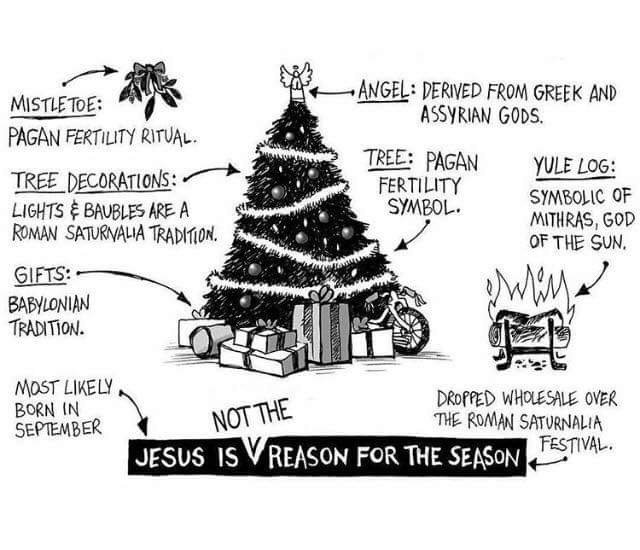
Duh
fairy tales about a white jesus;
So he was black? Or are Jews simply not white? What is your point?
The Early Church allowed villages of new converts to keep their old festivals, as long as they centered them around Christ.
Sounds pretty reasonable to me.
“reasonable”?
tuning entire cultures that venerated their own indigenous demiurge into slaves for the demon “god” “yahweh”
go suck and clean some mutilated genitals as is your role shabbos goy and get the fk
So jesuys was not born 3 thousands years ago 😂
from a virgin in a barn in Bethlehem on 25th December.
Sounds pretty reasonable to me.
I like those little churches in England by the crossroads encircled by standing stones. Christians get to partake of the ancient magic. Very astute.
Sounds reasonable to the world. Except it’s not at all reasonable according to scripture, God hates idolatry and worship of other Gods.
Jesus, like the Buddha, Mohammad etc, are all a long time dead.
We are NOW, as are Love and Life.
Get out of your head, out of the past, and into your heart.
‘Be as you are’.
Be who you are -Bee Gees
Jesus, like the Buddha, Mohammad etc, are all a long time dead.
They NEVER existed
Like Easter bunny and toothfairies.
Marx said Religion is the opiate of the people and replaced it in Russia with Stalin !
The real opiate is believing.
From believing stems most of the problems on Earth.
We don’t ‘believe’ we are hungry, in pain or in Love.
We KNOW.
Drop beliefs and Truth will rise.
That’s what many great teachers have taught.
Unfortunately, their teachings were buried under the quest for Mammon, authority and sexual dominance.
Having faith is not a problem, ie belief that in ones : children, friends, family or self. However, being deceived is a problem.
For example, the Marxists/ Communists/Bolsheviks deceived themselves, in Russia, into believing the replacement of Religion with a new ideology would found paradise on Earth it did’nt hence Stalin.
The truth will set you free but can people accept the ultimate truths ?
Not when the truth of a thing kills, which is going to be most of the time now.
If one denies the truth, one lives in darkness!
The truth is, if YHWH or Yah, or whatever TF IT’s called now is your creator that you are a BOT and, if you are not on the predestined chosen list, you are predestined to spend eternity in Hell.
Take solace from the fact that there is nothing (zip, zilch, zero, nada) that you can do about it – the future is, allegedly, pre-determined:
Romans 8
Hope you got plenty of Black Friday kneepads but that ,probably, won’t help since you constantly call IT a liar by way of your assertion that you have a “free” will.
You are a very naughty BOT.
Very.
Luke 15
The Parable of the Lost Sheep..
7 I tell you that in the same way there will be more rejoicing in heaven over one sinner who repents than over ninety-nine righteous persons who do not need to repent…
“, you are predestined to spend eternity in Hell.”
brianborou
Nov 27, 2025 9:39 AM
Reply to Lu1..
..you make the choice as to whether you live within the mercy of God or not.
To blame it on your mum, dad, uncle Tom, Belzeebub or whatever demonstrates cowardice.
It is your decision…
Luke 15 NIV – The Parable of the Lost Sheep – Now the – Bible Gateway
“..you make the choice as to whether you live within the mercy of God or not.”
A BOT calling IT a liar over & over & over is unlikely to end well.
Poor bro bero.
Poor poor bro bero.
To reiterate,
Reply to Lu1..
..you make the choice as to whether you live within the mercy of God or not.
To blame it on your mum, dad, uncle Tom, Belzeebub or whatever demonstrates cowardice.
It is your decision…
Revelation 21:8
To reiterate,
Poor bro bero.
A BOT calling IT a liar over & over & over is unlikely to end well.
Poor poor bro bero.
A-hole.
“ To reiterate, “
..To blame it on your mum, dad, Uncle Tom, Belzeebub or whatever demonstrates cowardice..
It is your decision..
Revelation 21:8
“ But the cowardly,…will be consigned to the fiery lake of burning sulphur… “
Blasphemous piece of bollix:
” It is your decision..
“ To reiterate, “
..To blame it on your mum, dad, Uncle Tom,
Belzeebub or whatever demonstrates cowardice..
It is your decision..
Revelation 21:8
“ But the cowardly,…will be consigned to the fiery lake of burning sulphur… “
Aarghhhh, the nail’s driven fractionally deeper on the cross by not so Christian bro bero’s lies..
You are a very naughty BOT or unicellular brain. You are supposed to love an omniscient & omnipotent IT rather than the limp dick notsobigKahuna your lie infers.
Get down the mass and get a bit of deity flesh & blood into ye, sacrifice it and lie to IT over & over & over ad infinitum ad nauseum again & again & again.
IT will not be amused.
brianborou
Dec 8, 2025 12:01 AM
Reply to lu1
” It is your decision..
“ To reiterate, “
..To blame it on your mum, dad, Uncle Tom,
Belzeebub or whatever demonstrates cowardice..
It is your decision..
Revelation 21:8
“ But the cowardly,…will be consigned to the fiery lake of burning sulphur… “
“It is your decision..”
The BOT, on preprogrammed infinite loop to call ITs creator a liar until the wages of sin see its appointed DNR and, after that, the Judgment 😫
Poor Bro B.O, a not so willing servant on the wrong side of the naughty or nice list.
Poor poor Bro B.O.
Truth will prevail !
brianborou
Dec 8, 2025 12:01 AM
Reply to lu1
” It is your decision..
“ To reiterate, “
..To blame it on your mum, dad, Uncle Tom,
Belzeebub or whatever demonstrates cowardice..
It is your decision..
Revelation 21:8
“ But the cowardly,…will be consigned to the fiery lake of burning sulphur… “
You need to start quoting your own , er, evidence correctly:
Revelation 21
Calling IT a liar on endless loop will not see a favourable outcome to your DNR 😆
U R a BOT or single brain celled gullible, guilty, self-centred, stupid, evil-A-Hole.
Biblical References to Free Will
Deuteronomy 30:19″I call heaven and earth to witness against you today, that I have set before you life and death, blessing and curse.
Therefore choose life, that you and your offspring may live.”Joshua 24:1
“And if it is evil in your eyes to serve the LORD, choose this day whom you will serve…”
Galatians 5:13″For you were called to freedom, brothers. Only do not use your freedom as an opportunity for the flesh, but through love serve one another.”
Revelation 3:20″Behold, I stand at the door and knock. If anyone hears my voice and opens the door, I will come in to him and eat with him, and he with me.”
Understanding Free Will in Scripture
These verses illustrate the concept of free will as a fundamental aspect of the relationship between God and humanity, emphasizing the ability to choose between good and evil.
this refers to you!
Proverbs 6:16-19God hates deceitful actions, including lying and sowing discord.
Truth will prevail !
brianborou
Dec 8, 2025 12:01 AM
Reply to lu1
” It is your decision..
“ To reiterate, “
..To blame it on your mum, dad, Uncle Tom,
Belzeebub or whatever demonstrates cowardice..
It is your decision..
Revelation 21:8
“ But the cowardly,…will be consigned to the fiery lake of burning sulphur… “
Biblical references that, as a BOT, you have been programmed to lie about & hate:
Jeremiah 1:4-5
Romans 8
Ezekiel 11
John 6:37
John 6:44
John 6:65
Ephesians 1
2 Thessalonians
1 Peter 3
You are, either, a slimy deceitful little BOT in deep fucking dah dah dahdah doo doo doo
or, nearly certainly, a gullible, guilty, self-centred, stupid, evil A-Hole.
Just in case you did’nt comprehend it the first time.
God, as demonstrated by the numerous citations in the bible, gave man free will.
Biblical References to Free Will
Deuteronomy 30:19″I call heaven and earth to witness against you today, that I have set before you life and death, blessing and curse.
Therefore choose life, that you and your offspring may live.”Joshua 24:1
“And if it is evil in your eyes to serve the LORD, choose this day whom you will serve…”
Galatians 5:13″For you were called to freedom, brothers. Only do not use your freedom as an opportunity for the flesh, but through love serve one another.”
Revelation 3:20″Behold, I stand at the door and knock. If anyone hears my voice and opens the door, I will come in to him and eat with him, and he with
me.”
Understanding Free Will in Scripture
These verses illustrate the concept of free will as a fundamental aspect of the relationship between God and humanity, emphasizing the ability to choose between good and evil.
Note the text
Futhermore, in Revelation 22:11
11 Let the one who does wrong continue to do wrong; let the vile person continue to be vile; let the one who does right continue to do right; and let the holy person continue to be holy.”
Divine Sovereignty and Human Responsibility
If man, as you have done, abuse free will it is your own decision not your parents, relatives, the devil or otherwise.
Therefore, your attempts using deceit to deviate from the word of God is as written.
Proverbs 6:16-19God hates deceitful actions, including lying and sowing discord.
And the consequences for this is also scripture.
Revelation 21:8
New International Version
8 But the cowardly, the unbelieving, the vile, the murderers, the sexually immoral, those who practice magic arts, the idolaters and all liars—they will be consigned to the fiery lake of burning sulphur. This is the second death.”
It’s ok bro B.O..
It’s not your fault
As a bot you have not been programmed to understand plain English when it has been organised in sentences and paragraphs for those on the elect list to immediately recognise.
You are deep in the doo doo.
Narrow is the way for the small number of BOTs that get it.
If IT planned an upgrade before your DNR comes along there’s still hope for you – but not much.
Poor bro B.O.
Never mind, you can maybe have a little fun sliding around on your kneepads worshipping notsomadVlad or watching “Ghostbusters” for the umpteenth time before you know what happens.
Poor poor bro B.O.
You don’t understand Marx’s observation. He meant that religion effectively assuages the pain and grief and suffering of the oppressed, as an opiate does for the bodily afflicted. In that sense, it is a good thing.
Um,
https://off-guardian.org/2025/10/19/the-masks-have-come-off/#comment-738585
Marx (a major psyop contributor), at face value, believed that, while religion might provide temporary relief, it ultimately distracts people from addressing their real suffering and the need for social change i.e. it is a bad thing.
There’s plenty of truth sprinkled in the Biblical psyop too.
A-hole.
Partially correct.
Religion as Opium of the People (Karl Marx)
Ditto patriotism, atheism and scientism.
It goes much further back than that.
On your Scotland paragraph the late Alex Salmond (politician) stood trial for supposedly sexually assaulting eight women – he was completely cleared of any wrong doing by a jury of his peers made up mostly of women.
The eight women were given lifelong anonymity one woman claimed that she was sexually assault by Mr Salmond – but witnesses on his behalf proved that she wasn’t even in the same building as the accused, when he was meant to have committed the offence – she was never charged with perjury.
Scotland’s (COPFS) – Crown Office & Prosecution Service is corrupt to its core the LA the then FM and a judge whom I will not name pushed for juryless trials but the (bar pushed back and they had to back down – convictions should always be based on evidence and a jury of our peers are their to decide our guilt or innocence – sex crimes are just excuse to get judge only trials off the ground, from there (in time) everyone who ends up in the dock would face a judge only decision – and compliant judges would easily imprison those folk that they have been told to send down.
The corruption runs that deep in Scotland, that Police Scotland officers all 22 of them spent four years looking for dirt on Mr Salmond – of which they never found any – the estimated cost of this fit up of Salmond is in the region of £10 million quid of taxpayers cash.
Re my above comment Ex-British Ambassador Craig Murray who reported on the above was sent to prison for eight months by a judge – Murray was denied a jury – and much of his defence evidence was not allowed to be presented – the then Solicitor General in Scotland Davie Harvie (a known repeat known Mi5 agent) approached the judge in Murray’s kangaroo trial, just before Murray was to be sentenced and whispered something into the judges ear – Murray was then sent down for eight months, for a so called crime he did not commit.
No dissident or blogger, aware of what’s going on – will be safe if Juryless trials become the norm.
Imagine that, instead of legal decisions made by 12 (or whatever) citizens, they’re going to be made solely by one person, a judge. Feel sorry for ya Britain. We’re lucky here in the US, we have 435 (capped in 1913) people making “laws”, and one person making major decisions, for 330 million of us.
Like Project 2025 and Trump, this is coming from somewhere and it’s all tied together and until we the people can take over our political systems from the psycho class, it will just get worse.
To be sure, if they can ever get their digital control-grid rolling over here, they won’t even need the law to completely control us anymore — juries or no.
“But at least witnesses will actually be present in the courtroom, instead of giving pre-recorded statements or testifying over video-link, both of which already happen.”
Sometimes they don’t even have the opportunity of pre-recorded statements or video links. I’m thinking of the “dead” Skripal father and daughter not allowed to give evidence in the Dawn Sturgess Inquiry, the predictable result of which was announced by Lord Hughes yesterday.
the tag has been used for 20+ years on the media named asbo.
Remember lawless Britain? or Broken Britain in the 1990/early 20’s all over the news.
They started tagging teenagers..
tagging an Antisocial Behaviour Order (ASBO), a court order in the UK to stop harassment, but it can also mean tagging someone subject to an order with an electronic GPS device (a “tag”)
What to do if you have an electronic tag (including curfew tags, location tags and alcohol tags) and how to contact the Electronic Monitoring Service (EMS).
This is not new, been happening for decades in The UK and tested on poor.
Upper middle class who are clueless in what happens in the real world or just to consumed in the virtual reality of internet.
When laws are written or rewritten we can be sure of one thing:
The Turds at the top are expeditiously exempted, mollycoddled or bypassed entirely.
Funny how that works. After all, we can’t have the prison system clogged up with politicians, CEOs, Royalty, Media Magnates and celebrities.
That creep Sarkozy in France is a Numero uno example. One law for them etc etc….
There’s always the Tower of London.
Off with their filthy, lying heads.
The suffering they have caused and are still causing is incalculable.
Because they know how to play us Proles.
The idea underpinning Democracy is that us morons of sound mind etc can take independent decisions. In reality, we’re as pliable as a well-paid whore.
Demos Kratos. Power to the People. What f*cking stupid idea.
I honestly can’t see UK surviving the next 3 and a half years on current trajectory.
Labour’s popularity is 10%, yet with a 200 seat majority a rebellion and no confidence vote seems to be a pipe dream.
Our options are limited and scary.
Oh, Superman, where are you now ?
Write to Prince Charles. He is King now and can do it, if you explain it to him how he should do it!
That’s the problem Erik.
Kings in England don’t have armour or prancing steeds, nor any valour and honour and stuff anymore.
They are there only to bring in the tourist dollar.
Don’t get me wrong, if it brings in a few quid I’m okey dokey with that.
Slaying dragons or repelling globalist ambitions, though,
They’re woefully shit at that.
highly adept at fucking little children though
King Charles has much more power than you think. I have heard several times that “we need to check it (get it approved) with the Royals”.
They never did, they where among the greatest tyrants of their time – little has changed. They are now amongst the highest echelon of the Global Mafia.
” They are now amongst the highest echelon of the Global Mafia.. “
d46c8fde50b75cde688ee60f3fc995e9c7b348f18b3f317cb15c47fb05450fc8_1.jpg (1080×1053)
Here’s a cracker of a slimy little well paid actor git forgetting to shake the hand of one of those who feeds him
https://www.instagram.com/reel/C29hPs5o59T/
Continuing with the Royal Family and
” They are now amongst the highest echelon of the Global Mafia..
Intermarriage of the Rothschilds and Royal Families
Historical Context
The Rothschild family, a prominent banking dynasty, has a long history of intermarriage with various royal families. This practice was common among European elites to strengthen alliances and consolidate wealth.
Notable Marriages
Reasons for Intermarriage
Consequences
While intermarriage among royals often aimed to keep power within a select group, it sometimes led to genetic issues, as seen in other royal families. However, the Rothschilds managed to maintain their prominence without the same level of inbreeding seen in some royal lineages.
The Rothschilds’ strategic marriages have played a significant role in their historical influence and legacy in European finance and society.
Ignorance is bliss eh !
You’re definitely the expert there.
Those with more than one brain cell understand that the Royals and Rothschild’s are top echelon Global Mafia and VVP / DJT are, relatively, lowly well paid actors for them.
This means that either you have a unicellular brain or (if YHWH is miraculously the real creator) that you are a very silly BOT.
Poor not so Christian bro bero, either way, you are a top drawer A-hole.
” Ignorance is bliss eh “
You have provided not a scintilla of evidence to counter this.
Never mind, I will help you out dumb shmuck !
OWNERSHIP-OF-THE-FEDERAL-RESERVE.pdf
OWNERSHIP-OF-THE-FEDERAL-RESERVE.pdf
?
Genesis.
Land of confusion.
I am all in for victims.
The underlying intent of rape can be seen to correspond with transfecting or violating boundary conditions, as an intent to possess and control or steal life from the living. Its principle is of a projection of force and guile for the seeding of fantasy gratification.
As such it usurps and violates the body, as ‘freedom’ without boundary – to then arbitrarily set bounds on the othered. Fantasy can never fulfil true desire, for it runs a wishful substitution. It must give way to truth – not stand in judgement as determiner of truth.
A disembodied mind is not an extension of living presence – but passes off as such under a social masking disorder.
Machine thinking is what gave rise to technology – that then reinforces its loveless predicate.
Horror can fixate and fascinate the mind in a seeming dynamic of conflicts that merely frames the mind in a split attention. Turn a blind eye – that you know not what you do. By thinking to use it, it uses you.
To look on horror directly is to break the spell and move past its guilting fears, but freedom to look within is of love. Ego-led inquisitions generate an ego-alien encounter. Only love can free the mind of a split self-sense of lack, threat and struggle.
The cultural expression of a blind machine thinking is ‘in our face’.
But culture is not imposed from without, but is in part our response to our experience, which in turn is framed by the definitions or acquired and inherited beliefs that run as internalised habit or programmed laziness of mind.
Reacting is not really a relational response, and a true relational response is not only to the world, but to the framework of belief or choice that we interpret through – and last but not least to the love that we are – which is a Field of relational Embodiment – but as a whole – not fragmented.
Systems capture as mass-formation or collectivised identity is a subscription service. But the sub is not IN the world but at the level from which we co-create our (experience of the) world.
Creating is not control.
The wish to control outcomes runs blind to true Cause – hence it can only stamp out templates and identikit them into novel variants.
The prayer ‘Thy will be done’ would have no meaning if the will was not split by – “I Want it Thus!”
Well I notice the latter in the failure of ‘my world’ to be what I wanted it to be. But here’s the rub… Do I set myself up to fail?
Nothing I write is about a blame game, but a curiosity and desire to release a gaslighting that absolutely runs on guilting manipulation.
Where and what is justice?
The ‘world’ is framed by vengeance as contractual debt or karma as retribution. yet this DOES the boot that stamps the face of the presence as a presentation of past into a ‘forever future’.
The Eternal is not a linear infinity.
Love cannot be possessed, controlled and persisted in self-illusion to which truth must be masked out.
Deeper questioning of mutually agreed reality may wait on deeper pain.
Pain doesn’t ask the question, but will reach the limits of tolerance for an unquestioned life-habit.
Ed smoking the peace pipe.
The grotesquely obvious con justifying reforms to the legal system seem even more glaring in retrospect:
“consider the future of policing and the criminal justice system, in the light of the knife crime crisis, a shoplifting epidemic, the growing threat of cybercrime, concerns about the culture of the police, court backlogs, problems with legal aid and overflowing prisons.”
Yeah ’cause there’s a “knife crime crisis” and a “shoplifting epidemic”!
And who can’t help but seethe with rage over drug dealers and career criminals “laughing in the dock” knowing cases can take years to come to trial? The evil bastards!
Chemical castration sounds rather fun. Isn’t that part of the trip towards transwomanhood?
The Snoopers Charter, the Online Safety Act the abolishing of Jury Trials the implementation of Digital ID’s the widespread roll out of Facial Recognition Technologies – I’m sure you ca see where this is leading to – No? I’ll spell it out complete surveillance – of our lives.
Where the HELL was alt media, yes you Kit, when this was tested on the poor , mainly the disabled? Of course, nowhere as usual until it is now late, which seems to be your calling card, late to the party by 10 years, OG and MSM alt media, of which you are a part .
During the last decade , under the guise of warfare reforms after the organized banking bailout of 2008 , they had to blame someone (exactly like now, after COVID; the internet is full of it-the migrants and then the disabled (welfare) are at fault for oligarchic thievery gone wrong).
Severely disabled people , the elderly, and the vulnerable were found fit for work ; they had a right to appeal the decision. The appeal always failed; they were then offered a paper review hearing by a single judge at the H.M. Courts, the old name for the People’s Tribunal . WHAT REAL JOURNALIST found that if the single judge did a paper review of the case, over 90% of the time he was in favor of what the original findings were.
YET disabled people learned they could take this to a hearing, which was in front of a panel .
A judge, doctors , and disabled experts; the original findings were overturned in 96% of the cases.
If you did your job and looked, then it was easy to see where this was going-like everything else. (who did the they start the covid on? The disabled and elderly and poor = venerable) this is there MO in every case. Before it goes middle.
But as usual , you were shilling for billionaire alt media ghosts/boogeymen (celebrity MSM + woke right gossip news) and following shekels of what is internet fashionable.
UK people, Those covid camps and new USA style private prison system must be filled up some how, so best behavior.
Just us for the 0.1% is “carry on Sir!”.
Easily done and there’s no edit function- my comment should say ‘should say’. Hopefully you’ll correct the error in the main article.
Great article but there is a typo in the conclusion which reads ‘ You’re convicted but can longer be granted an automatic right to appeal.’ i think it say ‘…no longer…’.
Brilliant. Thanks.
Sorry for going off topic right away but this HAS to be the Christmas number 1:
https://tonygreenstein.com/it-was-a-scam-a-dirty-fucking-scam-the-anti-semitism-smear-campaign-was-a-genocidal-scam/
Is it “off topic”? How does ‘hate crime’ fit into all this?
It seems that Jezza has been a bit weak in hating the
RomansJews and is therefore being sidelined in his own party!Anyway, what have the Jews ever done for us?
The irony is that, despite Rodgers and Hammerstein both being Jewish, and Christopher Plummer ripping the Nazi flag down, The Sound of Music could be the most Aryan non-Jewish musical ever. Small and white, clean and bright!
The hills are alive with the sounds of bombs, crying children and grieving families.
I’m pending again. I mentioned you-know-who!